The Royal Castle in Warsaw lies in the center of the city. Until the 18th century, it was the seat of the Polish kings. However, the castle hill has been inhabited already for 8000 years. The oldest preserved parts of the castle date back to the 15th century. The castle garden dates from that time.

During the Second World War, the building together with the old town was completely destroyed by the German Armed Forces. From 1971 to 1988, one rebuilt it with donations, among others from Poles who emigrated to the USA. Since 1980, the castle together with Warsaw’s old town belongs to UNESCO world cultural heritage.
As it raining on our first day in Warsaw, it is the perfect time to visit the castle.

We start our tour in the hall of the Royal Council. Its task was to advise the king. The ballroom, decorated with ornaments, follows.
It is the largest hall in the building. During the time of Stanislaw August, one held state banquets, balls, concerts and theater here.
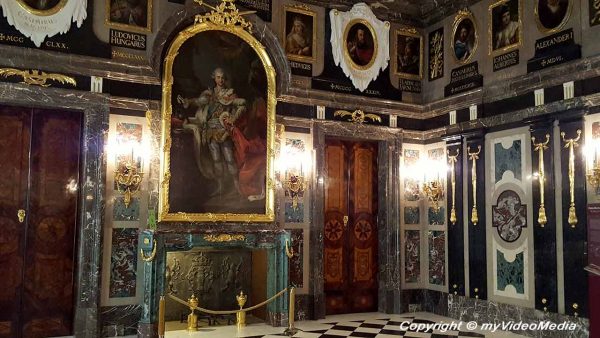
In the following marble room, a series of portraits of Polish kings decorate the walls next to the marble facings. They survived the war unscathed because one had stored them outside.
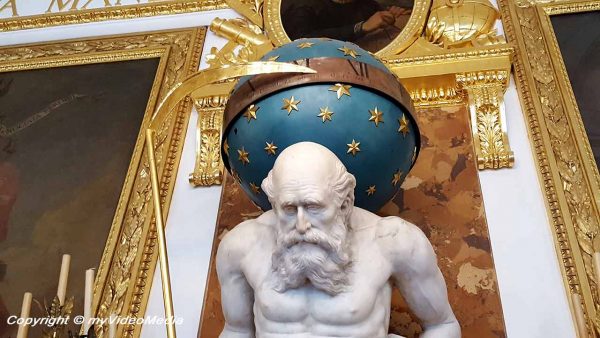
The following Knights’ Hall is in front of the Throne Hall and serves as a waiting room for audiences. The colors red and gold dominate in the Throne Room.
Please watch the 4K UHD video here
You are currently viewing a placeholder content from YouTube. To access the actual content, click the button below. Please note that doing so will share data with third-party providers.
More InformationIt was the reception hall for important persons such as ambassadors and nuncios. Many fragments of this room are original parts.
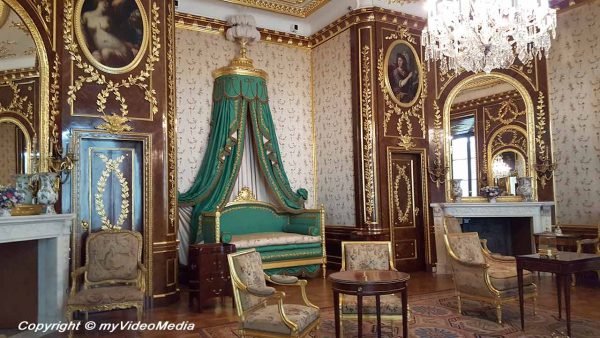
The adjoining round conference room leads to the private rooms. The bedroom with its green bed and canopy deserves a special mention.
The old audience room follows. It was used for receptions until the completion of the Throne Room.
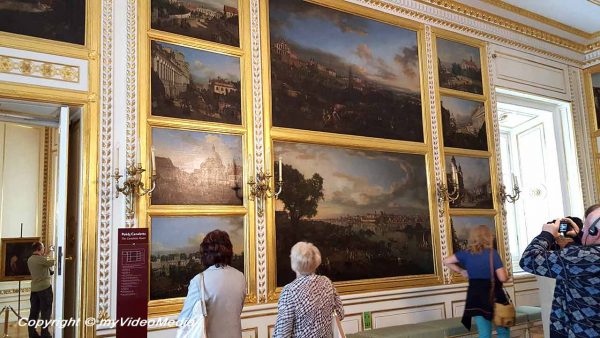
In the Canaletto room, we see some old paintings. These were helpful for the reconstruction of Warsaw after the war.
In the chapel of the Royal Castle are some ceremonial swords of Stanislaus Augustus on display.
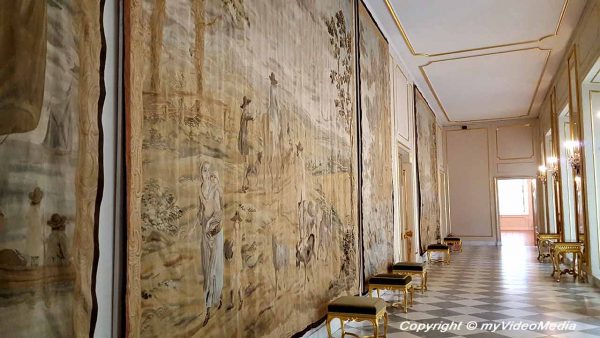
Next is the apartment of Prince Stanislaw Poniatowski, the Grand Chamberlain of Lithuania and nephew of the last Polish king Stanislaus II August Poniatowski.
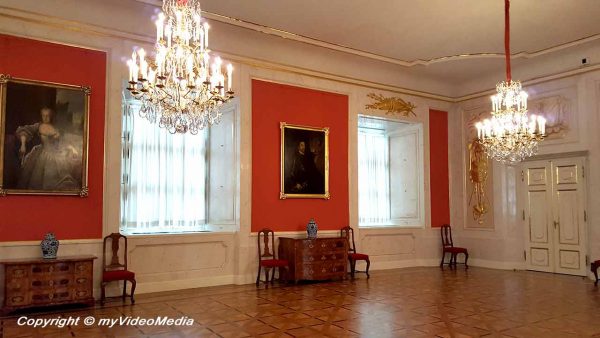
Then the new Chamber of Deputies (the Lower House) of the Sejm, the Polish Parliament and the Senators’ Hall for the Upper House. On large painted maps you see the empire of Poland and Lithuania.

The last large painting shows the abdication of the ruler and the end of the Kingdom of Poland at the end of the 18th century.
Karolina Lanckoronska donates her collection of paintings including two Rembrandt paintings to the castle in Warsaw and Krakow, in 1994.
In the 17th century, one built the Tin-roofed Palace southeast of the castle on the Vistula embankment. Named after the roofing, as it was the first building in Warsaw with a tin roof. Until then, only shingle roofs were common.
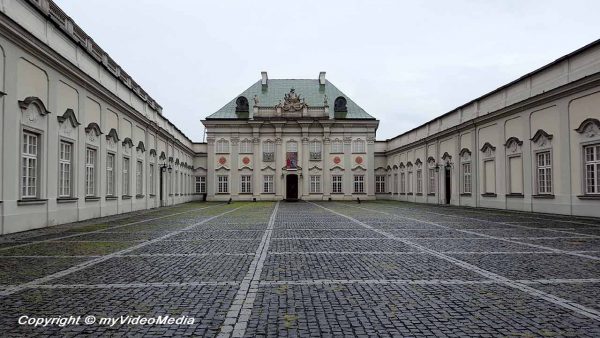
It was built by the magnate family Lubomirski in 1701. In the 18th century, it served as a meeting place for the Masonic Lodge. During the reign of Stanislaus August Poniatowski, his nephew Jozef Antoni Poniatowski lived in the palace.
He was Minister of War in the Duchy of Warsaw, Prince of the Holy Roman Empire and Marshal of the Empire. His equestrian statue stands today in front of the presidential palace.
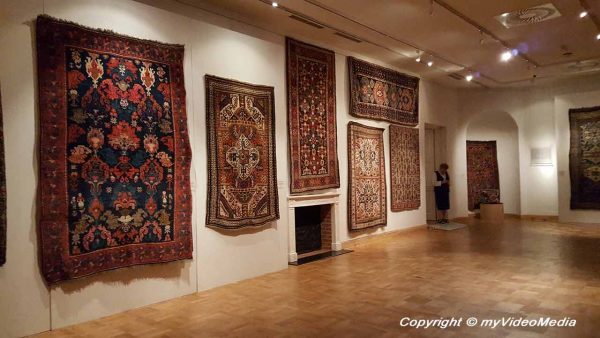
The ground floor of the Tin-roofed Palace now houses an exhibition of carpets, collected by Teresa Sahakian, a Polish woman living in Belgium. She died in 2007.
The collection includes carpets from Persia, Anatolia, Central Asia, and the Caucasus.
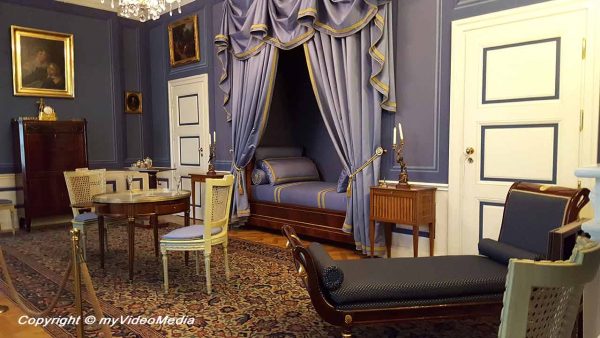
We end our visit on the upper floor. Here is the apartment of Prince Jozef Antoni Poniatowski.
Please read on > City walk in the southern part of Warsaw
Pin it for later
Text, photos and video: Copyright © myVideoMedia