The Hellfire Pass lies in the province Kanchanaburi and is a railway cutting on former Burma Railway.
The so-called Death Railway became famous through the movies “The Bridge on the River Kwai” and „To End All Wars“. POWs and conscripted civilians had to build the railway from Bangkok to Burma under inhumane conditions.

We come by train from the River Kwai Bridge and leave at the Tham Krasae Railway Station.
In a restaurant with beautiful views of the River Kwai (Kwai), we enjoy our lunch. A large buffet offers plenty of choices. Then we continue by car.
Hellfire Pass
It partly goes steeply uphill and the mountain slopes on the left and right side of the street already anticipate, which terrain awaits us. We pass Nam Tok, today the terminus of the Burma-Thailand Railway before we arrive at a large parking lot.
We stop in front of the modern museum and have to go down a steep mountain slope before we reach the former marked-out route of the railroad track.
Please watch the 4K video here
You are currently viewing a placeholder content from YouTube. To access the actual content, click the button below. Please note that doing so will share data with third-party providers.
More InformationNext to the pathway one can partly see the railroad ties. Only a few tracks remained because they had been dismantled after the war and used elsewhere.
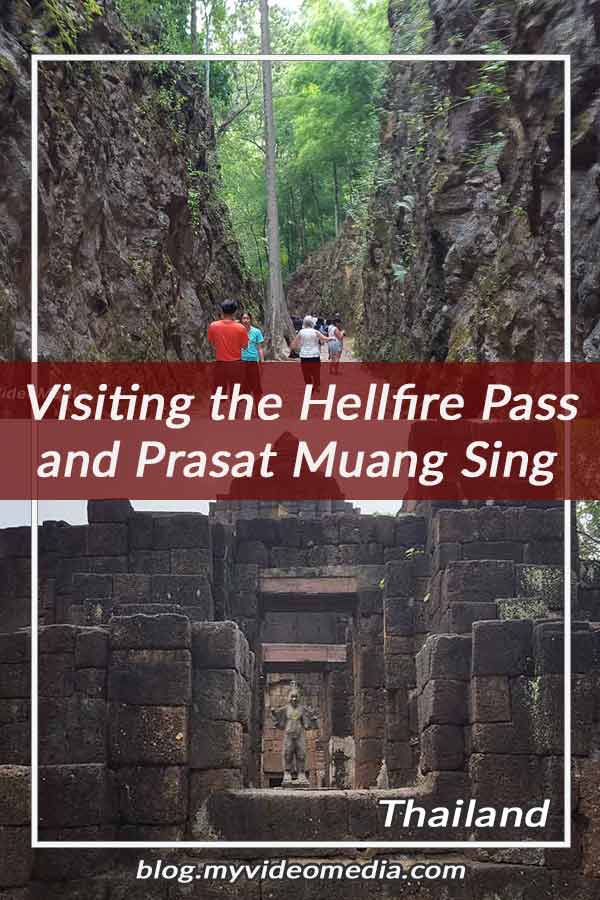
At the top of the pass, the track bed cuts deep into a rocky hill. Broken and abandoned tools prove that the cutting was made manually with primitive means. Blasting holes were drilled by hand with metal taps and sledgehammer into the rock. Rubble was carried aside in bags.
The Hellfire Pass and the adjacent cuttings were excavated by POW labor working in round-the-clock shifts over a desperate period of 12 weeks in 1943. At night, the cutting was lit by fires, lamps and diesel torches. The eerie light and shadows of the gaunt POWs and the guards playing on the rock walls gave the place its name, Hellfire Pass.

A memorial stone was set up by the Australian government at the end of the valley. The initiative for this came from the Australian Mr. J G “Tom” Morris.
In 1942, he was captured in Singapore and then worked on the railroad for 3 years. After he had survived dysentery and malaria, he worked as an ambulanceman in a camp. 40 years later, he wanted to see the Hellfire Pass again. In the Australian government, he advocated to set up of a memorial place for his dead comrades here. In 1987, it was finally opened and supplemented by a museum in 1994.
During the steep climb from the railway line to the museum, we became aware, under which efforts the people had to work here in the hazy and hot atmosphere of the jungle.
The American dead were returned to the USA, other Allied dead are buried here on war cemeteries at Thanbyuzayat, Kanchanaburi, and Chungkai, which can also be visited.
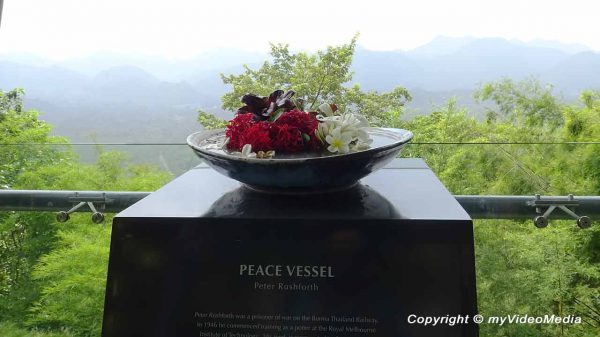
On the contemplation deck at the Hellfire Pass Museum, the ‘Peace Vessel’ created by Peter Rushforth commemorates the P.O.W.’s at Hell Fire Pass.
Prasat Muang Sing
Further downstream, 49 km of Kanchanaburi is the original Khmer city of Prasat Muang.
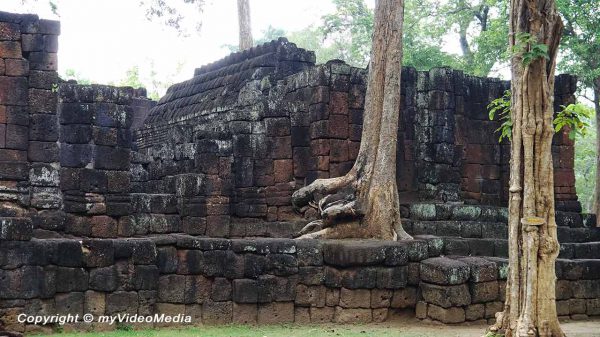
The complex dates from the late period of the Khmer empire, when it reached its greatest extent. Prasat Muang Sing was the westernmost city of the Empire.
Presumably, Prasat Muang Sing was built during the reign of Jayavarman VII. (1181-1220).
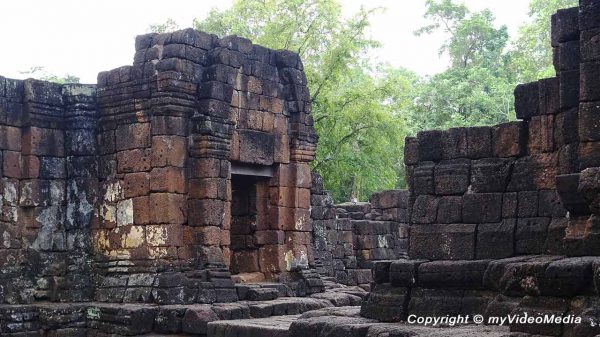
The complex consists of two monuments. The first monument is the heart of the sanctuary. 4 gates in the fortified wall face the central building.
The Prang inside was used for ceremonies. Here stands the statue of god Bodhisattva Avalokiteshvara.

The second monument was overgrown by trees and vegetation. The ruins looks like the first monument, but there is a difference. In the second monument the Prang is located in the back.
It is believed that a statue of Buddha Java Mahanath, given by King Jayavarman VII stood here. A statue showing Buddha protected by a Naga,and other statues were found and are exhibited in the National Museum.
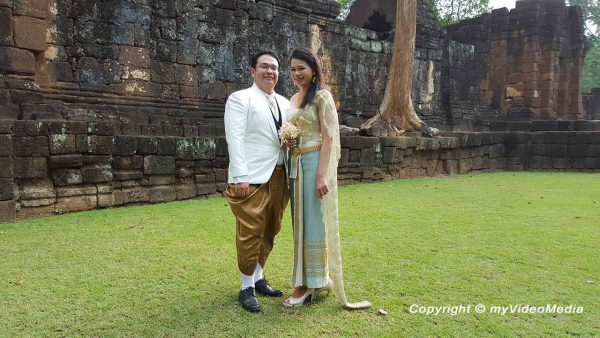
Today, the well-kept area is often used by bridal pairs for wedding photos.
Pin it for later
Text, photos and video: Copyright © myVideoMedia