The Sukhothai Historical Park is about 13 km west of the modern city of the same name.
Sukhothai means literally translated “Dawn of Happiness”. In 1238, the city was founded from an ancient Khmer settlement. For 140 years, it was the capital of the first independent kingdom Sukhothai. In 1378, Sukhothai became part of the Thai kingdom of Ayutthaya and lost importance.
On 70 km² there are still about 193 ruins of the former capital. In 1991, the UNESCO declared the Sukhothai Historical Park a World Heritage Site.
Massive earth walls and moats, which are about 2×1.6 km surrounded the former capital. Four entrance gates lead into the city.
We enter the Sukhothai Historical Park to the east and see Wat Traphang Thon right in front of us.
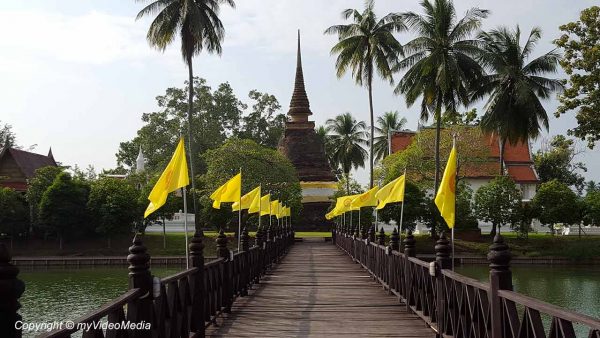
Wat Traphang Thon
Wat Traphang Thon lies on a small island in the midst of an artificial lake and can be reached via a narrow wooden bridge.
Please watch the 4K UHD video
You are currently viewing a placeholder content from YouTube. To access the actual content, click the button below. Please note that doing so will share data with third-party providers.
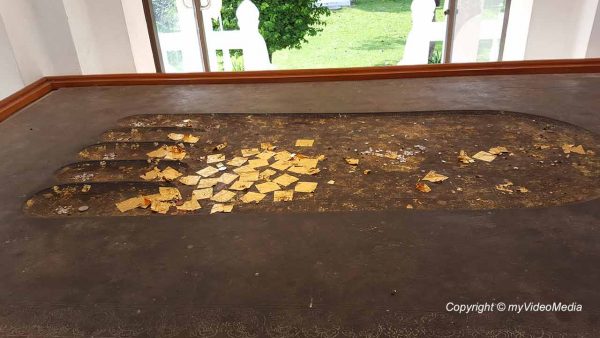
More InformationNext to a modern ordination hall, we see a footprint of Buddha in a Mondop (vestibule) next to a Chedi. A Mondop is a place to exhibit particularly sacred objects.
The size of the footprint is believed to symbolize the spiritual greatness of Buddha. It was made in 1359 and contains 108 auspicious symbols.
To the east of the lake is the only monastery in the Sukhothai Historic Park that is inhabited by monks. During our visit, the people celebrated a temple festival with extensive meals.

Wat Mai
From Wat Mai, only the base of the prang is preserved. Around this, some columns of the original hall still stand.

King Ramkhamhaeng
His monument overlooks the Sukhothai Historical Park. King Ramkhamhaeng was the most important ruler in the kingdom Sukhothai. He reigned from 1279 to 1298.
Under his rule, Sukhothai reached its greatest extension. An own writing was developed from the writing of the Khmer, the Mon, and the Burmese. Buddhism was introduced.
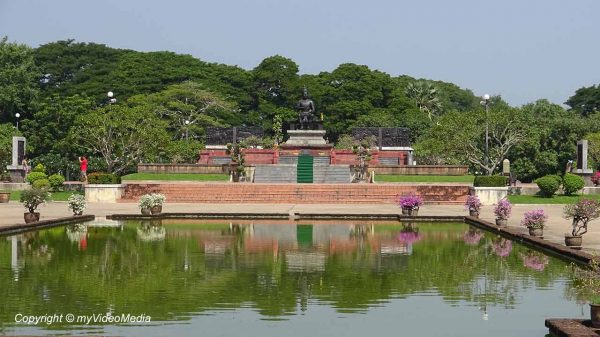
King Ramkhamhaeng based his reign on three pillars: Theravada Buddhism, kingship, and cultural independence.
Wat Sra Si, Wat Chana Songkhram, Wat Tra Kuan
All three Wats are close together, west of the monument of King Ramkhamhaeng. They were built almost at the same time.
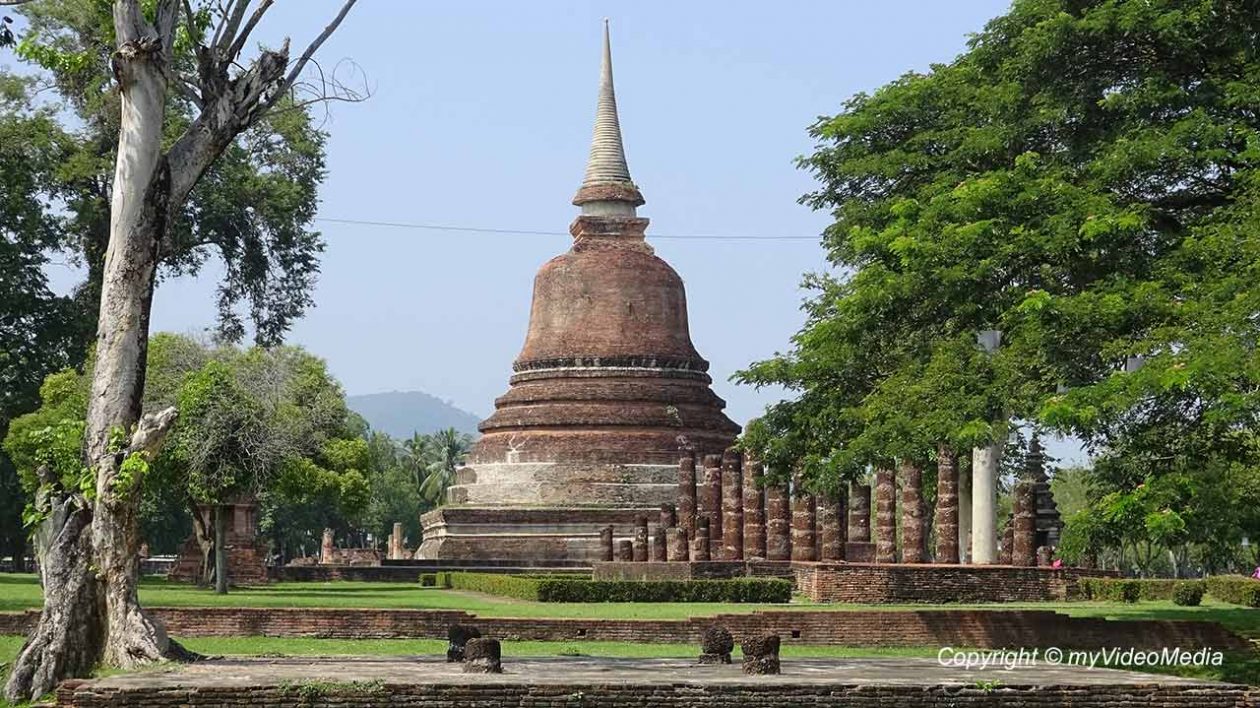
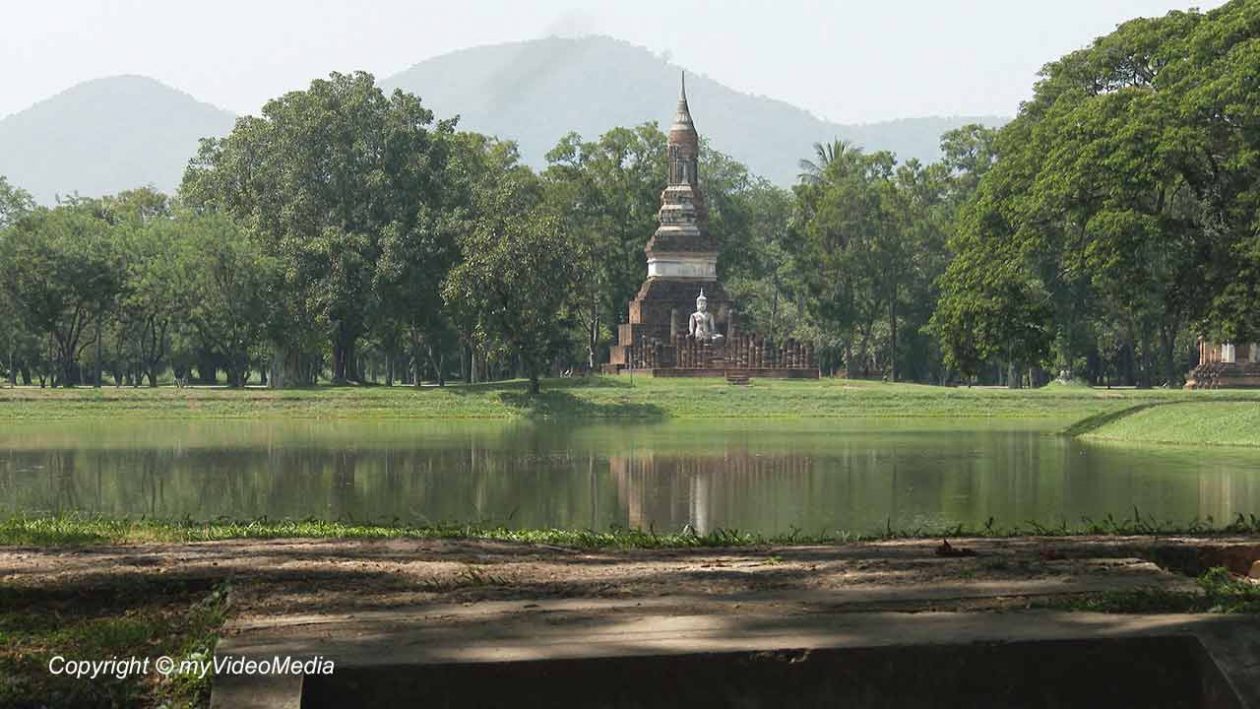
Wat Sra Si is surrounded by a lake.
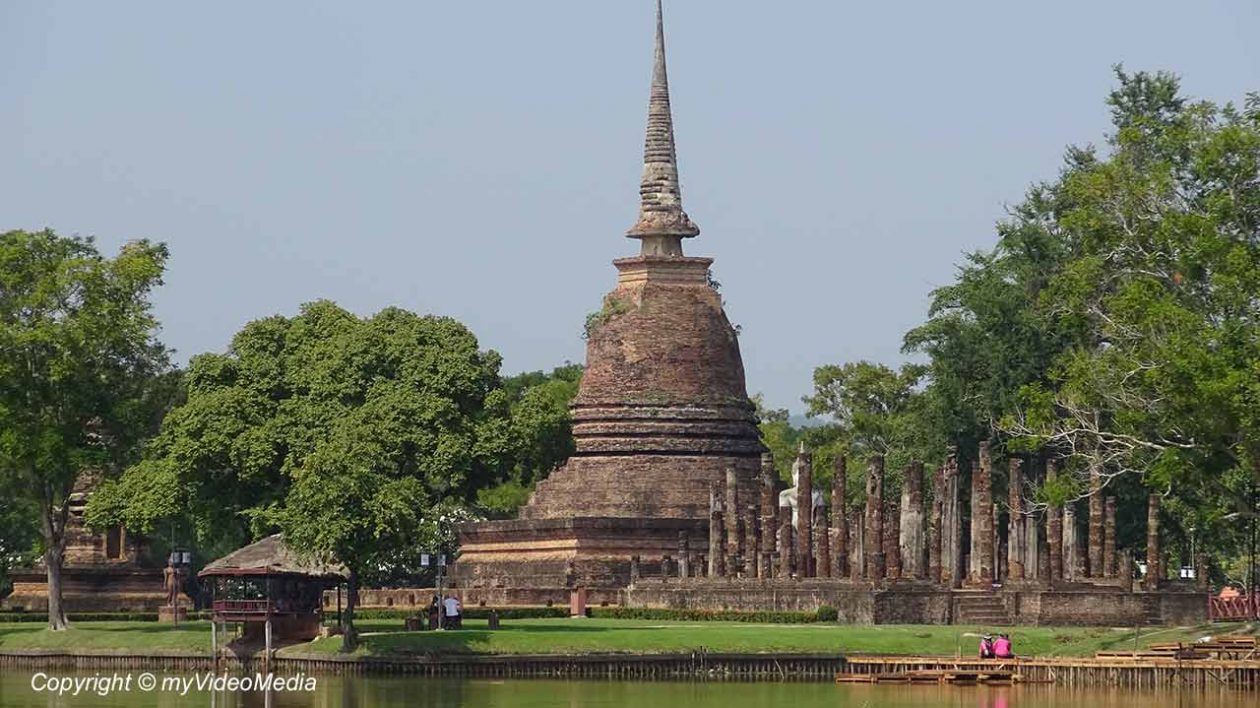
Royal Palace and Wat Mahathat
We turn to the Royal Palace and Wat Mahathat. These two complexes form the center of the old city. The Wat Mahathat was the central temple of the kingdom. King Sri Indraditya, who ruled from 1238 to 1270, founded Wat Mahathat. Around 1345, King Leo Thai enlarged Wat Mahathat to its present form.

A huge prang dominates the complex. At its base is a famous relief with Buddha-worshiping disciples.

On the large area, you see mighty Buddhas, Chedis, and smaller temple buildings.
Wat Traphang Ngoen
From afar, we see Wat Traphang Ngoen. It also lies on a small island in a lake and was set up presumably in the 14th century.
Wat Sri Sawai
At the end, we pay a visit to Wat Sri Sawai. It counts as one of the oldest buildings in Sukhothai. Three Prangs form the center of the temple. The construction in Khmer style was probably started in the 12th century, but not completed. Only in the 15 century, the building measures were completed in the Hindu style. It is a Brahmanical building, a shrine in the Indian style of a predecessor religion of Buddhism.

In the pedestal of the pillars are crypts, to which one can descend. A double wall and a moat surround the pillars. Some reliefs remind of Angkor.
Exhausted and impressed by the various buildings and details in the Sukhothai Historical Park, we return to our accommodation.
How to travel to Sukhothai
Sukhothai is about 430 km north of Bangkok. At the Northern Bus Terminal near the Chatuchak market in Bangkok, you can take the bus to Sukhothai.
Flights and the train connections only go to Phitsanulok, 50 km from Sukhothai. From there you can take a local bus to Sukhothai.
Please read on > Sukhothai Fresh Market and Ramkhamhaeng National Museum
Pin it for later
Text, photos and video: Copyright © myVideoMedia