After our visit to Hulbuk Citadel in Pingan, we continue in northwestern direction. At the entrance of Vose (Imeni Vose), we stop for lunch.
From a hall of the building, music penetrates and cheerful people stand around and talk. We may take a look into the hall and realize that the people celebrate a wedding. The young bridal couple sits elevated at the head of the room, while the people dance in front of them.
Later, they leave the wedding and say goodbye to their relatives. We are pleased about their luck and that we had the opportunity to take the pictures. We wish them the very best on their shared path of life.
Kulob
Afterward, we drive on to Kulob, the provincial capital of Charlton. There are a busy hustle and bustle here. I almost overlooked the monument, erected for the 2700th anniversary, in 2006.
We turn east and leave the city. The country has a sparse vegetation, but also here we see larger herds of cattle.
Shurabad Pass
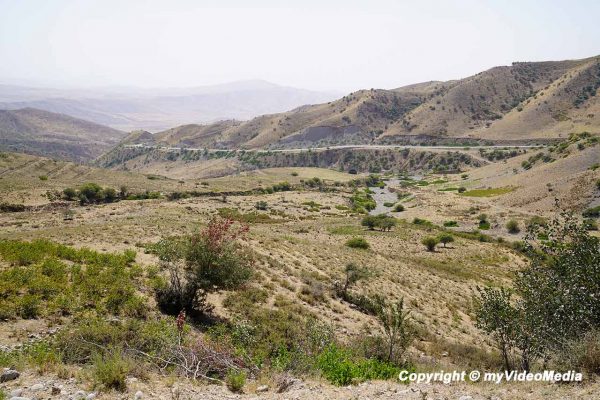
The dusty stony street winds from Kulob up to the plateau of the 1980 m high Shurabad Pass. On the way, we have an excellent view of the valley around Kulob.
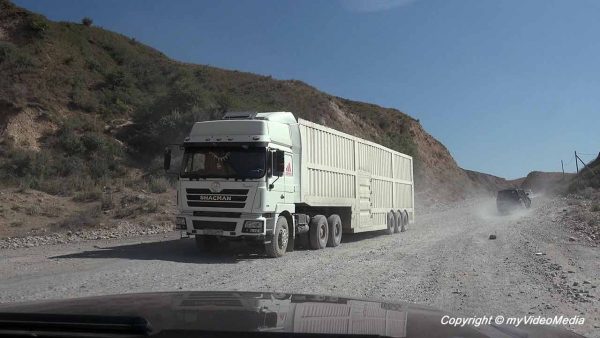
We drive through a barren and partly wild and rugged landscape. Here at the latest, we see the huge trucks that supply the region with goods from China. More than once we have seen trucks with a breakdown at the roadside. The drivers are left to their own devices. They do a great job but are by no means to be envied.
You are currently viewing a placeholder content from YouTube. To access the actual content, click the button below. Please note that doing so will share data with third-party providers.
Visitors passing the gate are greeted with a ‘Welcome to Shurabad’. The place is on a high plateau. From here, the road was renovated very good.
Only small road sections are still work in progress. The mountains are becoming even mightier and the valleys deeper and deeper. We reach the pass height and the view opens downward.
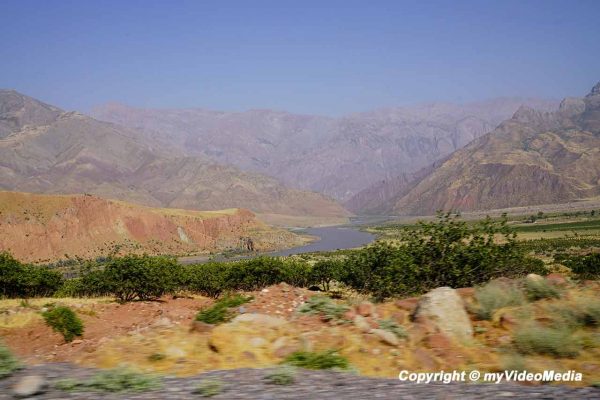
A winding road leads to the bottom of the valley. We arrive at the Panj River, the most important river in the Pamir.
On the opposite side of the valley, the river disappears between impassable mountains. The mountains towering up in front of us already are part of Afghanistan.
The Panj River now forms the border between Tajikistan and Afghanistan over a large section of the route.
You are currently viewing a placeholder content from GetYourGuide. To access the actual content, click the button below. Please note that doing so will share data with third-party providers.