Brussels is a city which cannot be described with a cliche. The city has different faces.
This is due not only to the architecture, which is characterized by various stylistic epochs, but also due to the complexity of its population. In Brussels, 57 % of the population have a migration background.
Please watch the 4K UHD video
You are currently viewing a placeholder content from YouTube. To access the actual content, click the button below. Please note that doing so will share data with third-party providers.
More InformationDuring a first tour we try to get an impression of this city. Looking out the hotel window we see modern office architecture where glass facades protect the interior of the concrete blocks against curious eyes.
The situation is different on the opposite side of the Boulevard Leopold II. For the most part the old buildings still exist, although some monstrous office buildings have cut a swath in the old quarters.
On Sunday morning we have the streets almost to ourselves, when we pass the Royal Theatre La Monnaie De Munt. We leave the old city behind us and arrive at Place d’Espagne Spanjeplein with an equestrian statue of Don Quixote, his horse Rocinante and Sancho Panza his companion.
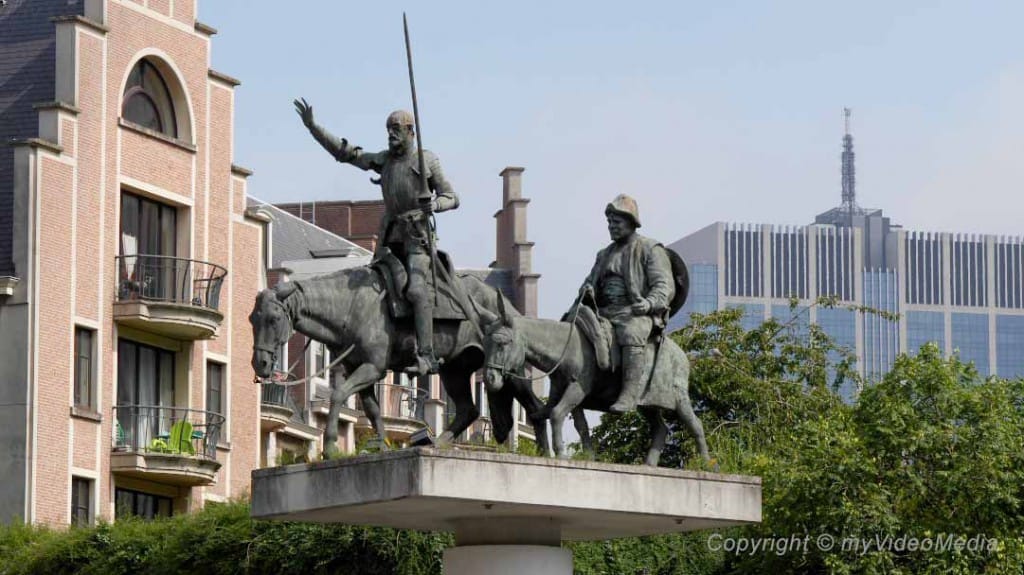
Passing the central train station where the rails are belowground, we reach the Royal Palace (Palais de Bruxelles) and the Place Royale with the church of Saint Jacques-sur-Coudenberg.
Diagonally opposite the Royal Museums of Fine Arts.

On the road to Quartier Marolles we pass the church of Notre-Dame au Sablon till we reach the Palace of Justice, the most prominent building of Brussels.
It was built on the former Gallows Hill and dominates the city with its size and its outstanding location.
Not all residents were satisfied with the construction of the building, since parts of the local population were driven off their area.
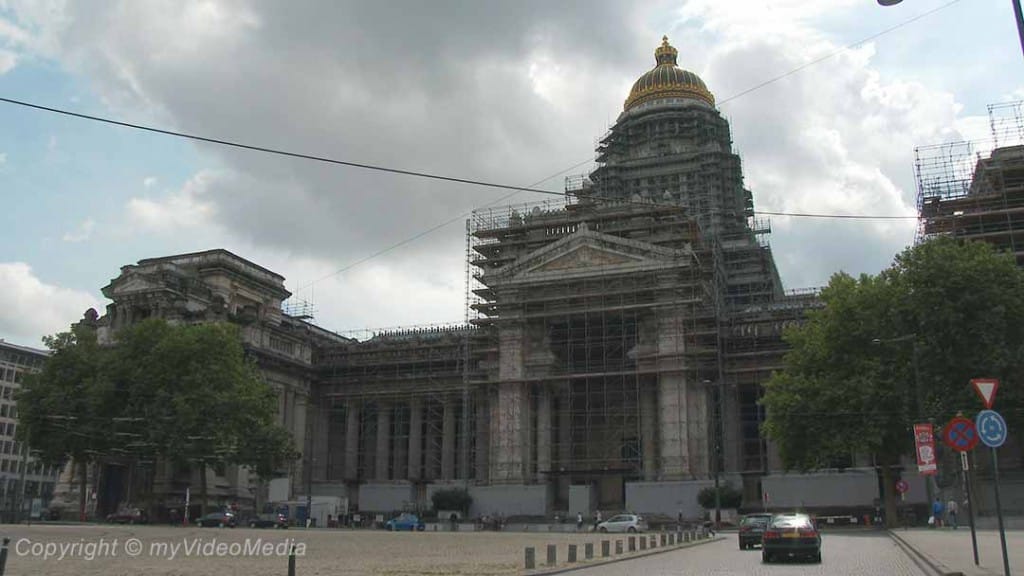
From here you have a wonderful view over the city. An elevator brings you to the Lower Town.
The Porte de Hal is the southernmost point of the Pentagon, as the inner district of Brussels is called due to its pentagonal shape. The former city gate serves as a museum today.

To us, Brussels presents itself as a multicultural city where different cultures harmoniously coexist.
Please read on > Exploring the city center of Brussels
Pin it for later
Text, photos and video: Copyright © myVideoMedia