Waterloo in Belgium lies approx. 15 km south of the center of Brussels.
The Battle of Waterloo
June 18, 2015, marks the 200th anniversary of the Battle of Waterloo. After Napoleon’s return from exile, he recruited a new army to enforce his claim to power.
The alliance of the British, with General Wellington and the Germans, with Field Marshal Blücher, responded immediately and it came to the decisive battle of Waterloo. Napoleon’s defeat led to his abdication and renewed exile on the Atlantic island of St. Helena. 50,000 soldiers lost their lives in this one-day battle.
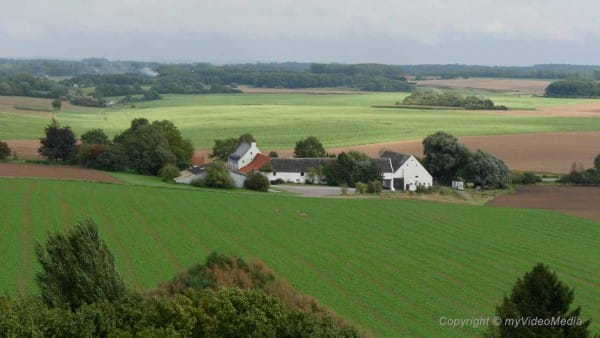
The farm La Haye Sainte, which still exists today, was especially hard-fought.
The consequences for Europe
The Napoleonic era had ended and the restoration of Europe was rung. In France, the Bourbon rule was reinstated. After the Congress of Vienna under the leadership of Prince Metternich, Europe got a new face. An essential element was the foundation of the German alliance and thus the end of the German small states.
It was a return to monarchical forms of government. The bourgeois ideology was still on the rise and led to national revolutions later. Slavery was ostracized now. France was condemned to reparation payments but accepted into the Holy Alliance in return and kept its great power status.
Please watch the 4K UHD video
You are currently viewing a placeholder content from YouTube. To access the actual content, click the button below. Please note that doing so will share data with third-party providers.
More InformationThe Lion’s Mound
In addition to a number of national monuments, the Lion’s Mound is the most important monument of the Battle of Waterloo.
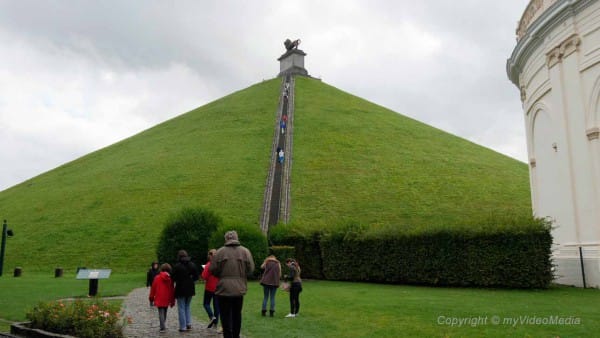
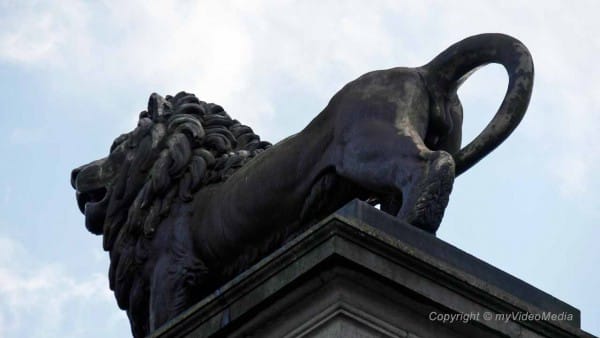
It was built by the Dutch King William I. and marks the point where the Prince Guillaume of Orange, the heir to the throne and commander in chief of the first corps of Wellington’s army, was wounded. A 226 steps steep staircase lead to the top of the Mound (41 meters high) which is crowned by a cast-iron lion, poured from the cannons of the battle. The lion symbolizes the return of peace in Europe.
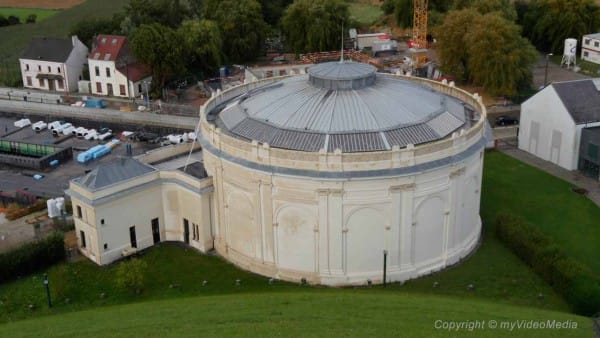
The Panorama, a rotunda with a 360 º panorama painting, at the foot of the hill conveys an impression of the battle.
A Belgian customs officer explained us spontaneously why Napoleon always had one hand in his uniform. A Tradition says that it was no heroic attitude, instead Napoleon tried to ease his stomach pain.
Napoleon’s headquarters
The House, where Napoleon spent the night before the battle, can still be visited today. It is 7 km further south, in the Maison du Roi at the Chaussée de Charleroi. A statue of Napoleon stands in front of it.
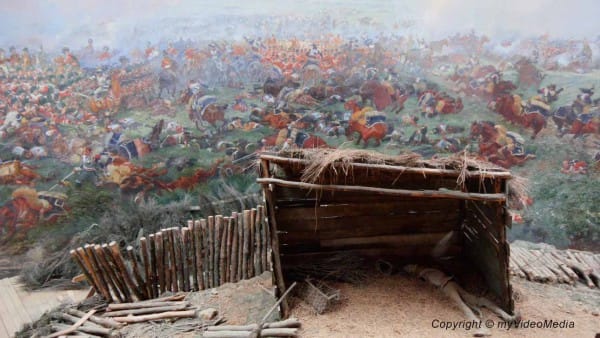
One is lost for words, to be at a place where so many people have suffered a violent death in one day.
Text, photos and video: Copyright © myVideoMedia