The Palatine and the Roman Forum, formed the center of ancient Rome.
Historical Overview
100,000-year-old settlement traces from the middle Stone Age were found on the Palatine Hill. At first in the 8th century, a village with a surrounding wall was here set up. (753 BC is considered the founding year of Rome).
With the further development, the rich and prosperous settled on the Palatin Hill. Augustus purchased a property with a relatively modest house on the hill, which he systematically extended with acquisition of additional land to his residence. He built a temple of Apollo, a home for his wife Livia and furnished it with a series of status symbols.
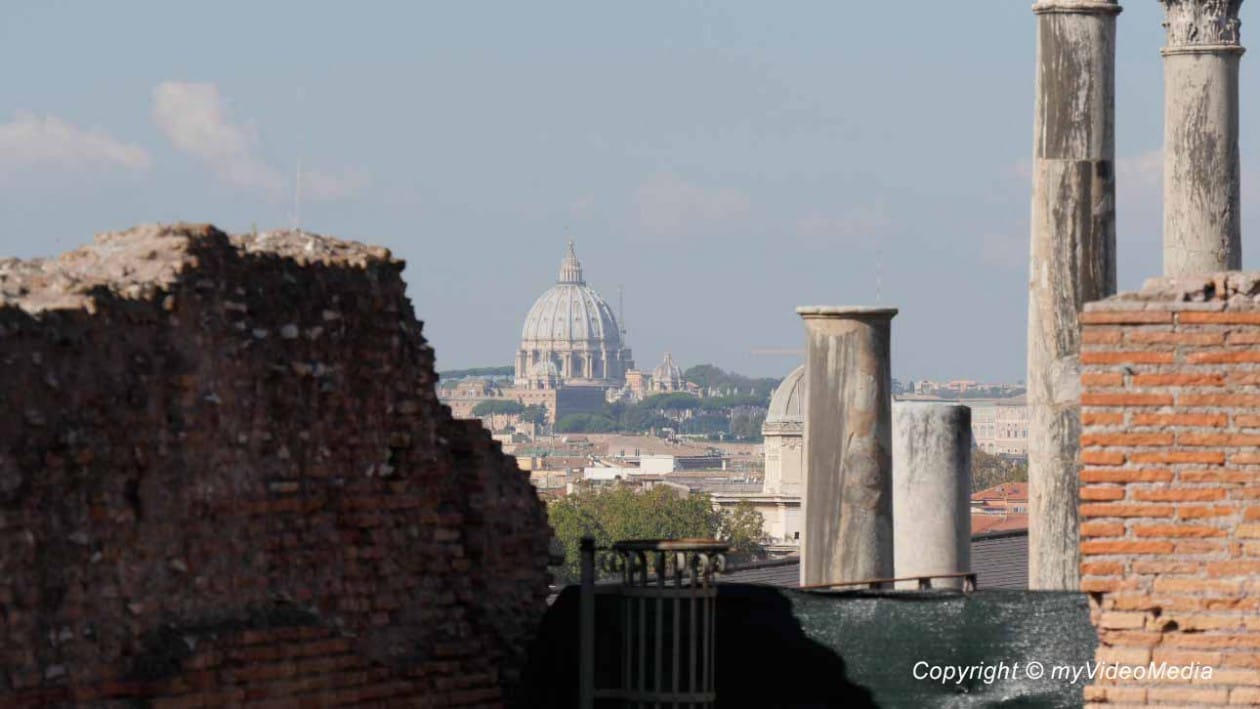
Archaeologists found a richly ornamented cave under his house which was worshiped in the ancient times as Lupercal. The she-wolf Lupa shall have suckled Romulus and Remus in this cave.
Likewise, the remains of a hut were found that got known as the House of Romulus in the annals. Augustus seemed to have chosen this place consciously, since it was in direct connection with the foundation of Rome. His successor Tiberius build the Domus Tiberiana, which was enlarged by Caligula and Nero.
Domitian then built a massive palace complex which consisted of three parts, the Domus Flavia, the Domus Augustana and the Hippodrome.
Septimus Severus expanded the complex eastwards by thermal baths, the Domus Septimi Severi.
Please watch the 4k UltraHD video
You are currently viewing a placeholder content from YouTube. To access the actual content, click the button below. Please note that doing so will share data with third-party providers.
More InformationThe Palatine
Coming from the Colosseum, pass the Arch of Constantine, we enter the Palatine by the side entrance at the Via San Gregorio. We first come across the Hippodrome, which was probably a garden or a kind of art gallery. No proof of a race course was found. In the center of the eastern gallery was a royal box.
Then we reach the Domus Augustana, the private apartments of the emperor. From the terrace you have a good overview of the Circus Maximus. Again and again we are amazed by the height of the individual floors.
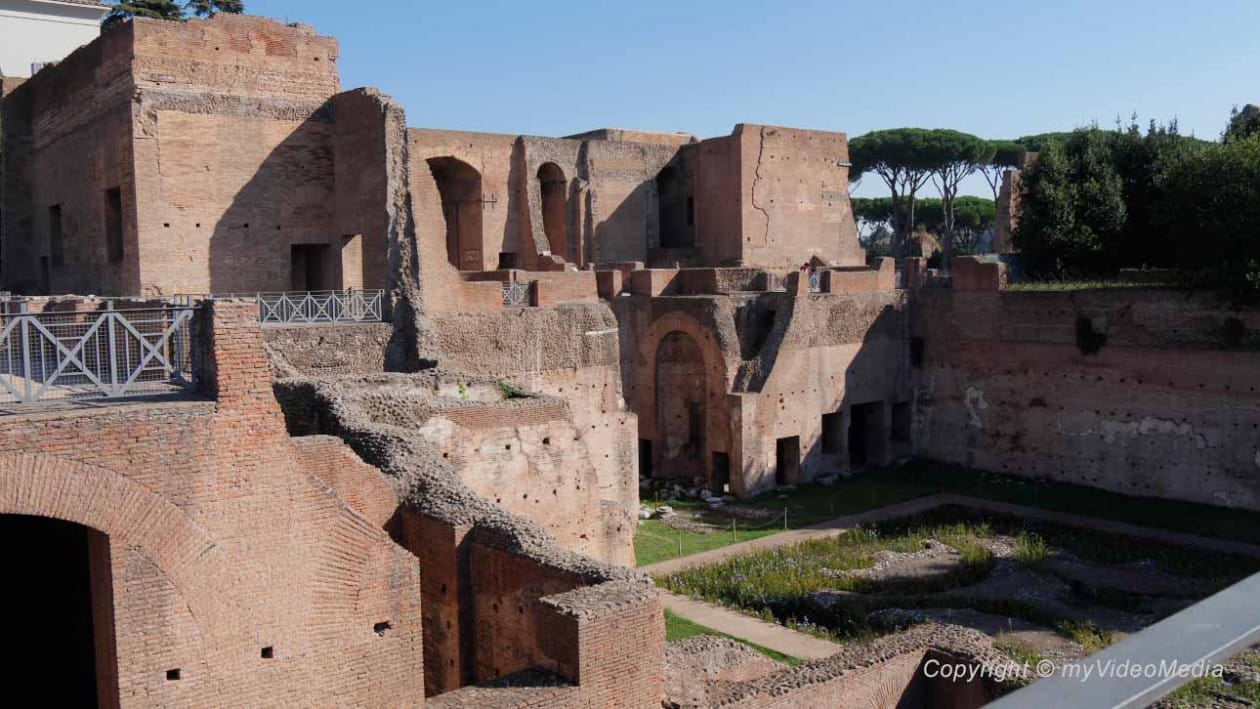
Directly after is the Flavian Palace, the palace for public office. The Throne Room impressed by its huge dimensions, even if only a few remains are present. However, a piece of a wall corner still rises in the height so that one can imagine the volume of the room quite well.

Again and again, Mrs Livia Galante draws our attention to the materials used, e.g. at a column which was manufactured of yellow marble from Simitthu (Chimtou) in Tunisia, which was extremely popular in Rome. After an earthquake middle of the 3rd century the working halls in Simitthu were destroyed and the supplies dried up.
We pass through the Farnese Gardens above the Domus Tiberiana, from here one has the most beautiful view of the forum Romanum and the city of Rome.
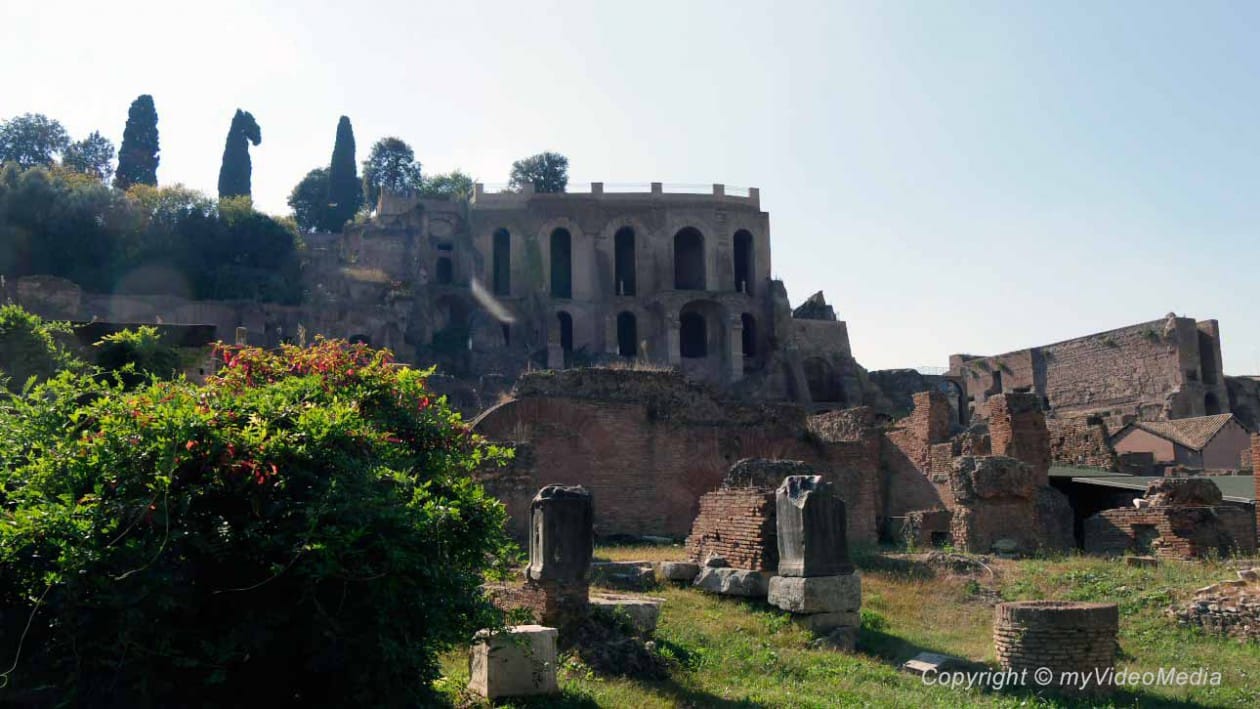
A seagull wanted absolutely to be filmed and puts itself in the limelight in front of my lens.
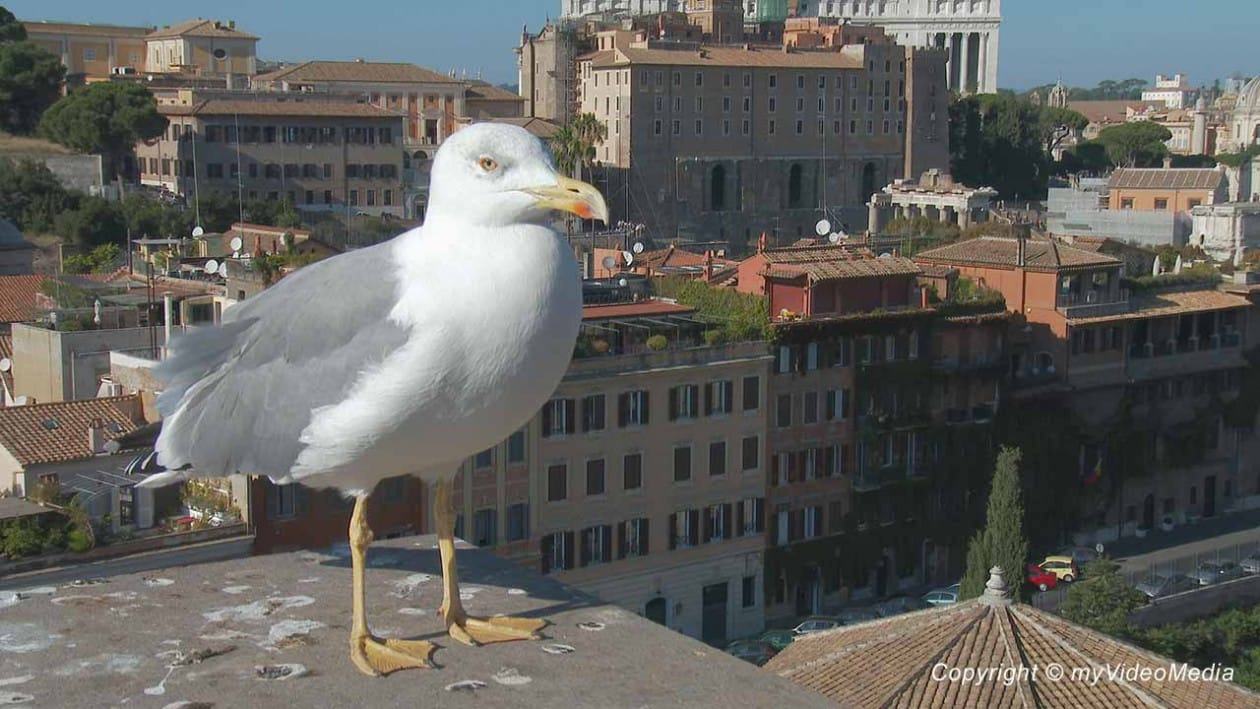
After a quick look at the house of Augustus and the Temple of Magna Marta we visit the Clivus Victoria, which lies directly between Domus Tiberiana and Roman Forum. Hadrian had spanned the road with massive archways, since then it is called Via Tecta.
We leave the Palatin Hill via the magnificent entrance, the Clivus Palatinus. The road was flanked by colonnades and spanned by the Arch of Domitian. The triumphal arch was planned as a monumental entrance to the imperial palace. Today only remnants are still visible.
The Roman Forum
We reach the Forum at the Arch of Titus, set up by Domitian for his deceased brother Titus erected. It is characterized by its reliefs in the inner archway.

If you turn your sight towards the Capitoline Hill, you have a nice overview of the forum. To the right rise the remains of the Basilica of Maxentius, a monumental lobby for the emperor. This is followed by the Temple of Valerius Romulus, which impresses with its bronze doors. Next to the entrance area there are still some tombs dating from the Neolithic period. Thereafter, you see the Temple of Antonio and Faustina. Both owe the preservation to the conversion into a Christian church.
The central area is dominated by the columns of the Temple of Vesta and the Temple of Castor and Pollux. The Temple of Vesta was the central sanctuary of the Roman Forum.

To the left is the House of the Vestals and behind the monumental remains of the Domus Tiberiana. Once arrived in the middle of the square, you will find a small covered monument, the Temple of Caesar.

If you turn your sight towards the Capitol, you see the Basilica Amelia on the right, behind the Curia Julia (house of Julius) and opposite to the left the Basilica Julia . All these were meeting places for the senate.
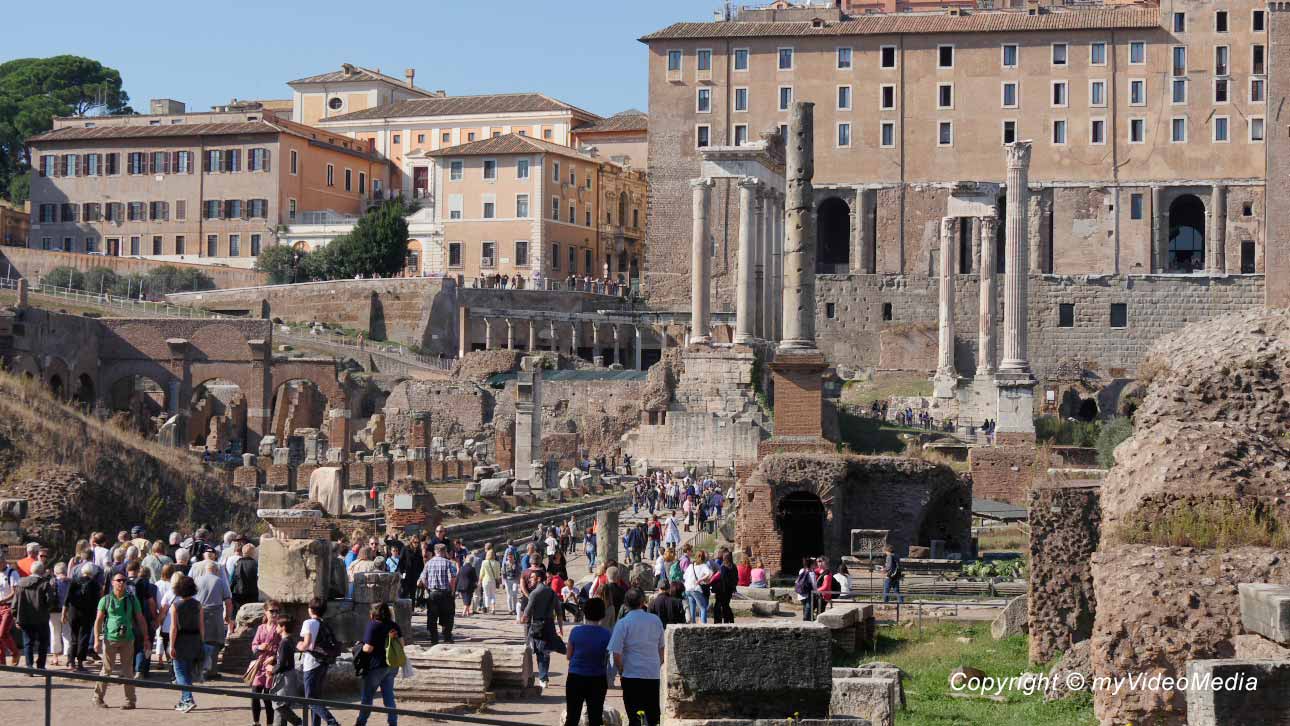
The Tabularium on Capitoline Hill was the records office of ancient Rome. Directly in front of it one recognizes the columns of the temple the saturn the national treasury was kept in this.
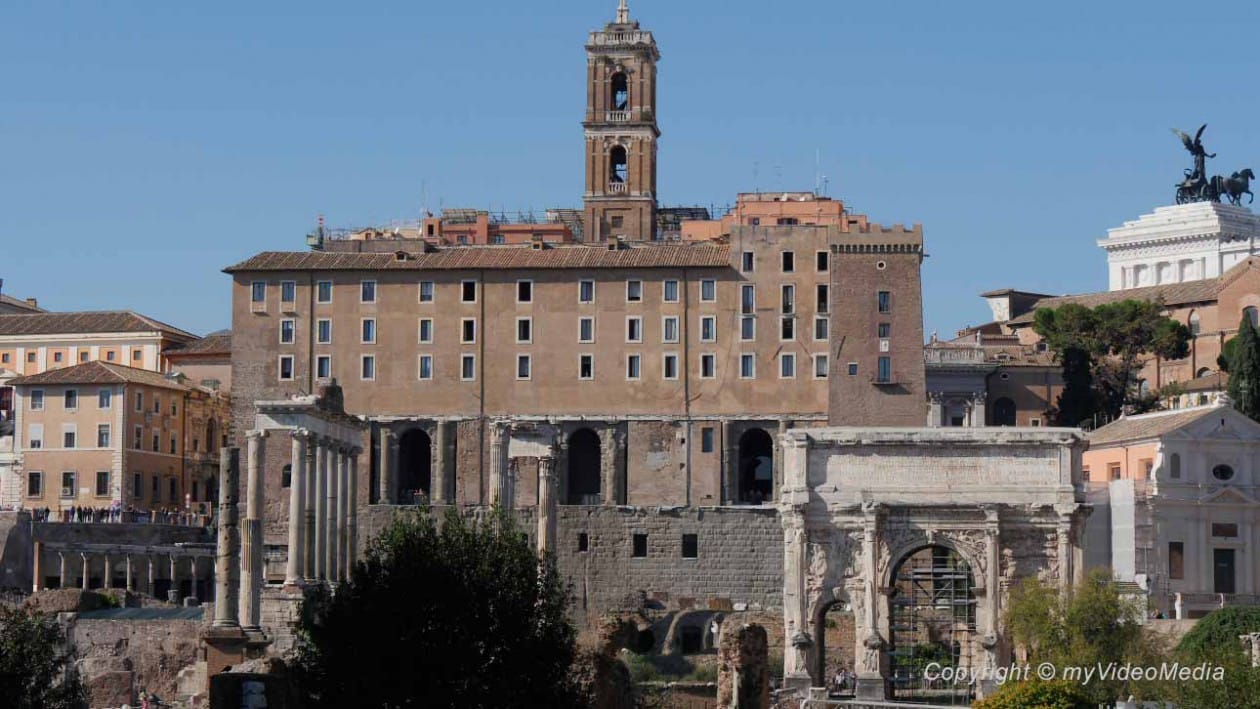
Directly in front of it you recognize the pillars of the Temple of Saturn in which the state treasury was kept. The Arch of Septimus Severus dominates on the right.
Overwhelmed by the impressions we leave the center of power in ancient times.
Please read on > Off the beaten path in Rome
Pin it for later
Disclosure : We were kindly invited by Context Travel and as always, all opinions about our experiences are our own.
Text, photos and video: Copyright © myVideoMedia