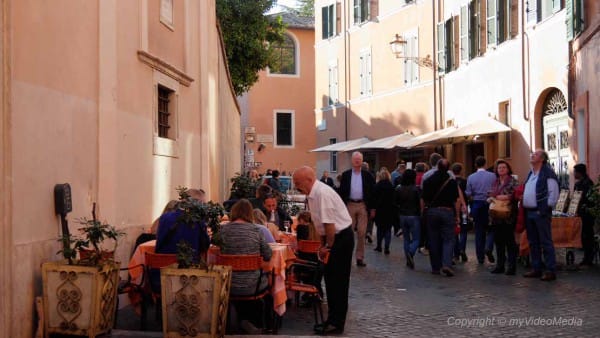
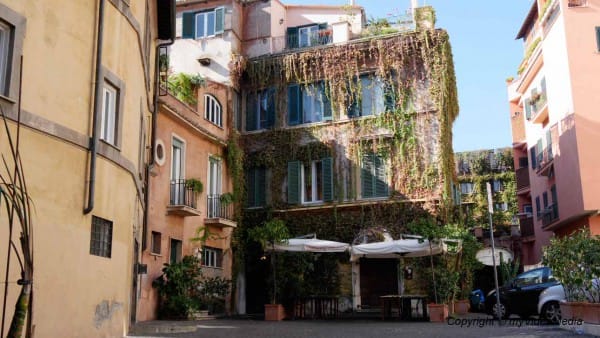
Trastevere, the name means “beyond the Tiber” and describes the location of the district on the west bank of the Tiber. Narrow winding streets and hardly any traffic are the typical features of these quarters that make it particularly attractive for tourists.
Archways, blind alleys, residential buildings full of corners form pretty photo motives, of which there are countless.
The high density of churches points out that it has always been this is a densely populated residential area.
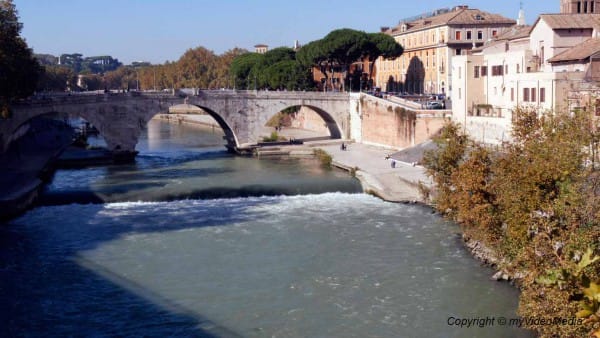
We reach Trastevere across the Pons Fabricius, the Tiber Island and the Pons Cestius. There we keep to the left and through picturesque lanes we arrive at
Please watch the 4k UltraHD video
You are currently viewing a placeholder content from YouTube. To access the actual content, click the button below. Please note that doing so will share data with third-party providers.
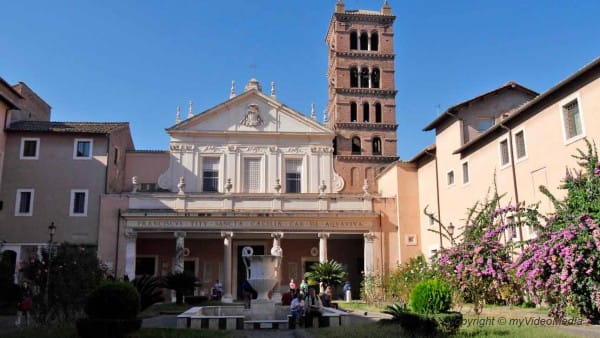
More InformationSanta Cecilia in Trastevere
Saint Cecilia, the patroness of musicians, died a martyr’s death here. First one tried to scald her, as it miscarries, she was beheaded. Later one built this church where she was buried.
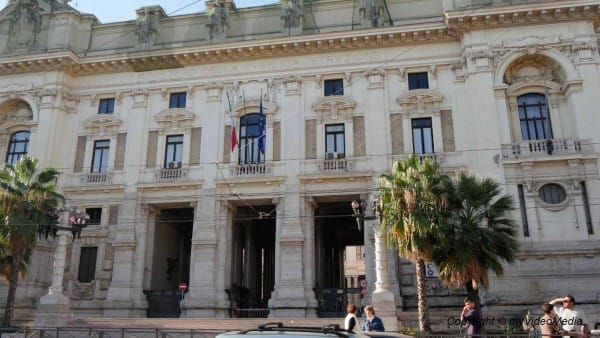
Passing the Ministero della Pubblica Istruzione (Ministry of Education),
we reach
Santa Maria in Trastevere
and the piazza of the same name. The square forms the real center of Trastevere. Musicians, painters and sellers gather here on the restaurant-lined square which inevitably attracts the tourists.
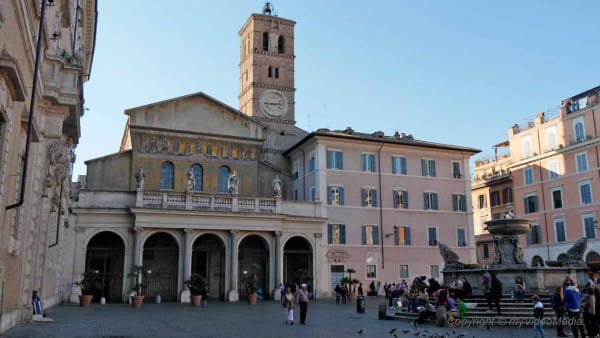
But not only here, also in the surrounding streets you find restaurants, bars and Osterias.
Passing the Porta Septimiana we walk to Fontanone di Ponte Sisto in Piazza Trilussa. We leave Trastevere and return in the evening with Dario Andreucci, who works as a tour guide for Mind the Guide.
He sees that the church San Benedetto in Piscinula is currently open and leads us in.
The church was built in the 11th century on the foundations of the dwelling house of St. Benedict. Benedict lived in the 6th century BC. In the back part of the church archaeologists came across the cell in which he lived.
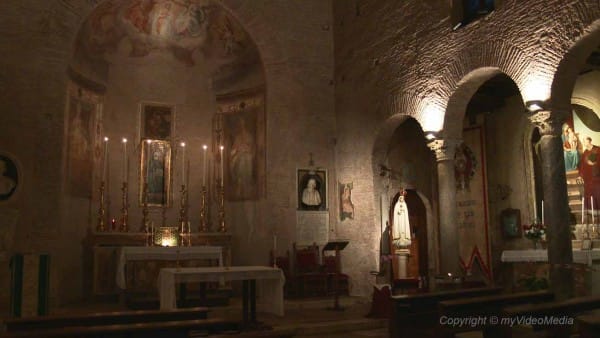
The medieval church gives a good impression of the former construction, when the first three-aisled basilicas were built. The church floor is adorned with beautiful Cosmati (marble decorations). On the way to Piazza Santa Maria, he draws our attention to the
Convento Dei SS. Quaranta
The Convento Dei SS. Quaranta was built in the 18th century and served as a hospice for the poor and needy. It is dedicated to 40 martyrs and Pasquale Baylón, a Spanish priest.
We watch the hustle and bustle on the Piazza Santa Maria for a while, before we make our way to the hotel, where we pass the “Bar San Calisto”, a meeting place for writers and intellectuals.
Please read on > Mercato di Porta Portese
Looking for a hotel in Rome? You can book it here
Text, photos and video: Copyright © myVideoMedia