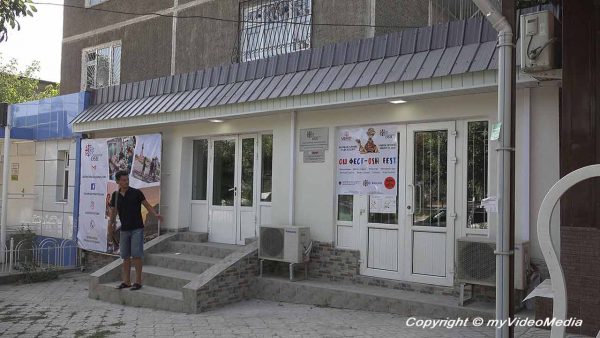
On the last day of our stay in Osh, we make an excursion to Uzgen, approximately 50 km northeastern of Osh. Before that, we have the chance to visit the office of Destination Osh, because our companion Abdullaev Atabek still has something to do there.
Uzgen history
Uzgen has only about 50,000 inhabitants but is one of the oldest towns in Kyrgyzstan. It lies on the north shore of Kara Darya, one of the two source rivers of Syr Darya. During the snowmelt, its riverbed swells up from 20 m to 200 m width.
In the 2nd century BC, a customs office on the Silk Road was established here at the entrance to the Fergana Valley. An important trading center developed soon, too.
Before that, however, Alexander the Great is supposed to have maintained a troop camp here. 990-992, the Kara-Khanid Khanate conquered large parts of Transoxania from the Samanids and Uzgen became capital of one of the part-kingdoms. From here they finally conquered Bukhara and Samarkand. In 1080, Uzgen came under the rule of the Seljuq dynasty.
Later, the city belonged to Genghis Khan’s empire, then to the Chagatai Khanate of the Mongols and afterward to Timur’s empire. From 1512, Uzgen belonged to the Khanate of Bukhara and then to the Khanate of Kokand, before it came to the Russian Empire in 1876.
On June 4th, 1990, it came to serious disputes between Kyrgyzes and Uzbeks, which claimed up to 1,000 deaths. Only the intervention of the Soviet army ended the riots.
The Minaret

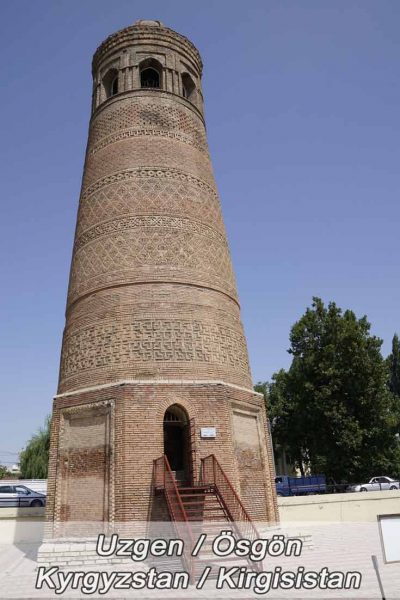
In Uzgen we drive directly to the minaret, one of the sights of the town. Mr. Khusniddin, a member of the Museum of Architecture, explained us the history. The minaret was set up as observation and beacon tower. Approaching enemies could be seen early and neighboring towns be warned.
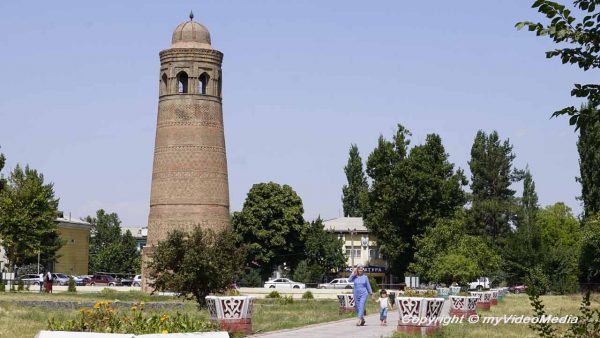
Originally the minaret was 44 meters high, but during an earthquake in the 16th century, the upper part was destroyed, so it is only 24 meters high today. The top now serves as a viewing platform and is crowned by a dome.
The Mausolea
Only 150 m away are the mausolea that are famous far beyond the town boundaries.
Please watch the 4K UHD video
You are currently viewing a placeholder content from YouTube. To access the actual content, click the button below. Please note that doing so will share data with third-party providers.
More InformationThe about one thousand years old buildings have survived the storming by Genghis Khan in 1219/1220 and are part of the few, still preserved buildings from that period. The three halls with their domes are built so close to each other that they appear like one single building.
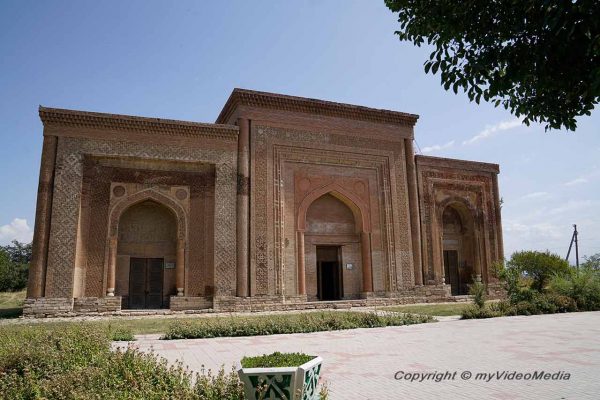
The middle and largest mausoleum was built for the conqueror of Bukhara and Samarkand, Arsian-llek Nasr-ben-Ali, who died in 1013 AD. The northern mausoleum was for Jalal al-Din Ali, a Ghurid leader from Bamiyan (Afghanistan), who died in 1215.

For whom one built the third mausoleum is no longer known today.
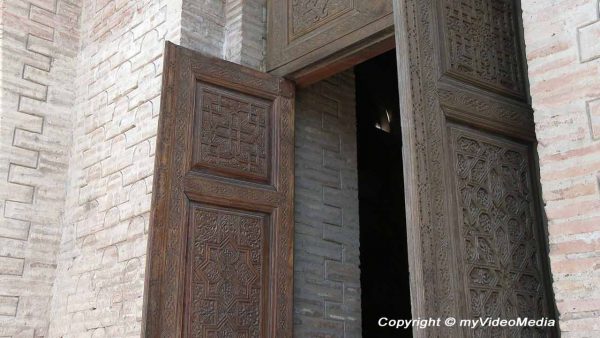
All three buildings stand out due to their artistic façades with ornaments from terracotta and alabaster carvings. The southern and smallest mausoleum is artfully decorated with ornaments, arabesques and document friezes. All have impressive portals that emphasize the importance of mausoleums.
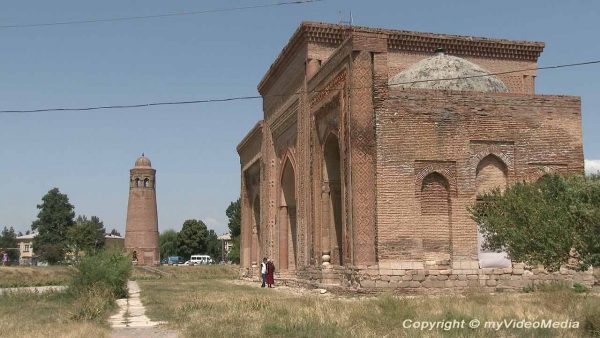
The entrances of the buildings face west so that the end face points to the east.
At the end of our guided tour with Mr. Khusniddin, Mr. Avaz Tursunbaev the director of the Uzgen Archaeological-Architectural Museum Complex joined us, to answer any open questions.

We take the opportunity to view the terrain from the air by means of a drone. Impressive is the wide valley of the Kara Darya.
Please watch the 4K UHD video
You are currently viewing a placeholder content from YouTube. To access the actual content, click the button below. Please note that doing so will share data with third-party providers.
More InformationThe green areas are rice fields on which the famous brown rice is grown. The Uzgen rice is of high quality and so popular that it costs 6 times the price of the local rice. It is often used for the national dish Plov.
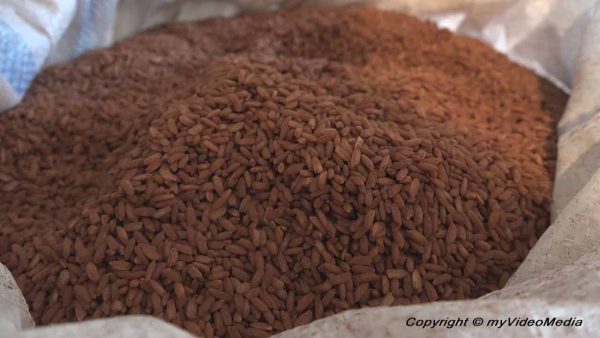
Impressing is also the dense population, even so, every house has an inner courtyard. The archaeologist Bernstam carried out excavations here from 1945 to 1950.
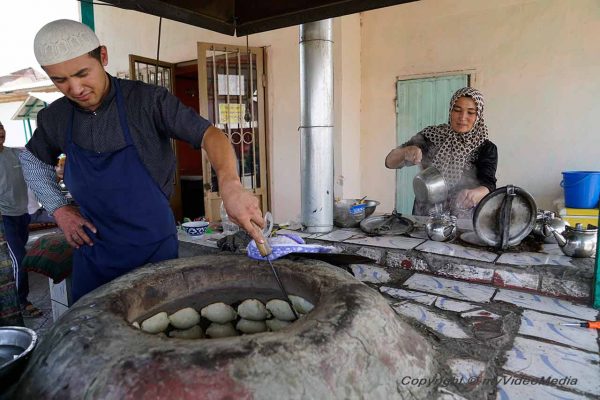
After visiting the archaeological site we visit a traditional restaurant. Before the entrance, one bakes Somsa in a classic oven. Of course we have to try them, they are delicious.

The restaurant is full, which suggests that it is also appreciated by the local population. We notice that a lot of horses are transported by trucks. We should learn the reason soon.

After lunch, we go to the livestock market. It is nearly over so that only still few animals are here. However, given the size of the market and the number of animals that have already passed us today, we can conclude that this is a very large market.

Afterwards, we wanted to visit the bazaar, but in the morning, we already heard many sirens. The cause was a fire in the bazaar, which then remained closed.
So we drive to a rice mill.
Rice mill
In the surroundings of Uzgen, you still find about 30 rice mills. The water of a small creek turns a water wheel and thus a wave, with several pestles attached. The unpeeled rice is filled in a container and threshed by the pestle until the shells fall off.

From the rice mill, we have a wonderful view of the rice fields.

On the way back to Osh, we pass innumerable stalls with watermelons. Atabek cannot resist and takes two beautiful specimens home to Osh.
Please read on > Sunset and Plov
Pin it for later
Disclosure: Our trip was organized in cooperation with Discover Kyrgyzstan, and made possible by the support of the United States Agency for International Development (USAID). All opinions are our own.
Text, photos and video: Copyright © myVideoMedia