The coastal city of Hoi An lies on the banks of Thu Bon River in Central Vietnam, about 30 km south of Da Nang. The name Hoi An means “peaceful meeting place”. Hoi An was once the largest trading port in Southeast Asia. Not at least because of the well-preserved old buildings, temples, and pagodas, Hoi An is considered as a living museum.

History
The Cham founded Hoi An in the 4th century.
The Cham People
The Cham were originally associated with the Malay-Polynesian population groups. As of the 3rd century, various centers were formed in southern Vietnam. First came the Lin-yi, who presumably ruled their empire Campa in today’s city of Hue. Their main trade was the slave trade. After various attacks on the northern Vietnamese and Chinese, it came to a punitive expedition in the 4th century.
After that, a new center was established in today’s province of Quảng Nam called Indrapura, near Da Nang.The first temples were built in My Son. Aside from the Hindu religion, Islam continued to prevail. After further disputes with Vietnamese and Chinese, the Cham were expelled to the South around the year 1000.
The new capital was moved to Qui Nhon. The disputes continued, but the Khmer also interfered. In the short term, the Cham were able to conquer Angkor but were then devastatingly beaten. Only with the decline of the Khmer empire, the Cham recovered again. But the warlike conflicts with the Vietnamese went on. In the meantime, they were able to conquer Hanoi, but then they were defeated again. This time from the Vietnamese.
In Southern Vietnam, there was a fourth Cham Center at Na Trang, that carried out disputes with Javanese and Malay. Later, they were also subdued by the Vietnamese.
Today it is estimated that about 100,000 to 150,000 Cham live in Vietnam, and about 500,000 to 700,000 in Cambodia. Furthermore, there are about 500,000 Highland Cham.
Hoi An
After the expulsion of the Cham, Hoi An lost its importance. It was not until the end of the 16th century that the port was opened to the outside, whereupon many traders from China and Japan settled here. Hoi An became the largest port in Southeast Asia and part of the Silk Road.
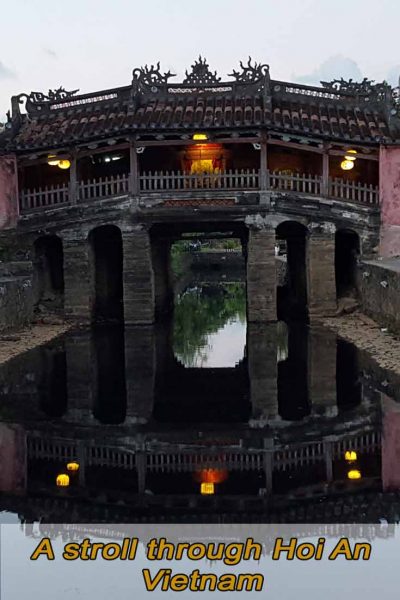
Japan had sealed itself off and conducted its foreign trade via Hoi An. At that time, the town was divided into two parts. The local population lived in one part, the Japanese in the other. Both parts were connected by the Japanese bridge (Chùa Cầu), which is now the landmark of the city.
You are currently viewing a placeholder content from YouTube. To access the actual content, click the button below. Please note that doing so will share data with third-party providers.
More InformationAfter the foreign trade was banned in Japan in 1653, the English East India Company, the Dutch Oostindische Compagnie, and the French Compagnie des Indes Orientales settled here. But, the companies soon withdrew again.
In 1644 the Ming Dynasty in Beijing was overthrown by the Qing Dynasty. Many of the Chinese fled to Southeast Asia. Hoi An was almost taken over by the Chinese.
From the 17th century onward, the port silted up more and more. Thus it lost its importance for the bigger trading vessels until the port of Da Nang took its place.
During the Tay Son Rebellion in 1780, Hoi An was almost completely destroyed but rebuilt afterward. Yet, the town didn’t reach its former importance again. In turns, the historical urban features remained unchanged. Furthermore, Hoi An also survived the Vietnam War, making it the only city in Vietnam that is still genuine with its old culture. Since 1999, the old town is noted as a UNESCO world cultural heritage site.
Our stroll through Hoi An
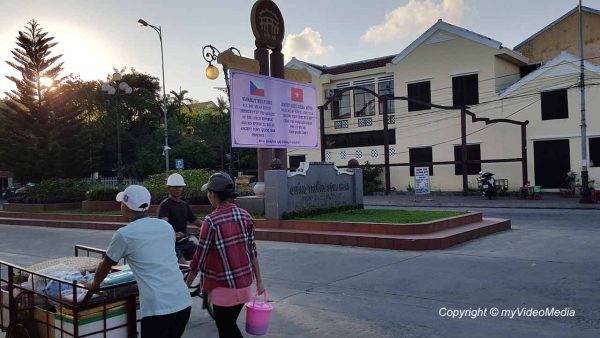
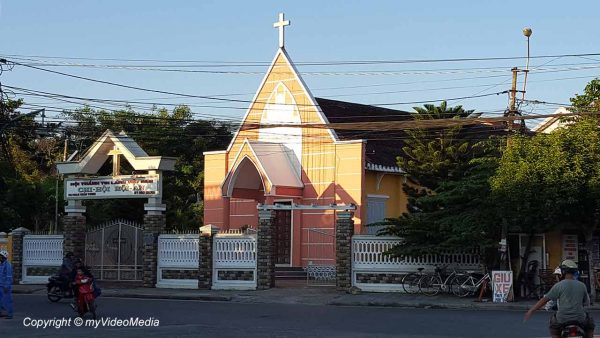
We start our discovery tour at the square where the Nguyen Thi Minh Khai crosses with the Tran Hung Dao. We immediately notice the Christian church, Nhà thờ Tin Lành. It was used to store food for the needy. Across the street is the Chinese temple Dinh Tu Le.
A few meters further, we see two Confucian temples, the Mien Tho Khong Tu and the Van Mieu Hoi An, to the right and left of the road.
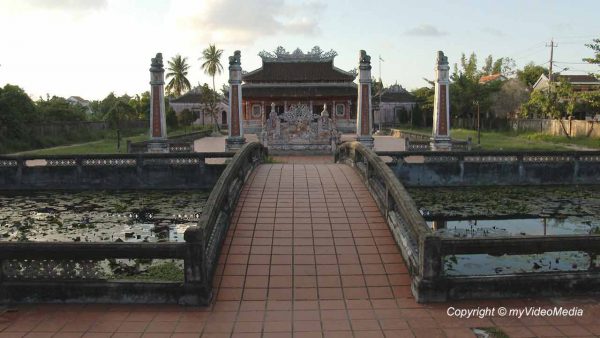
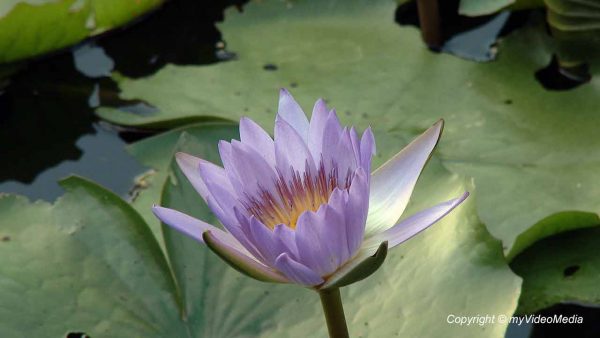
Van Mieu Hoi An has a water basin spanned by a bridge. Lovely lotus flowers flourish in the pond.
The Tran Hung Dao gives us the first impression of Hoi An. Here, tourists can buy everything the heart desires, especially textiles.

But the street scene also reflects the multicultural diversity that makes up the charm of this city.
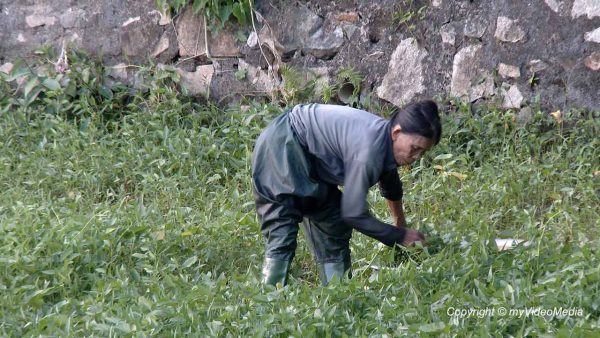
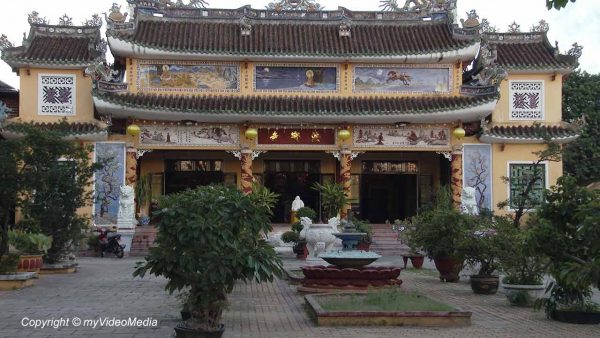
We watch a woman in the Hai Ba Trung who reaps plants with the sickle. The field is huge. We hope that she does not have to reap the whole field. On the opposite site is Hoi An’s largest temple, the Chua Phap Bao. It is a Buddhist temple with Chinese architecture.
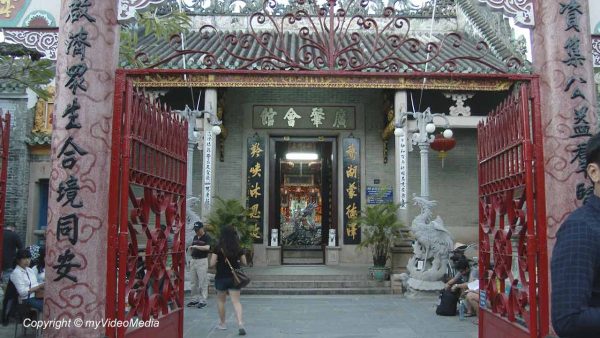
For a while, we look at the hustle and bustle of Tran Phu. Rickshaw drivers and tourists dominate the place. At the crossroads to Chau Thuong Van, the Cantonese community maintains an assembly hall, called Hội Quán Quảng Đông. Dragons shape the image inside.
We reach the Japanese bridge which picturesquely vaults across a channel.
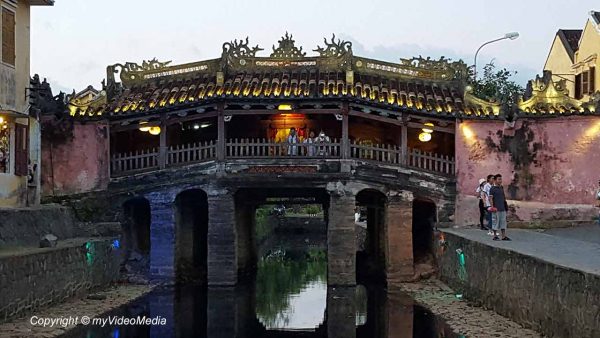
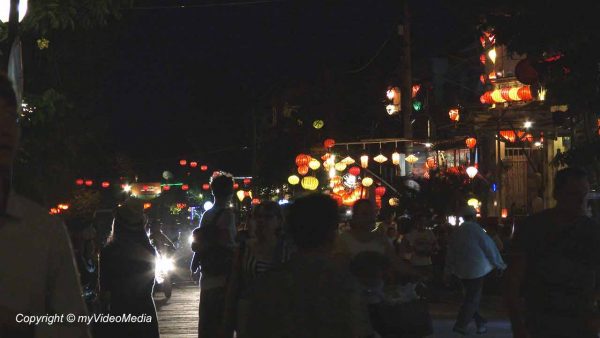
Slowly darkness rises and Hoi An shows its full beauty. Countless lanterns with candle light make the surroundings appear in a mystic light. Fishing nets reflect in the water. Together with fishing boats, they give the scenery an almost fairy-tale mood.
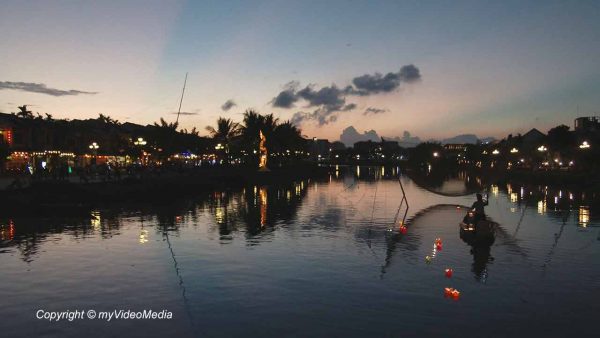
That is why Hoi An seems to be a paradise for weddings. Countless couples with photography teams are on the road and try to capture the vibes.
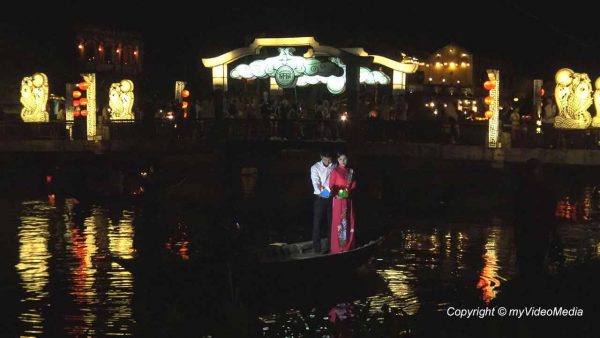
We benefit from the fact that the bridal couples are always optimally illuminated.

We cross the Song Thu Bon. Here, the night market presents itself in shrill light.
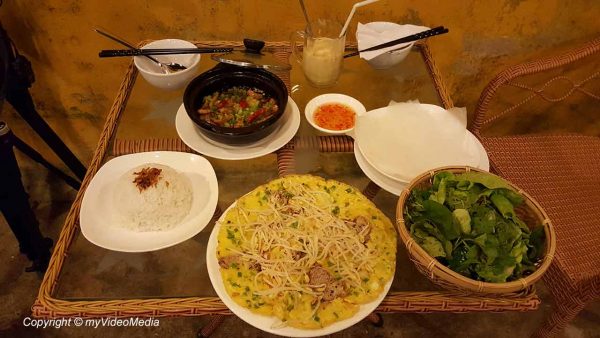
In search of a restaurant away from the tourist center we find the Hyn An. Since it lies a little in secret, there is no great hustle and bustle. Thus the owners do their best to prepare the meal particularly well. We enjoyed a specialty of Hoi An, the Bánh Xèo – a crispy Vietnamese pancake, here served with pork and prawn, and a grilled pork with lemongrass and sesame.
We may even film the family altar on the porch on the second floor. A visit is worthwhile, the meal tastes excellent.
Invigorated and impressed by the play of color, we stroll back to our hotel.
Next >>> By car from Hoi An to My Son
Text, photos and video: Copyright © myVideoMedia