Aachen’s history is irretrievably associated with the person of Charlemagne and the Holy Roman Empire. Central buildings are the Aachen Cathedral and the town hall, that was completed in 1349. Between 1349 and 1531, the Coronation Hall was the venue for banquets on the occasion of Aachen’s royal coronations.

History
Already among the Celts and Romans, the springs and bathing facilities in and around Aachen were known. Charlemagne and his brother Carloman were anointed kings of the Frankish Empire, in 754. Other sources say he received the royal anointing in 768 in Noyon in France. In 768, after the death of Pippin, they took over the regency. In 771, Carloman died, and Charles became the sole ruler in the Frankish Empire.
Around 760, Pepin the Short built a court in Aachen, first mentioned in 765. Charlemagne already spent the winter there in 768/769. From 780 onward, he developed the court into a royal-/imperial palace.
The chance of which he had already fairly often dreamed, offered itself to him 799. Pope Leo III only just survived an assassination attempt on his person because of his immoral lifestyle and fled to Charles’s palace in Paderborn, where Charlemagne stayed because of the Saxon wars.
Presumably, the plan for the coronation of the emperor was agreed upon here. Charlemagne traveled with Leo III to Rome, and during the mass on Christmas Day, Leo III placed the imperial crown on his head. It was the first time in 400 years in the West that an emperor had returned after the fall of the Western Roman Empire. Charlemagne was now emperor in the legitimate succession of the Roman emperors. Leo III was under his protection, and the assassins were only banished from Rome but not sentenced to death.
The Town Hall (Route Charlemagne – Station Power)
After 794/795, Charlemagne regularly traveled to Aachen. The Aachen Royal Palatinate was more spacious than a Palatinate of a Franconian king before. With the building of the Council Hall, he saw himself closer to his aim of succeeding in the Roman emperors.

Probably, one used the architecture of the Constantine Basilica, the audience hall of Emperor Constantine from the 4th century in Trier, as a model for the Council Hall. The Council Hall also housed the royal throne at one end. After the imperial coronation in Rome, Charlemagne made Aachen his permanent residence.
Please watch the 4K UHD video
You are currently viewing a placeholder content from YouTube. To access the actual content, click the button below. Please note that doing so will share data with third-party providers.
More InformationIn the meantime, Charlemagne was about 50 years old, the average life expectancy for men was 40 years at that time, and had ridden a lot during his life, which probably caused him to suffer from gout. The warm thermal water in Aachen helped to relieve his pain. In the end, Karl became 66 or 67 years old, in those days an almost biblical age.
In the 14th century, the citizens decided to build a new town hall. Presumably, the Grashaus had become too small and no longer met the requirements. However, the royalty required that the new town hall had to contain a hall for the coronation banquet.
One built the new town hall on the walls of the old Palace of Aachen. The new Coronation Hall on the upper floor had a separate entrance, accessible only from the outside. Inside, no direct connection exists between the ground floor and the upper floor. Until the year 1531, the banquets on the occasion of the Aachen royal coronations took place here.
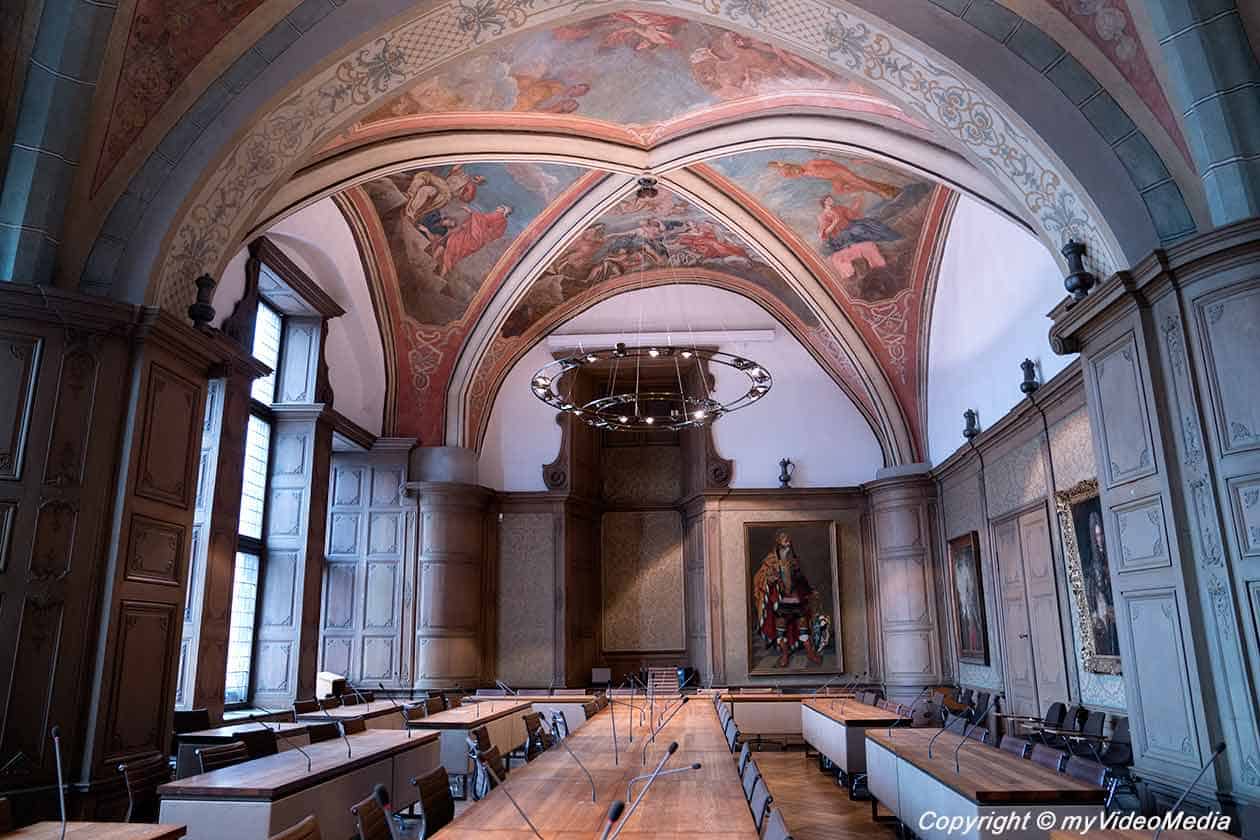
In the Council Hall, we receive a briefing from the tour guide Rolf Schnier, whose knowledge about Charlemagne and the town hall of Aachen is overwhelming. He leaves no question unanswered and knows every detail! On the wall is a portrait of Charlemagne, depicting him as a mighty old man with a long beard.

Rolf Schnier explains that there is no original portrait of Charlemagne, so he is always depicted in keeping with the spirit of the times. Above the entrance to the town hall, there is a depiction of him from Prussian times, where a relief depicts Charlemagne with a mustache.
An issue repeatedly raised in connection with Charlemagne (Charles the Great) is the origin of the by-name the Great. It may, of course, derived from his height. According to skeletal examinations, Charlemagne was 1.84 m tall. At that time, the average height of men was 1.70 m.
But, it can also derive from his achievements as king and emperor, because he united Europe into an empire, which did not succeed until the formation of the European Union, 1200 years later! Therefore Charles was exceptional in both areas.
After a fire in 1656, one renovated the halls on the ground floor in a new style. In addition to the Council Hall, they include the White Hall and the Red Hall, the Master Craftsmen’s Court, and the Master Craftsmen’s Kitchen.
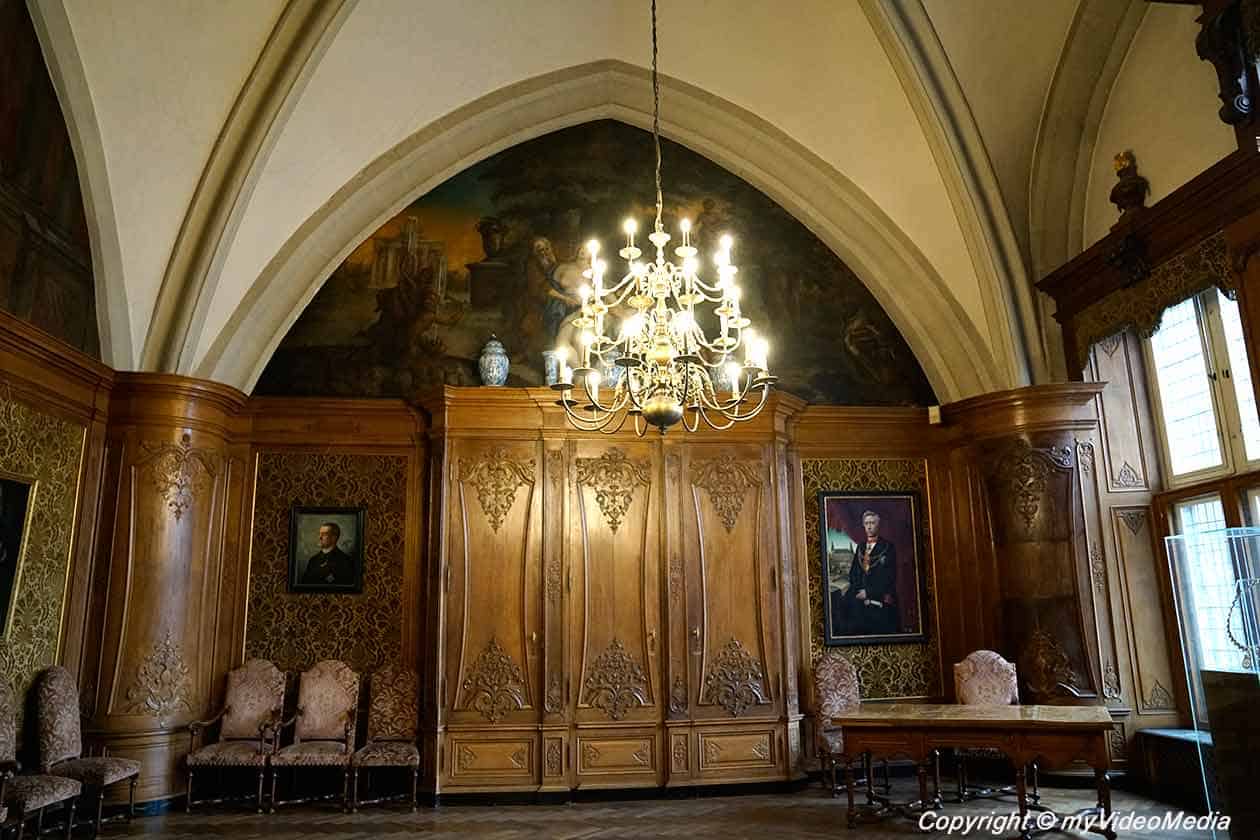
The Master Craftsmen’s Court formerly served an organization that examined the quality of the Aachen cloths. Later it was the office of the Lord Mayor.

In the showcases, one exhibits the Lord Mayor’s chain of office and valuable pieces of Aachen’s historic civic silver.
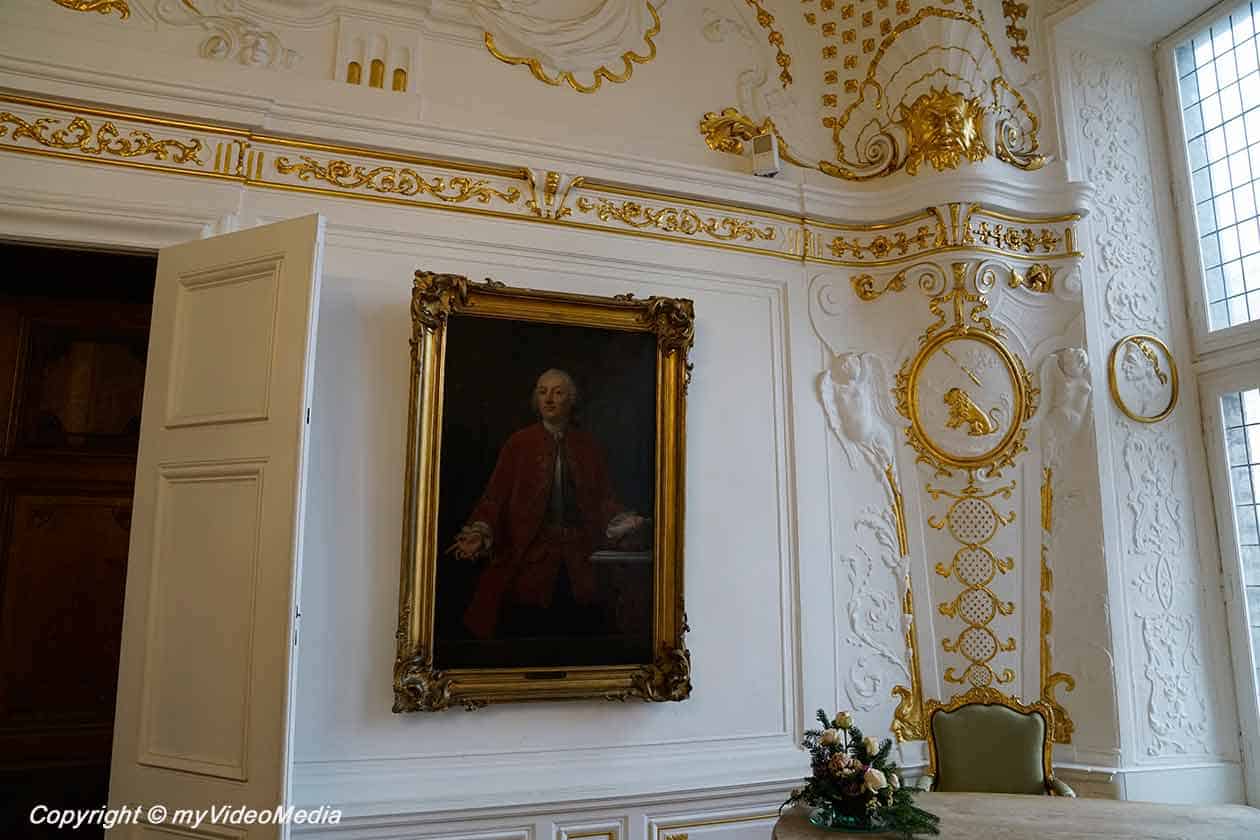
The White Hall was transformed into a small banqueting hall for the Aachen Peace Treaty to end the War of the Austrian Succession in 1748.
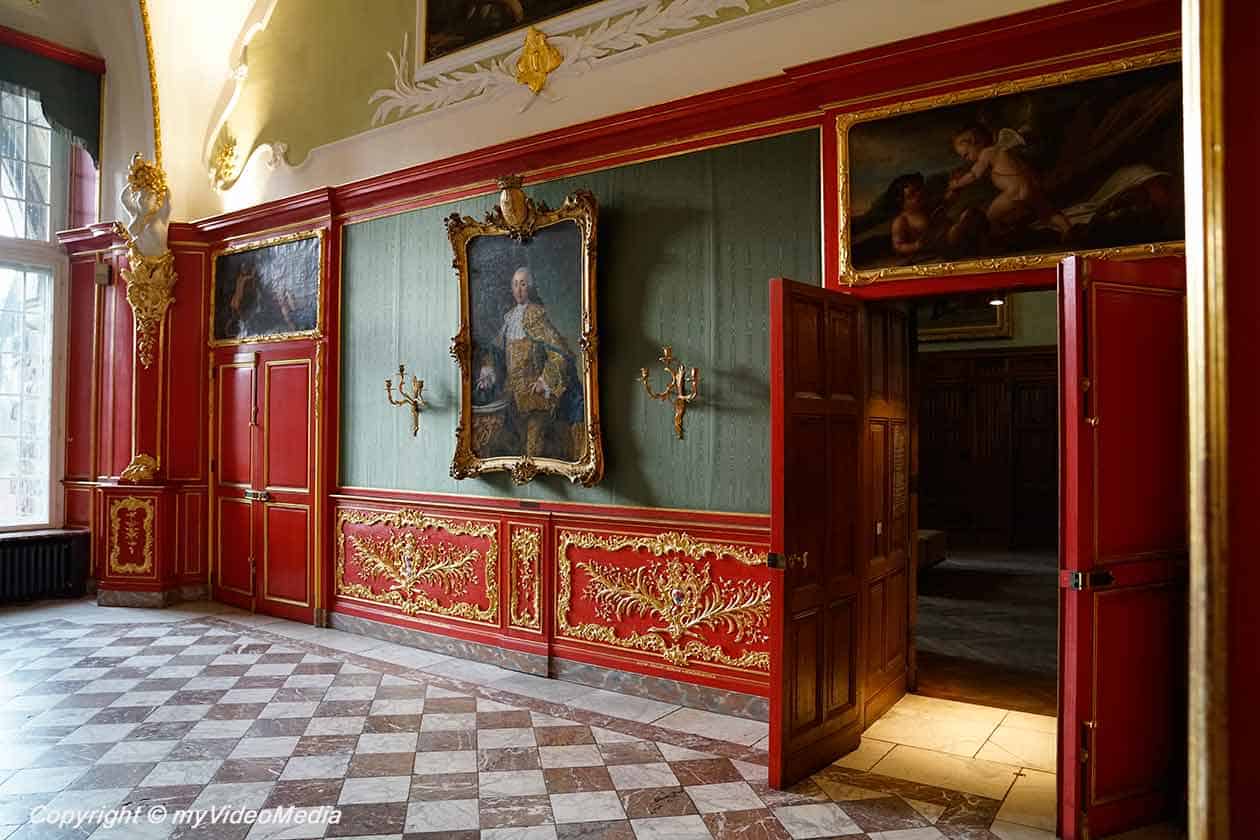
The Peace Hall (Red Hall) was supposed to be used to sign the Peace Treaty, but the warring parties could not agree on the ranking order. The room was equipped with four identical entrance doors so that everyone could enter the room at the same time, and no one had to walk behind another party.
In the Master Craftsmen’s Kitchen, you see a fireplace with a portrait of Frederick William III from 1830.
Video screens show war scenes from Aachen from 1944. During the 2nd World War, Aachen was the focus of air raids. In wise foresight, valuable inventory and wall paneling from the town hall was brought to safety from the air raids so that it still exists today.

In 1840, the Ark Staircase, named after the master-builder of Aachen Friedrich Joseph Ark, was installed between the ground floor and the upper floor. When walking up, a beautiful view of the Aachen Cathedral opens up to us.
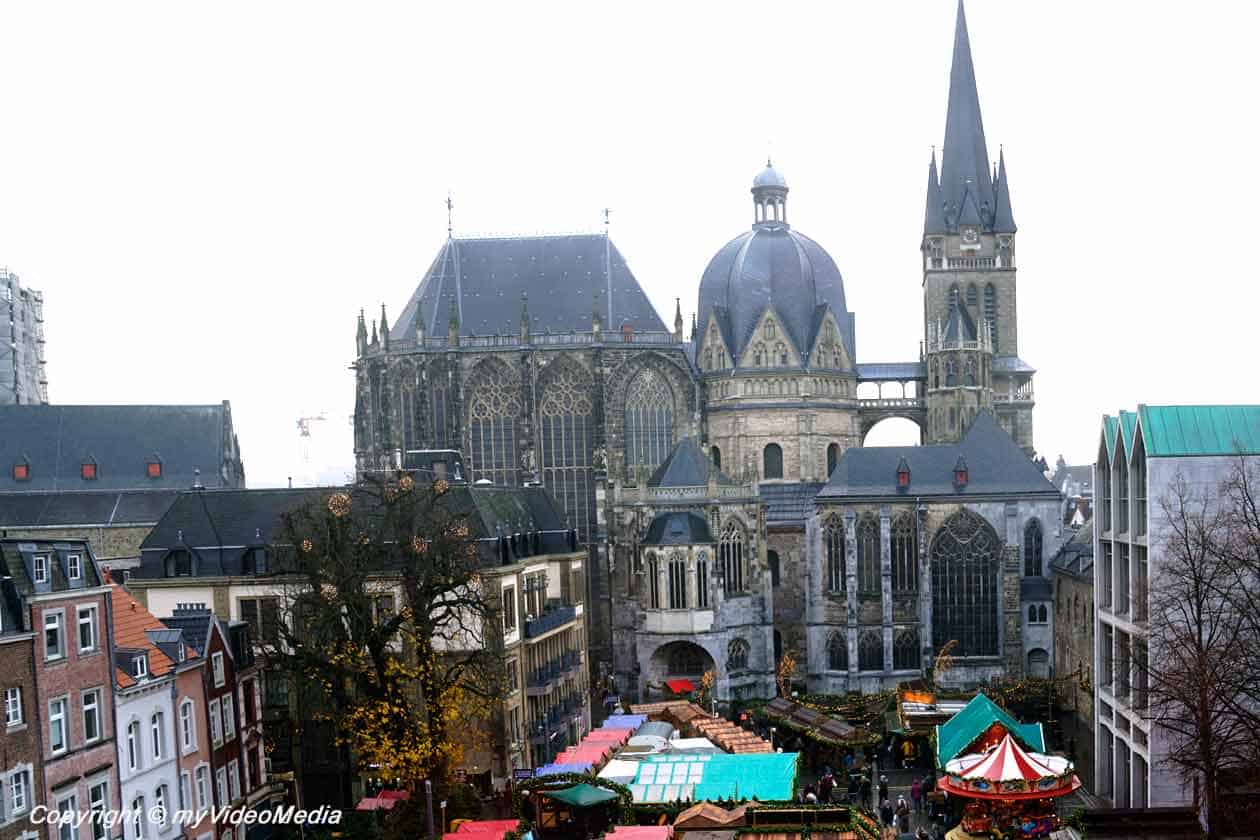
A mighty fire in 1883 again required enormous renovation measures inside, as well as the towers and roof trusses. The rededication took place in 1902 by Emperor Wilhelm II.
On the upper floor of the town hall is the Coronation Hall, which was renovated in the 19th century and embellished with magnificent frescoes with scenes of the life of Charlemagne, painted by Alfred Rethel.

Measuring 45 m long and 18.5 m wide, it was the largest profane hall in the Holy Roman Empire, after its construction in 1349.
Until 1531 the most influential persons of the empire gathered here after coronations. Nowadays, the annual awarding of the International Charlemagne Prize takes place at the end of May.
Also, an annual coronation banquet on October 23 commemorates the coronation of Charles V in 1520. It was the largest and the most magnificent celebration. Under Charles V, the Holy Roman Empire had its vastest expansion.

In a niche of the Coronation Hall, we see the excellent replicas of the Imperial Regalia, an integral part of every coronation. The originals are in the Imperial Treasury in Vienna.
Pin it for later

Text, photos and video: Copyright © myVideoMedia