Before we go to the Bridge over the River Kwai (Khwae Yai), we visit the museum commemorating the prisoners of war who had to build the Death Railway. It shows the working conditions the people had been forced to live with.
The majority of the prisoners came from the countries Japan, England, Australia / America, Thailand, and Holland. Hence the name of the museum is composed of the first letters.
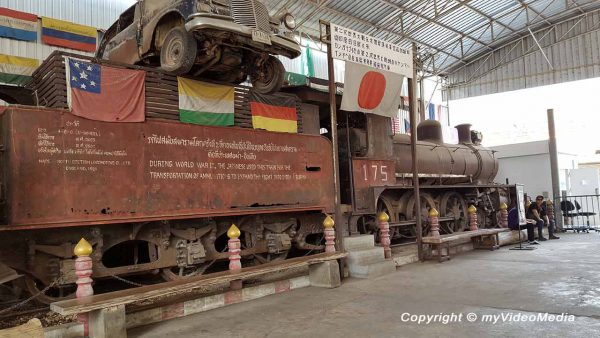
JEATH Museum
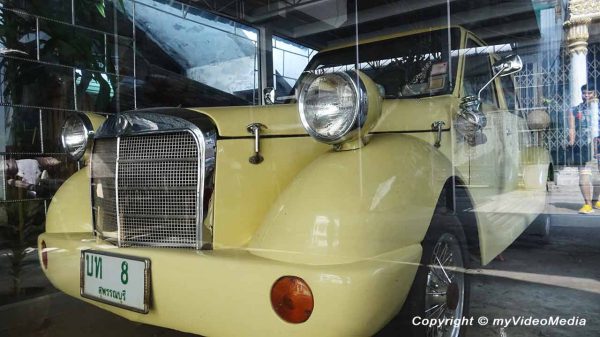
The huts of the prisoners, vehicles like cars, railroad freight cars and boats, with which they were transported are exhibited in the museum. Murals depict the bombing of the bridge by the Allies.
Right after the entrance area we see a part of the first wooden bridge over the River Kwai.

Later a steel bridge was built next to it. Both bridges were destroyed by the bombardment.
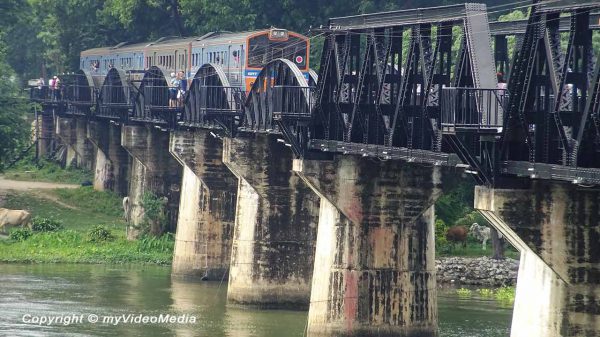
The steel bridge was rebuilt after the war by a Japanese company and is still in operation.
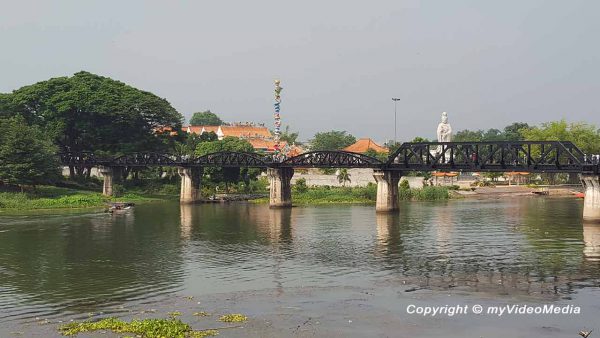
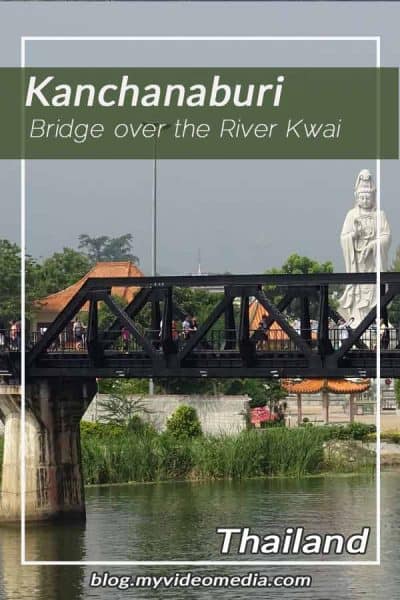
The bridge over the River Kwai
After the Japanese had occupied Thailand in the second World War, they planned a rail link between Thailand and Burma to supply their troops. At that time, the 320 m long bridge was the second longest bridge in Thailand. Both the steel bridge and the wooden bridge were constantly bombarded and had to be repaired again and again. Besides that, one used a train ferry. In 1945 the operation was finally stopped.
The bridge got its literary monument in the novel “The bridge over the River Kwai” by the French novelist Pierre Boulle and later in the movie “The bridge on the River Kwai” directed by David Lean. Not at least by the soundtrack, The River Kwai March, the movie remains unforgettable.
In reality, the lack of hygiene in the camps and thus caused diseases was the biggest problem for the forced laborers. The inhumane treatment was shown as a war crime.
Thailand-Burma Railway (Thang Sai Rotfai Marana)

This railway line became known as Death Railway. On a length of 415 km, it led from Khok Mo in Thailand to Thanbyuzayat in the former Burma.
Please watch the 4K UHD video here!!!
You are currently viewing a placeholder content from YouTube. To access the actual content, click the button below. Please note that doing so will share data with third-party providers.
More InformationToday, 131 km are still in operation on the Thai side to Nam Tok, mainly for tourist reasons. Beside 50,000 to 70,000 Pow, 200,000 Asian forced laborers and hundreds of thousands of Thai civilians were used as forced laborers for the construction of this line. One had promised wages to the civilians but never paid.
Depending on the estimates, 40000-90000 people died during the construction of the track.

We drive to Nam Tok and enjoy the view on a route, which people had built under great pain.

Please read on > Visiting the Hellfire Pass and Prasat Muang Sing
Pin it for later
Text, photos and video: Copyright © myVideoMedia