Chinatown
Chinese traders were the first ones who settled in today’s municipal area of Bangkok. The area where the grand Palace is today was once the center of the Chinese community. When King Rama I decided to build his new palace, he asked the traders to resettle. So they settled in the east of the new town. The Sampeng Lane, not even big enough for a car, was their new main road.

Today Chinatown is known as a gold trading center. Along Yaowarat Road you find a lot of gold shops.
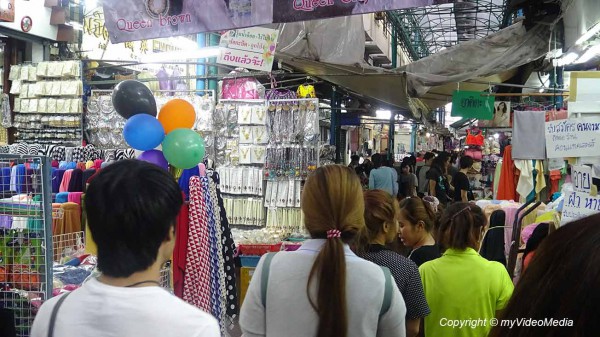
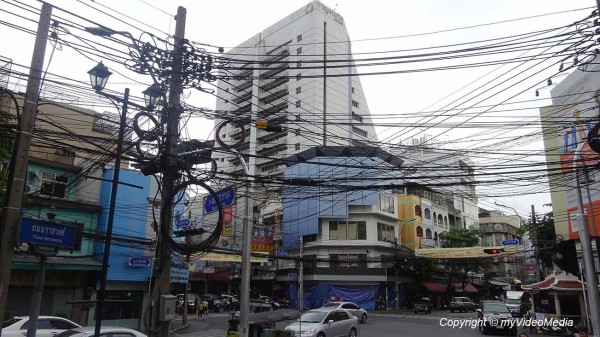
One should not suffer from claustrophobia or agoraphobia (fear of crowd) if one dares to go into the little lanes with innumerable sales shops. All kinds of furniture, as well as clothes and jewelry are sold. However, the people are considerate and friendly.
At the end of Chinatown is Wat Traimit with the famous Golden Buddha.
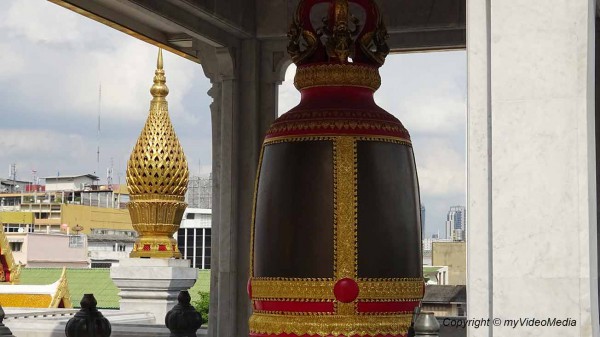
Golden Buddha
The statue originally comes from Sukhothai and was manufactured in the 13th or 14th century. Probably, before Ayutthaya was taken by the Burmese, the statue was covered with a thick layer of plaster and decorated with glass stones in order to protect it from a robbery. When the new capital was founded, King Rama I had given orders to bring back many of the Buddha statues from the scattered ruins in the country to Bangkok.

The Golden Buddha came into the small and insignificant Wat Chotanaram. When the temple was completely abandoned, the Buddha was brought to the nearby Wat Traimit. In 1954 the Buddha should move into a new temple building, but something went wrong. Anyway, the layer of plaster burst and the Golden Buddha appeared.
Please watch the 4K UHD video!!!
You are currently viewing a placeholder content from YouTube. To access the actual content, click the button below. Please note that doing so will share data with third-party providers.
The statue is more than 3 m high and weighs 5.5 tons. The base contains approx. 5% gold, the body of the statue approx. 40-80 % gold. The face mask weighs 45 kg and consists of 99% gold. The gold of the complete statue is valued at 250 million dollars.
Vegetarian Festival (Tesagan Gin Je) or Nine Emperor Gods Festival
The Vegetarian Festival in Bangkok takes place after the Chinese moon calendar within the first 9 days of the 9 month in September or October. In 2015, from 12th to 22nd October.
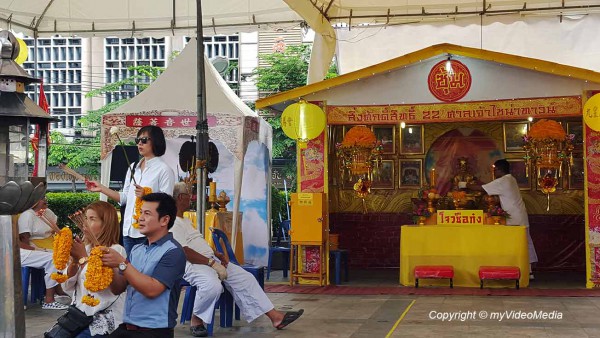
The celebration has its origin in Malaysia, Singapore and in Thailand. It was organized for the first time by foreign Chinese in Phuket. The festival is of Taoist origin and today also influenced by Hindu. In China this festival is unknown.

It is also called Nine Emperor Gods Festival, named after the constellation Great Bear. During this period, the people do not eat meat, fish, seafood, eggs and milk) and also abstain from spices and tobacco to cleanse the body.
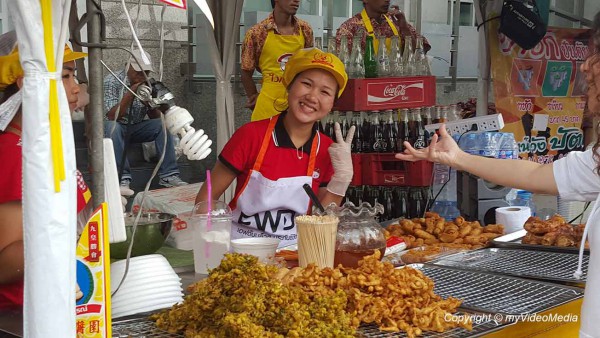
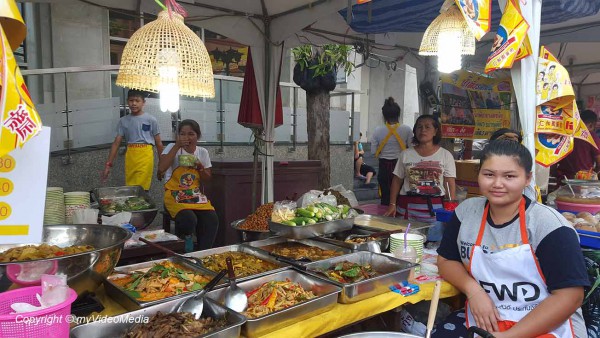
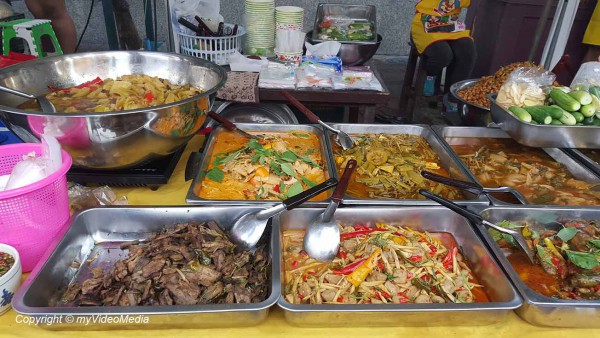
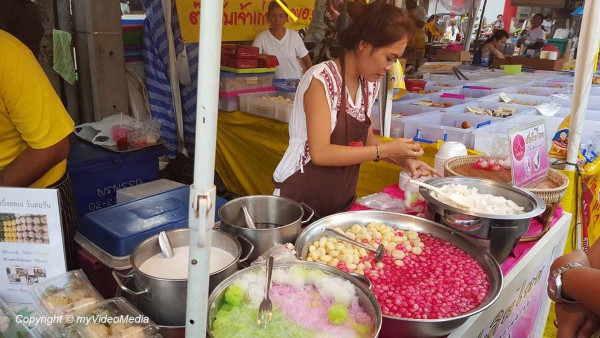
This is the reason why the festival is called Thesakan Kin Che, or vegetarian festival, in Thailand. But as you can see in the pictures, it is no question of renunciation, on the contrary, countless dishes are offered.
Fortunately we saw nothing of the usual self-mortification and self-injury.

The area is now densely populated with small houses. Many date from the colonial era, but the skyscrapers of real estate speculators are already recognizable at the edges of the neighborhood and will continue to advance.
Text, photos and video: Copyright © myVideoMedia