The Citadel and the Forbidden Purple City are undoubtedly the main attractions in Hue.
The Citadel
The citadel is laid out squarely with a side length of 2.5 km and is surrounded by a 6 m high fastening wall and a 4 m deep and 23 m wide moat. 11 gates allow the access.
Inside the citadel there are residential areas, which are separated by walls and canals. Nestled in this area is the Imperial City and the Forbidden Purple City, the imperial palace. The planning of the imperial city was based on the Forbidden City in Beijing.
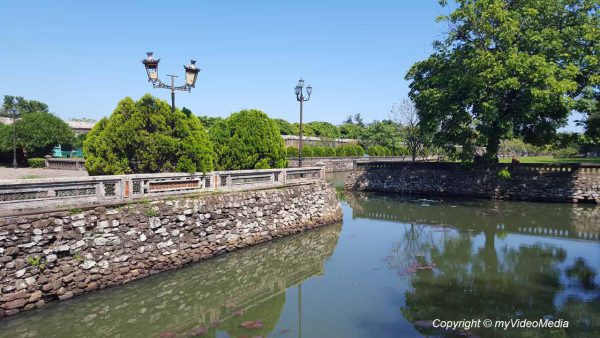
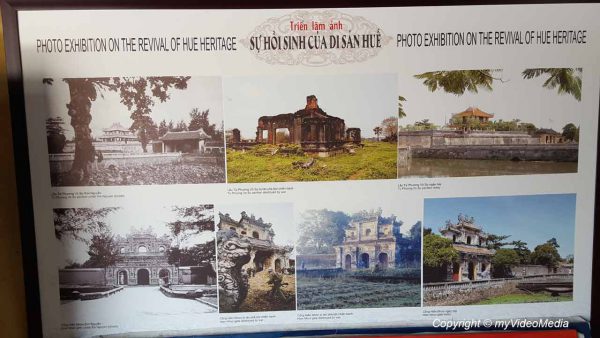
A large part of the complex was destroyed during the Vietnam War in 1968. When a fierce house-to-house fighting took place here during the Tet offensive, the Americans started to bombard the citadel.
Only a few buildings have been preserved. Vietnam does its best to advance the reconstruction of this unique complex. 30% of the buildings have been restored in the meantime.
The complex was built in 1805 by Emperor Gia Long, the first emperor of the Nguyen dynasty, who had come to power with the help of the French.
Until 1883, the Vietnamese emperors ruled the country from Hue. Afterwards the country was under French colonial rule.
In 1993, the citadel was added to the list of UNESCO World Heritage Site.
You are currently viewing a placeholder content from YouTube. To access the actual content, click the button below. Please note that doing so will share data with third-party providers.
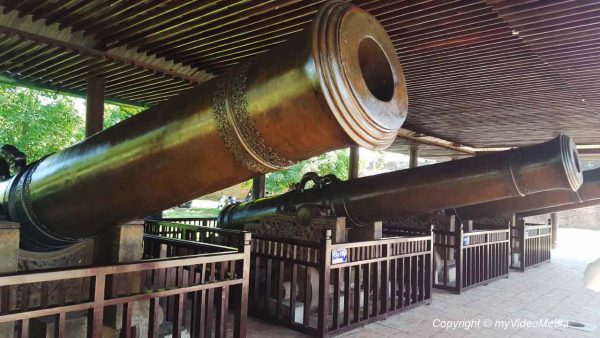
More InformationWe go past the mighty bastion with the famous 37 m high flag tower. Through a gate we reach the inside, where the Nine Holy Cannons, which have survived the destruction, are exhibited. They symbolize the four seasons and the five elements earth, water, light, wood and metal.
In 1803, Emperor Gia Long ordered all bronze wares of the Tay Son dynasty to be collected and melt into the cannons. Every single one weighs more than 10 tons and is 5 m long. They are the “Holy Invincible Generals”.
We enter the Imperial City by Ngo Mon Gate (Gate of Noon), which has been perfectly restored. To the left is the drum and to the right the bell tower.
The gate also served for the inspection of parades and ceremonies, where the Emperor stayed on the first floor. From here one has a good view of the Hall of Supreme Harmony with the throne of the emperor (Thai Hoa Palace).

In front is a pond with Kois which wait to be feed. One can cross the pond over the bridge of the golden water (Trung Dao).

The Forbidden Purple City

Behind it lies the Forbidden Purple City. In a beautiful pavilion, which was dedicated to the parents of the emperor, you can see dishes and utensils of the imperial court, but also numerous historical photographs.


The other pavilions around the large square were probably reserved for the concubines.
We stay in the eastern part, where we find the well restored Thai Binh Pavilion and the Imperial theater.
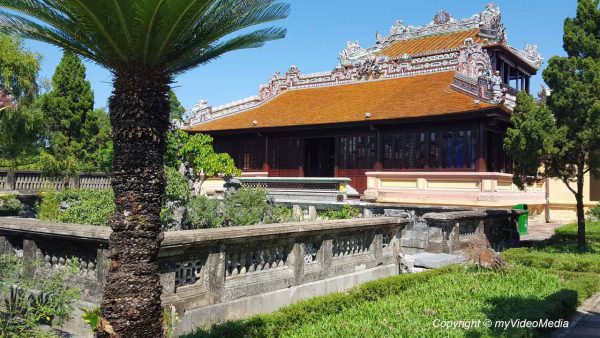
Thai Binh Pavilion, the emperor’s reading room, was constructed under Thieu Tri, the third emperor of the Vietnamese Nguyễn Dynasty (1841-1847). It was first restored in 1921 under Emperor Khai Dinh and again between 1990-1991. It is distinguished by artistic landscaping and unique pottery mosaics.
Behind it is the Thai Mieu and Trieu Mieu temple complex built in 1804. It consisted of about 10 buildings, with the two main temples, the Thai To and the Trieu Temple. Currently, extensive restoration work is in progress.
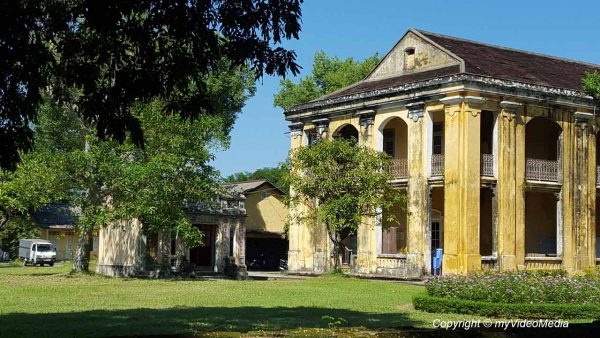
The former Royal treasury is still awaiting restoration. The main building dating from 1837, was replaced in the early 20th century with the present-day European-Style building.
In 1936, it served as headquarters for the imperial city guard. In 1957, it became the Hue College of Fine Arts.

We leave the complex by the Cua Hien nhân Gate in the east. Unfortunately we have seen nothing of the western part of the Forbidden City and the rest of the citadel, although it would have been a lot to discover there. Our stay was too short. You should take at least six hours for a visit.

Across the perfume river we drive to the Moc Vien restaurant for lunch. The restaurant is about 15 minutes from Hue and an oasis of peace.
In the lovingly arranged shady garden with ponds and bridges we enjoy an excellent menu and let the impressions reminisce.

Please read on > Tomb of Emperor Tu Duc – Hue
Pin it for later

Text, photos and video: Copyright © myVideoMedia
What a gorgeous palace and tour – I really want to visit this place and also the city in general – still on my bucket list of places to visit.