The next morning we first visit Goethe’s birthplace at the Großer Hirschgraben. Johann Wolfgang Goethe lived here until he went to Weimar at the age of 26.

The phase was interrupted by his years of study in Leipzig and Strasbourg. In the 2nd World War, the house was destroyed, but the facilities could be brought to safety before. From 1947 to 1951 the reconstruction took place. The building to the left of it is currently being converted into a modern museum.
Without staying long at the Goethe House, we go on to the Roßmarkt, a square with the Gutenberg monument in the center. One set it up to celebrate the 400th anniversary of the invention of the letterpress art.
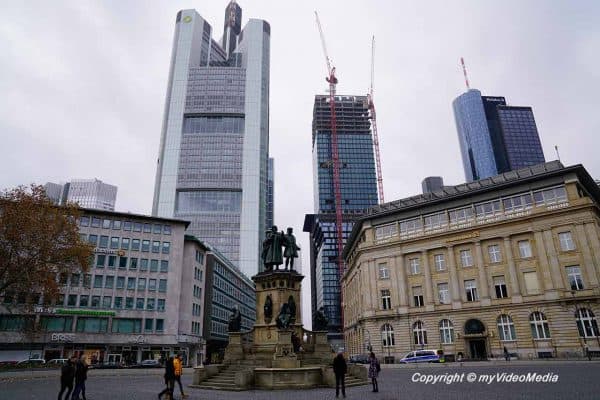
From here we can see the panorama terrace on the Maintower, which we will visit later.
Directly next to the Roßmarkt is the Goetheplatz. This square is also dominated by a monument. It represents, as you might expect Johann Wolfgang von Goethe.

Yet, at our visit, the statue was wrapped in a European flag, which probably proves that Goethe was a European. With this action, Pulse of Europe e.V. wants to set a sign for the future of Europe and counteract the divisive tendencies.
We cross the third adjacent square, the Rathenauplatz, turn into the Steinweg and reach the Hauptwache, a central traffic junction of the city. The Hauptwache used to be a guardroom and prison in the middle of the city. The most prominent prisoner was Johann Erasmus von Senckenberg, who spent 26 years here.
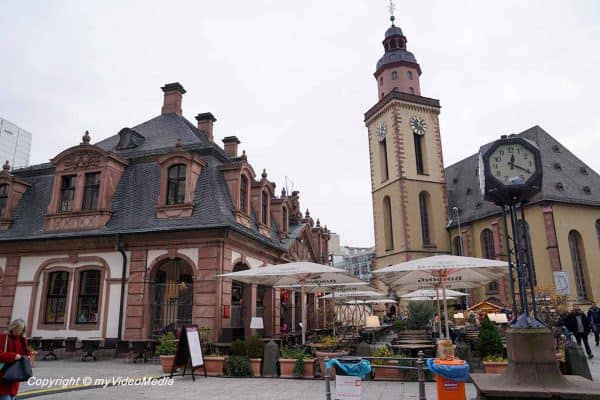
The silhouette of the Hauptwache has changed considerably in recent decades. In 2005, one demolished the telecommunications tower behind the Galeria Kaufhof and replaced by a huge shopping mall and business center.
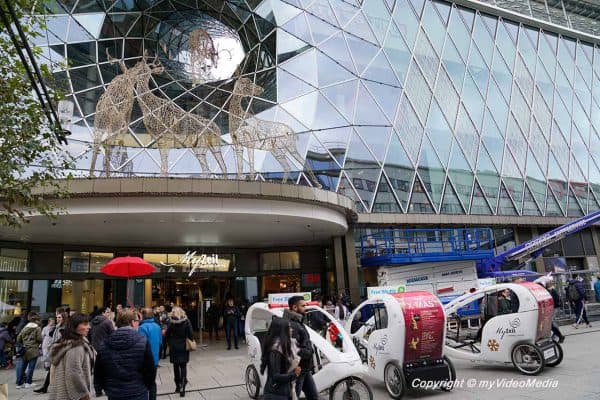
We stroll along the Zeil, Frankfurt’s most important shopping street, in the meantime planted with trees.

We also find Christmas stands at the Hauptwache. The one with Christmas cookies for dogs seemed the most original to us.
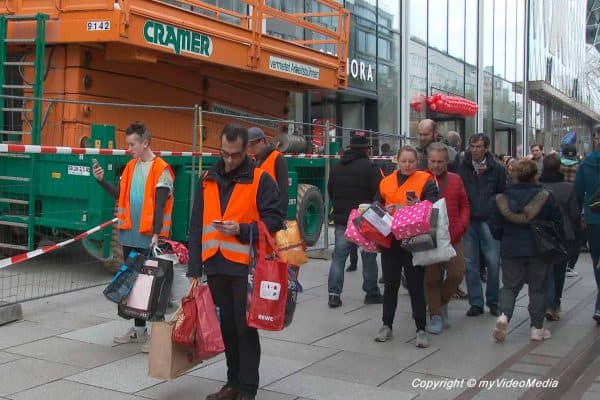
Suddenly we see a group of people with warning vests carrying lots of shopping bags. They stand motionless on the sidewalk. The running passers-by look somewhat surprised at the group.
We briefly enter into conversation with Prof. Snežana Golubović from the Frankfurt University of Applied Sciences, who stage artistic interventions in public space here.
Next, we visit the Freßgass, as the part of the Grosse Bockenheimer Straße has been officially called since 1977. Here, too, we don’t stay long but go to the viewing terrace on the Main Tower to enjoy the panoramic view. Every visitor of Frankfurt should treat himself to the view, as it is hard to find a better view of the city.
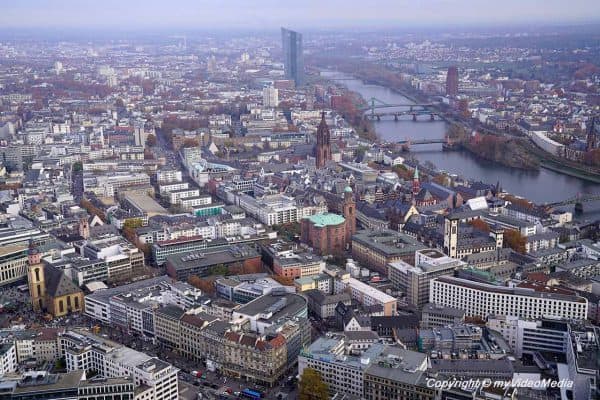
The sun slowly sinks towards the horizon, as we pass the towers of Deutschen Bank and reach the old opera house. Today it serves as a concert and event hall. During the war, the building was badly damaged and first reopened in 1981.
Please watch the 4K UHD video
You are currently viewing a placeholder content from YouTube. To access the actual content, click the button below. Please note that doing so will share data with third-party providers.
More InformationBack through the Freßgass we reach the Hauptwache again and continue in the direction of Eschenheimer Tor. In the Palais Thurn und Taxis, there are also some Christmas market stalls. The Palais was built by Imperial Hereditary General Postmaster Prince Anselm Franz von Thurn und Taxis.
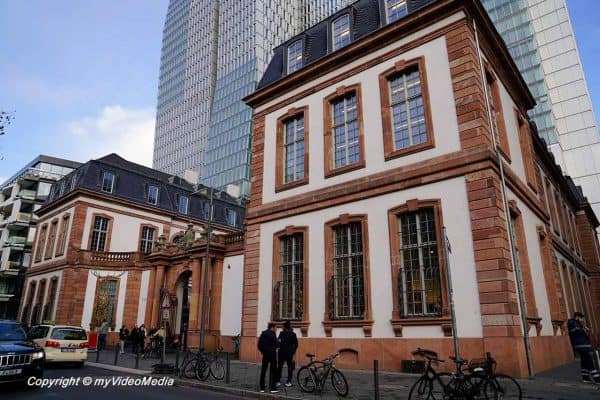
In 1748 it was the headquarters of the Imperial Mail. From 1816 to 1866 the Federal Convention of the German Confederation met here. Today it houses business premises and shops.

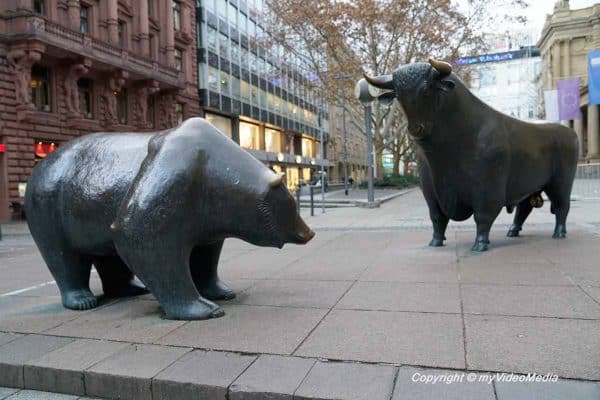
After a short visit at the Eschenheimer tower, it goes back via Schillerstrasse to the German stock exchange, in front of which bull and bear present themselves.
From the Hauptwache, we take the subway to Willy-Brandt-Platz. Here is the Schauspiel Frankfurt, which also functions as an opera house. Here, too, people are obviously speculating about a new building. The green spaces of the Gallusanlage are framed by the skyscrapers of the financial companies.
To the right is the Eurotower, which once housed the Bank für Gemeinwirtschaft. From 1998 to 2014, the building was the seat of the European Central Bank until it moved to its new building on the banks of the Main. Today, the Eurotower is the seat of the Single Supervisory Mechanism (SSM) of the ECB. The symbolic euro symbol in front of the building testifies to the symbolic significance of this building. The yellow stars symbolize the euro states.

When the lighting was switched on, one could see that one could recognize that a star was shining a little weak. Which country might this be?
Pin it for later

Text, photos and video: Copyright © myVideoMedia