Historical facts about Samarkand
The precursor of Samarkand was Afrasiyab. Today there is only a sandhill north-east of today’s center of Samarkand left. Afrasiyab, founded in 750 BC, was the capital of the province of Sogdia in the Achaemenid Empire, the first Persian empire.
Due to trade on the Silk Road, the city had come to prosperity already at this time. In 329 BC Alexander the Great conquered the city. After his death, Afrasiyab fell to the Seleucid Empire, one of the three Diadoch states that divided Alexander’s empire among themselves. Later it fell to the Greek-Bactrian Kingdom and then to the Kushan Empire.
In the third century, the Sassanids conquered the city. In the 6th century, it fell to the Khan of Western Turkey. After that, it came under Chinese influence. After the Chinese lost Central Asia to the Tibetans, the region came to the Umayyads, a family clan from Mecca, where Muhammad originated from. The reign was replaced by the Choresm Empire before Genghis Khan completely destroyed the city.
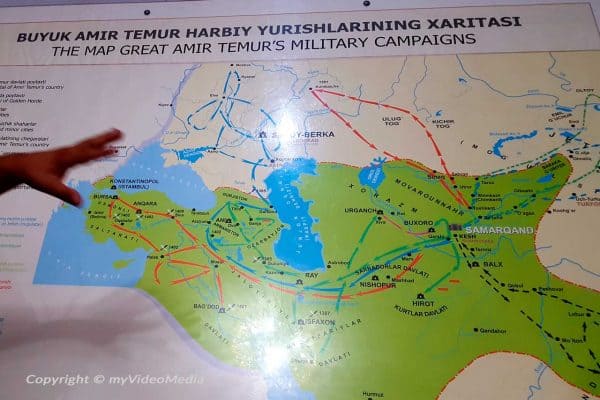
The city was rebuilt in the 14th century. Under the Mongolian ruler Timur, Samarkand became the capital of his empire. 150,000 people, mainly silk weavers, and gunsmiths, settled here. They developed the city into one of the most important metropolises of its time.
Because of this architectural heritage, Samarkand is legitimately called the Gem of the Orient. In 1500, the Shaibanids conquered Samarkand and the city became part of the Khanate of Bukhara.
The region experienced its greatest prosperity under Timur. Thus Uzbekistan relies on the historical heritage of Timur (Amir Timur or Tamerlane) to strengthen its identity.
Gur-e-Amir Mausoleum
The Gur-e-Amir Mausoleum is the final resting-place of Timur. In 1405 he set out on a campaign to China. After several days of extensive alcohol consumption, he died near Shymkent in present-day Kazakhstan.
Timur was a merciless conqueror who had hundreds of thousands if not millions slaughtered. But at the same time, he was also regarded as a promoter of culture and literature. He built one of the largest but also most short-lived empires of Central Asia.
But Timur was a conqueror and military leader, not a politician who created sustainable administrative structures and organizations. The destruction of the surrounding empires was so severe that Europe managed to overtake the scientifically and technologically advanced Central Asia.

The wonderful architecture, that we see today, is also limited to mosques, madrasahs, buildings for the Sufis and above all mausoleums. Only the Soviets finished this disastrous development and closed almost all Koran schools and mosques. Perhaps the destructive earthquake in Tashkent was also a positive development. A lot of aid money flowed into the country and one rebuilt a modern city. In addition, a functioning industry and agriculture have been built up. It remains to be hoped that this development will continue.
The Gur-e-Amir Mausoleum was actually intended for his favorite grandson Muhamed Sultan who died in the Battle of Angora in 1402.
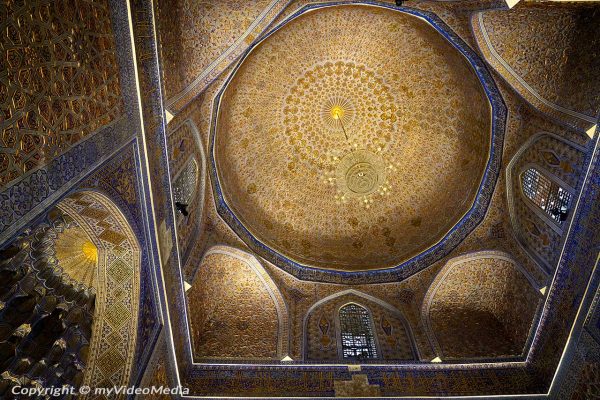
The building, completed in 1404, is known for the construction of the huge double-shell dome.
Originally the mausoleum was flanked by a madrasah on the left side whose foundation walls can still be seen. On the right side was a building for the Sufi Brotherhood, which was completely destroyed.
At the end of the rule by the Shaybanids, the monuments were decayed and not restored until the end of the Second World War.

Today the interior shines gold-colored with artistic ornaments and gives an impression of the craftsmanship of the people at Timor’s time. The dark cenotaph of Timur is of nephrite and was made from the throne of a descendant of Genghis Khan.
Rukhobod Mausoleum
The Rukhobod mausoleum is 200 m away, next to the parking lot. Dating from 1380, it is the oldest monument in the city. The Rukhobod Mausoleum is the burial lair of the Islamic theologian and mystic Sheikh Burhaneddin Sagaradzhi, his wife, and his nine children. Nine hairs of the Prophet Muhammad’s beard are said to be in a walled box.

The admission is said to be very expensive. It also serves as a souvenir shop.
Registan
The Registan is one of the architecturally most important places in Central Asia.

It is an ensemble of three madrasahs, where the middle madrasah houses a golden mosque.
Ulugbek Madrasa
The first built madrasah is the Ulugbek Madrasa on the left. It was set up between 1417 to 1420 and was one of the most important universities in Central Asia of the 15th century. The ruler and astronomer Ulugh Beg gathered 70 scholars with main emphasis mathematics and astronomy here. Among them the scientists Jamshīd al-Kāshī and Qāḍī Zāda al-Rūmī.

Together, they calculated the circle number π exactly on 16 decimal places for the first time. This result was only surpassed in 1596 by Ludolph van Ceulen. They also calculated the sine of 1º, also accurate to 16 digits.
In addition, they built and operated the Ulugh Beg Observatory, also known as Samarkand Observatory. After the assassination of Ulugh Beg, the observatory was destroyed.
Please watch the 4K UHD video here
You are currently viewing a placeholder content from YouTube. To access the actual content, click the button below. Please note that doing so will share data with third-party providers.
More InformationSher Dor Madrasah

Two centuries later from 1619 to 1636, one built the Sher Dor Madrasah opposite the Ulugbek Madrasa. It is mainly known for its architecture and images of tigers on the tiles.

Tilya-Kori Madrasah

In the middle, one built the Tilya-Kori Madrasah, from 1646 to 1660. It is known for its Golden Mosque. This richly with gold decorated mosque testifies again to the abilities of the masters at that time. Here you also find souvenir shops in the adjoining rooms.

From Registan one has a good view to the oversized bronze statue of Uzbekistan’s late first president Islam Karimov.

Please read on > A day trip to Shahrisabz
Pin it for later

Text, photos and video: Copyright © myVideoMedia
I’ve not traveled much in Central Asia. I do find both the architecture and the history fascinating. I think I’ll add Samarkand to my travel list. What is the best time of the year to visit?
Thanks for your feedback.
Samarkand is a beautiful place full of history. The best time to travel to Samarkand is April to May, and September to early November. In summer it is too hot