To visit the old town, as well as the historical buildings in Hoi An, every visitor needs to buy a ticket. The ticket costs 120,000 VND, about 6 USD. A large part of the revenue is for the preservation of the UNESCO world cultural heritage and is used for the restoration work.
Included in the ticket price are vouchers for visiting 5 of the 18 sightseeing places. They are devalued at the respective input.
While staying at Hoi An, you should keep your ticket even after visiting the 5 sites of interest. It might be checked in the Ancient Town. But this never happened to us.
Please watch the video
You are currently viewing a placeholder content from YouTube. To access the actual content, click the button below. Please note that doing so will share data with third-party providers.
More InformationHoi An Artcraft Manufacturing Workshop
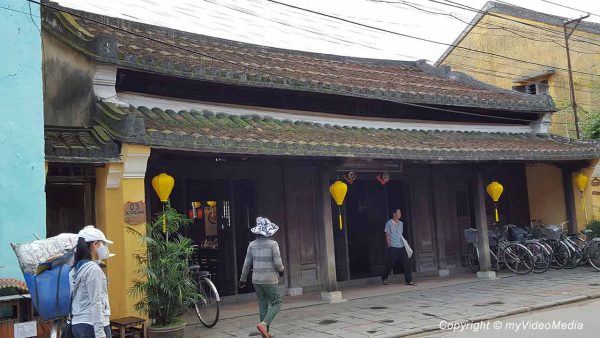
In the front part of the house, the artists of the Hoi An Traditional Art Performance House perform traditional Vietnamese dances twice a day.
Watch the video Traditional Dance and Music
You are currently viewing a placeholder content from YouTube. To access the actual content, click the button below. Please note that doing so will share data with third-party providers.
More InformationBeside the music shows at the Hoi An Art Craft Manufacturing Workshop, you find traditional performances in the Hoi An Traditional Art Performance House every day at 5:30 pm.
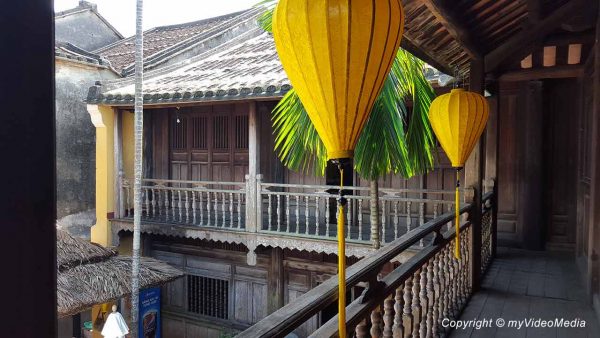
In the courtyard and on the first floor you can watch the production of lanterns and other souvenirs.
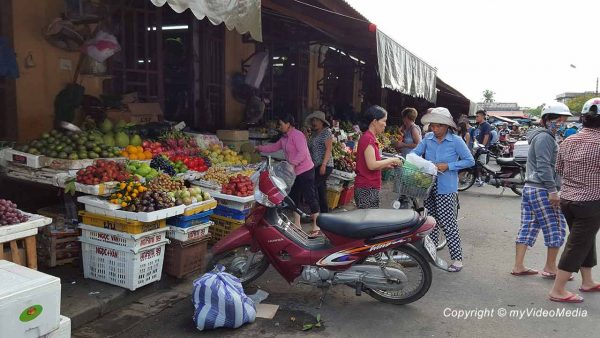
On the way to the next highlight, we pay a visit to the market hall. Many people make use of the excellent offer and come to have breakfast or lunch here.
Hoi Quan Phuoc Kien – Assembly Hall of the Fujian Chinese Congregation
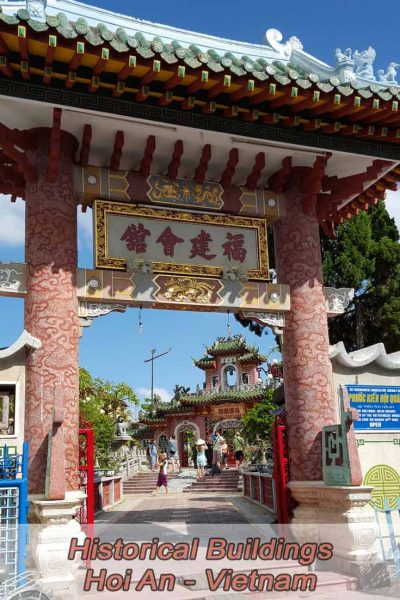
Hoi Quan Phuoc Kien is the magnificent assembly hall of the Chinese Fukien community. It is the largest and most beautiful of the five still existing assembly halls in Hoi An. It was built around 1690 by Chinese traders from the province of Fujian, in the southeast of China.
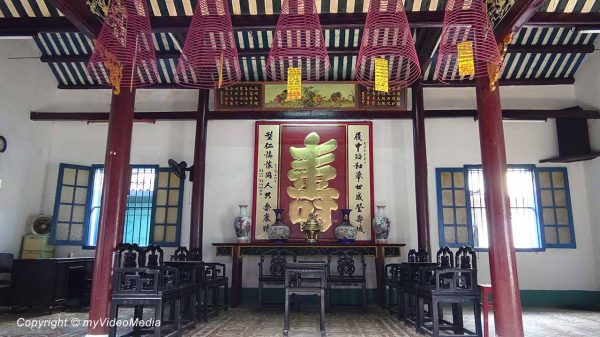
Inside is a temple to worship Thien Hau, the goddess of the seas and patron saint of sailors and fishermen. The assembly hall was repeatedly expanded and modernized up to the 1970s.
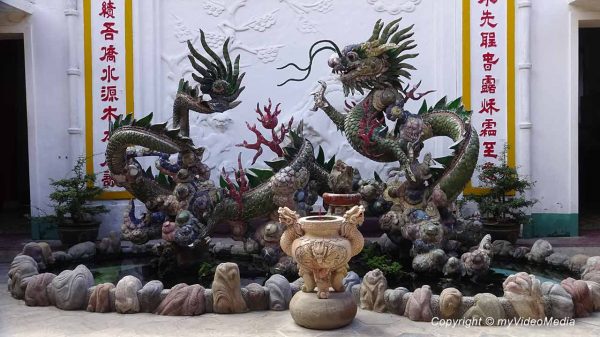
Through a richly ornamented stone gate we reach the inner courtyard with many ornamental plants, statues and a dragon fountain.
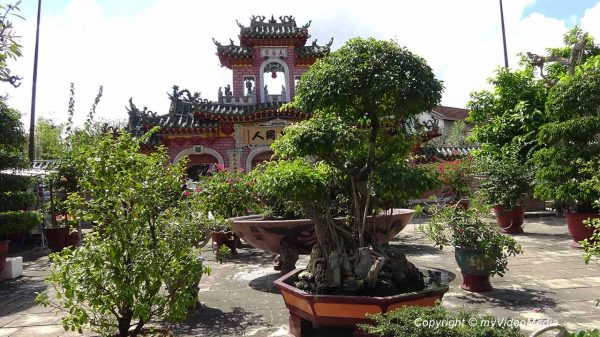
Murals and paintings inside show stories from the Fujian mythology and history. Animals play an important role here. Animal motifs can be found on many of the beautiful carvings, sculptures and wall paintings. The dragon symbolizes the power and the turtle is the symbol for a long life.
A model of a boat recalls the journey of founders to Vietnam.
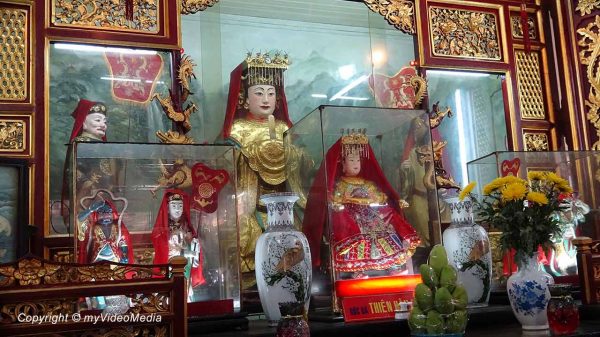
In a glazed altar is the statue of Thien Hau covered with gold leaf. She is accompanied by Thuan Phong Nhi, the goddess who can hear ships from thousands of miles away, and Thien Nhan Ly, the goddess with eagle eyes, who can see ships from the same distance.
The altar in the main hall shows the sitting sculptures of the heads of six families from Fujian. The six families fled from China to Hoi An after the fall of the Ming Dynasty and built the assembly hall. Smaller figures show the successors of the clan leaders.
To the right is the place of worship for the God of Prosperity and the figures of the goddess of fertility, three fairies and twelve midwives. It is said that each of the midwives imparts to the newborn an important ability for his first year of life, e.g. Sucking, smiling. This is why many couples from Hoi An come here to pray for the happiness of their future family.
Toc Tran – Tran Family Chapel
The house of the Tran family is one of the most historic buildings in Hoi An.
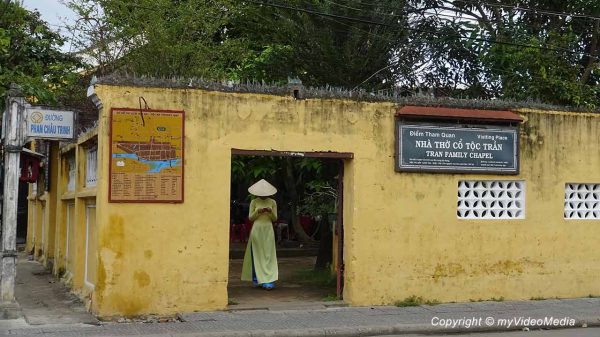
The Tran family came from China to Vietnam around 1700. The chapel was built at the beginning of the 19th century with donations by the family members as a place for the ancestors.
It was built by Tran Tu Nhac, a highly-respected mandarin under the Gia Long reign, before he was sent to China as the King’s envoys.

The architecture is a combination of Chinese, Japanese and Vietnamese styles. The house and the 1500 m2 garden were designed according to Feng Shui rules.

Even today the members of the Tran family meet once a year. In addition to the memory of the deceased, the children are educated about the Tran-clan’s tradition.
The extensive collections, such as porcelain, coins, etc. are exhibited in the rear rooms and accessible to visitors.
In the streets of Hoi An you always have the opportunity to see people performing handicrafts. Especially interesting is a silk embroidery. The young women concentrate fully on their work.
Duc An House
For over 400 years the house has been inhabited by the same family. Today, it is owned by Mr. Phan Ngoc Tram. It is the most beautiful house in Hoi An, as it is not used for the sale of souvenirs, but is preserved in its original form. The décor is characterized by the spirit of the owners. It is also a testimony to Vietnam’s history of the last 100 years.
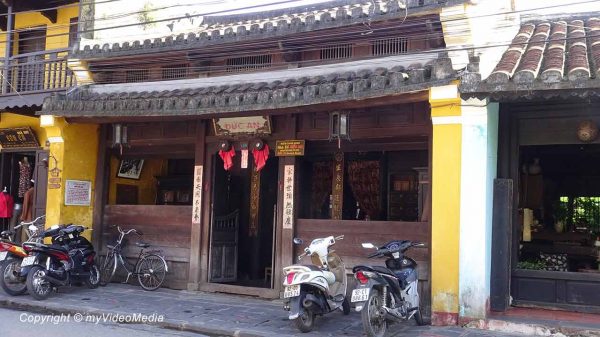
At the beginning of the twentieth century, it was a pharmacy. Through a newspaper and book sale, it rapidly developed into a meeting place for intellectuals, because the works of foreign political thinkers were also sold here.

A circle, advocating the nonviolent independence of Vietnam against the French colonial government formed rapidly. A regular guest in the house was Phan Chu Trinh, originally a Mandarin, later a lawyer, school founder, revolutionary and Vietnamese national hero.
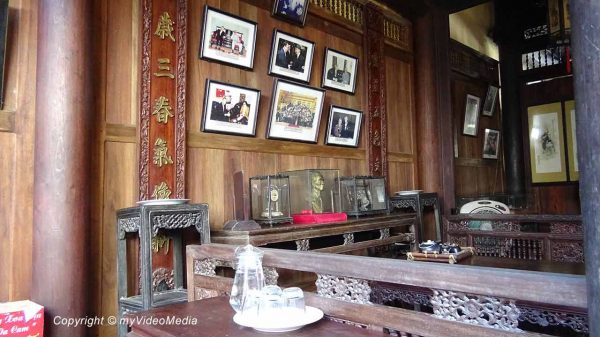
The owner of Duc An was Mr. Cao Hong Lanh. In 1930, he was a founding member of the Communist Party of Vietnam, and in 1957 deputy chief of the Central Committee.Mr. Cao Hong Lanh was also a friend of General Vo Nguyen Giap. For Viet Minh, he organized the guerrilla forces to resist the Japanese. As the commander-in-chief of the North Vietnamese army, he developed tactics for the battle of Dien Bien Phu, which led to the end of the French colonial rule. The German journalist Peter Scholl-Latour called him “Napoleon of the East”. General Vo Nguyen Giap was also responsible for the Tet Offensive, which marked a turning point in the Vietnam War. Later he was Minister of Defense, Deputy Prime Minister, member of the Central Committee, a member of the Political Bureau and national hero.
Tan KY house
The Tan Ky house was built almost 200 years ago. It has been inhabited for 7 generations and is the first private house recognized by the Minister of Culture in 1985, together with two other monuments, as a cultural monument.
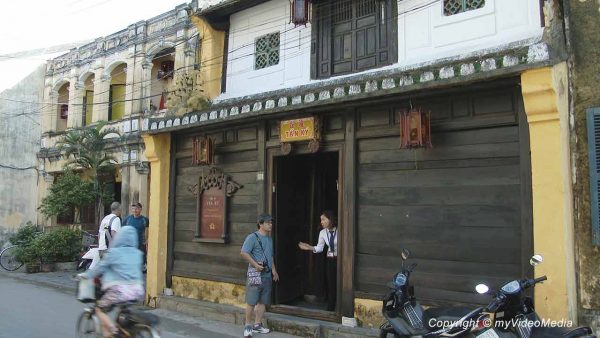
The house is an almost perfect example of a traditional merchant’s residence from the 18th century. During this time, Hoi An was a flourishing port town.
The name Tan Ky means “Progress Shop” and was given to the house by the second generation, to express the wish of the owner for a prosperous business. The furniture and high-quality works of art testify to the good financial situation of the owner.
In the building you find a combination of Vietnamese, Chinese and Japanese architectural styles. Thanks to the double construction and the use of high-quality materials, the house is almost completely preserved. The inside is made of wood and the outside structure made of bricks and tiles. The inner courtyard allows light to enter and provides ventilation. This keeps it warm in winter and cool in summer.
We could only visit the living area and the inner courtyard on the ground floor, as the residents are still living on the second floor.
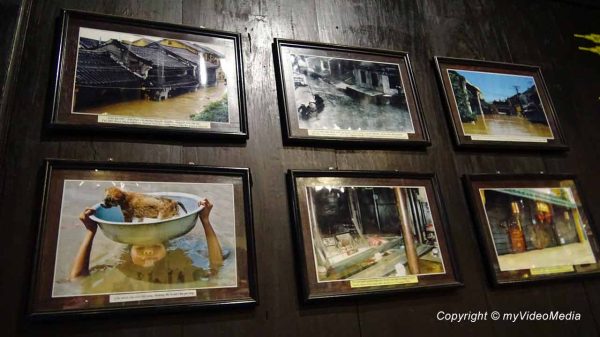
Nevertheless, there are also negative points. The house is located directly on the river and again and again, the river burst its banks and flooded parts of the building, as photos on the wall impressively testify. The worst flooding was in 1964. The level indicators on a wall remind of all these catastrophes.
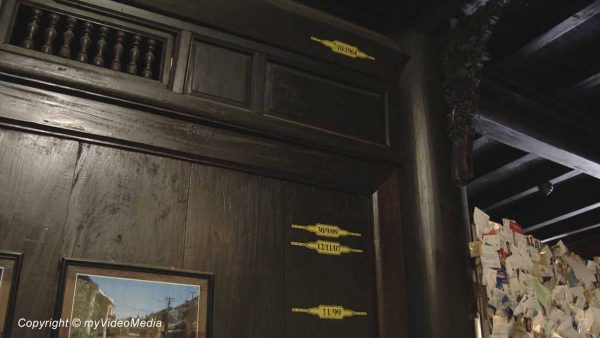
After all the visits we enjoy watching the people and the boats in the harbor. The cheerful colors and the play of the light in the water are a pleasant contrast to the rather dark-shaped dwellings.

Food stalls along the river
After sunset, we try to reveal a secret of the food stalls at the harbor. Usually one cooks on a small gas oven. At the side is a series of stacked plastic boxes. The food stall has 3 to 4 tables which accommodate between 15 and 25 people. The biggest surprise is when you get the menu. The different dishes are listed on several pages. We wonder how it work?
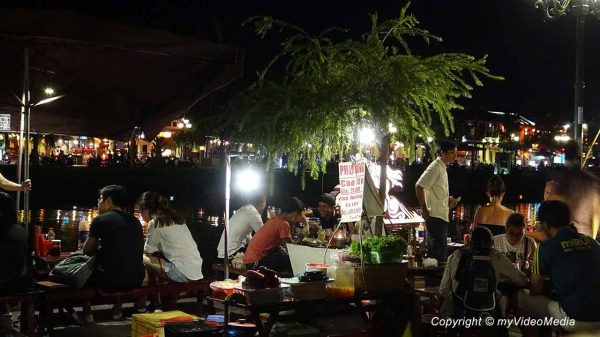
The man takes the orders and hands them over to his wife. (The roles can also be reversed.) Then he disappears. In the meantime, the woman roasts meat or fish. As a rule, beef, pork and poultry are available for meat varieties. Then she takes the stacked boxes and mixes the supplements according to the order. A good portion of the dishes in the menu differ only on the basis of the differently mixed supplements. The woman then serves the finished dishes.
In the meantime, the man reappears and brings dishes from neighborhoods or restaurants, which they do not have in their own offer. At the end of the day, the tables and benches are also packed, which must be brought by each food stall. It tasted excellent. One can only admire the minimalism and the improvisation of the Asians!

Pin it for later
Please read on > A stroll through Hoi An
Text, photos and video: Copyright © myVideoMedia
I’d love to explore Vietnam one day, it looks like an amazing country with such a fascinating culture!
Thanks for your comment.
We can highly recommend to visit Vietnam, we regret that we only spend two weeks there. There is so much to see and the people are very friendly.
Whenever we have the chance to go back to Southeast Asia, Vietnam would be our first choice.