The island of Aegina is the third island in the Saronic Gulf which we visit during our Athens One day Cruise. With 13500 inhabitants it is the biggest of the three islands of Hydra, Poros and Aegina, in population. Accordingly long, the main town stretches along the coast.

The most important source of income besides the tourism is the pistachio cultivation. 3-5 % of the world harvest come from here. In addition, Aegina is a popular summer residence for prosperous Athenians.
History of the island of Aegina
Aegina was already populated in the Minoan culture, 3000 BC. The first coins were minted here in the archaic time, approx. 650 BC. Trade flourished throughout the Mediterranean, particularly with the Etruscans. From 450 BC Athens won more and more important thus diminishing the influence of Aegina. After Aegina supported the Persians in the Persian Wars and was occupied. In the Battle of Salamis they fought on the side of the Athenians. However, they were subsequently attacked by the Athenians and forced into the Delian League.
Please watch the 4k UltraHD Video below
You are currently viewing a placeholder content from YouTube. To access the actual content, click the button below. Please note that doing so will share data with third-party providers.
At the beginning of the Peloponnesian War, the population of Aegina were expelled by the Athenians, in order not to support the Spartans. It was not until the end of the war, that the residents could return. In the Turkish-Venetian war in 1537, the Ottoman fleet, under the command of Hayreddin Barbarossa, attacked the island and killed almost all men and enslaved 6000 women and children.
In 1828, Aegina was for 10 months the capital of the first Greek state before Nafplio took over this role. In Aegina, Ioannis Kapodistrias was sworn in as the first President of Greece.
Temple of Aphaia
By bus we reach the temple of Aphaia, which forms an isosceles triangle with the Olympieion (Temple of Olympian Zeus) in Athens and the Temple of Poseidon at Cape Sounion. Coincidence or planning?
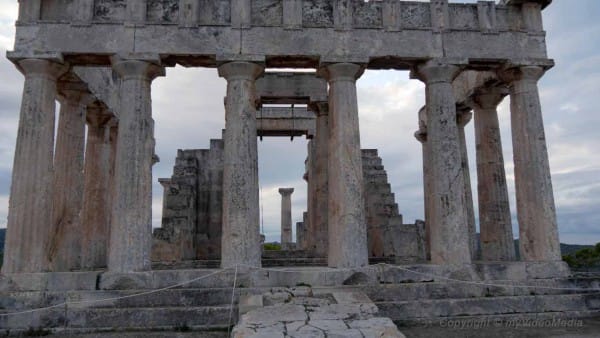
The temple was built around 500 BC. Today, the pedimental sculptures of the Temple of Aphaia are in the Glyptothek of Munich, where their color appearance was investigated. The sculptures are a unique example of the transition from Archaic times to Classicism. They were sold to the Bavarian Crown Prince Ludwig in 1812.
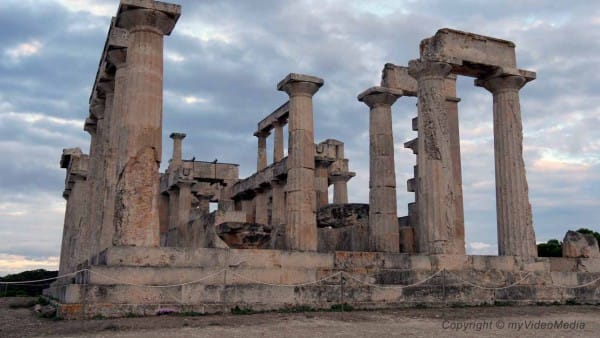
From the temple you have a wonderful view of the Saronic Gulf to Athens.
Cathedral of Saint Nectarios of Aegina
The newly constructed and still not quite completed cathedral is dedicated to recent Orthodox saints Nectarios of Aegina.
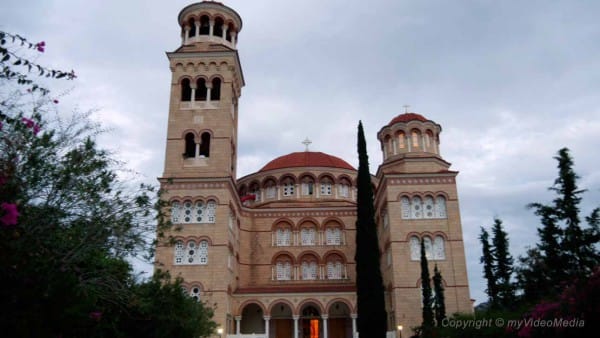
Nectarios of Aegina was canonized in 1961 and his relics are kept in a silver shrine in the cathedral.

After visiting the monastery church, we return to the port and make our way back to Athens.
Disclosure: We were kindly invited by Hydraiki and as always, all opinions about our experiences are our own.
Text, photos and video: Copyright © myVideoMedia