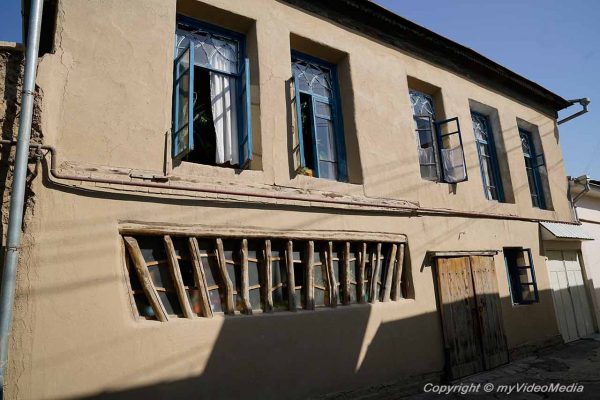
Before visiting the Hazrati Imam Mosque we want to take a look around the old town of Tashkent. Only some of the historical structure which so clearly represents the Orient remained after the earthquake of 1966.
Old town
We enter the neighborhood via Tarix Street, which is traversed by a small canal. High clay walls form narrow street canyons in the side lanes and prevent a view into the courtyards.
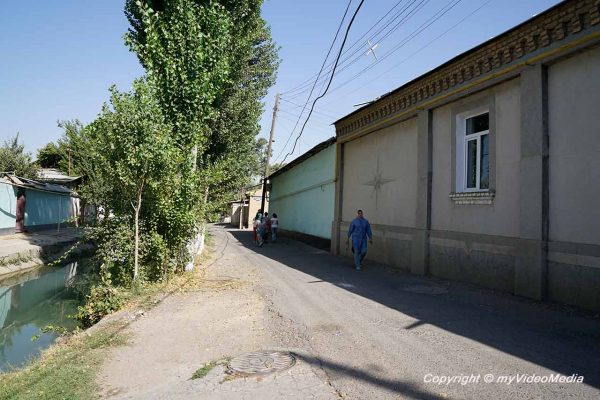
Thanks to our guide Nargiz, we have the opportunity to take a look at some inner courtyards. They have a different designs but give insight into the individual needs of the residents.
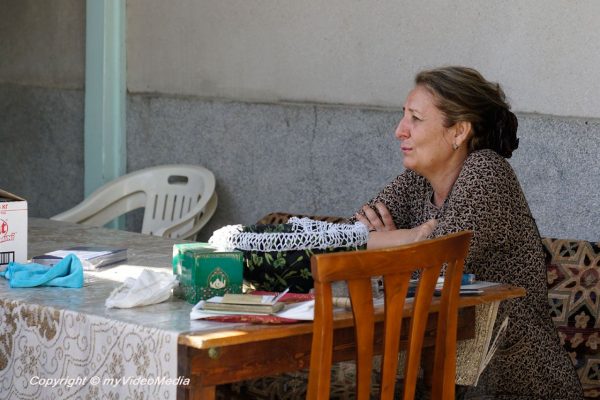
In the first courtyard, we meet a lady who proves a happy hand with her plants. But the animals also seem to be close to her heart. Besides to a dog and chickens, we can even discover a goat in a shed. In the next courtyard is a bed, where they can sleep in the open air during the warm season.

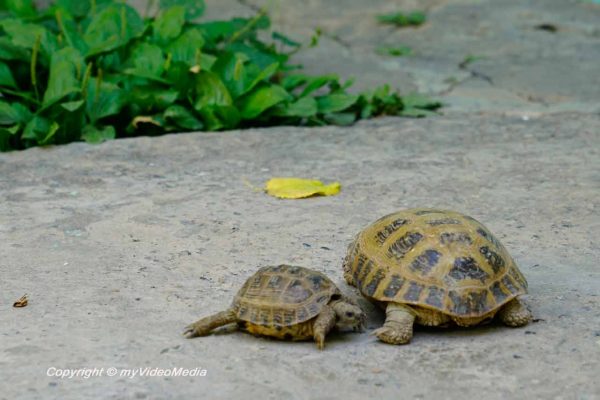
Here turtles enrich life. Also in the next courtyard, we see a bed and a fruit-tree provides shade. Everyone creates himself a little paradise.
Khazrati Imam Complex
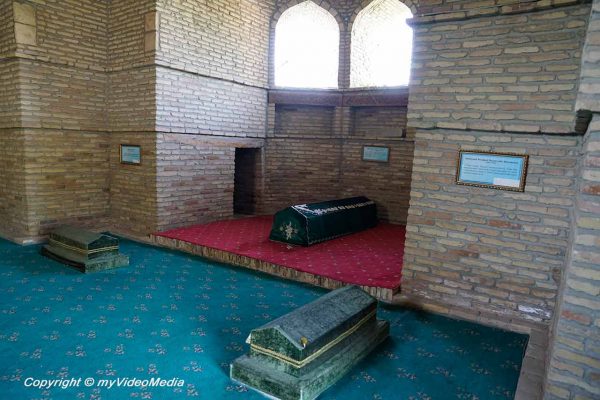
We continue our walk to the mausoleum, built by the 926 AD deceased Imam Abu Bakr Kaffal Shashi. It was erected in 1542 AD for him and some of his disciples. Believing Muslims still come here today to ask for help in emergencies.
Now we arrive at the Muslim center of Central Asia, the Khazrati Imam complex. On the one hand, it consists of the Barak-khan Madrasa, which was originally built as a mausoleum.
Barak-khan (Nauruz-Akhmed), a great-grandson of Ulugh Beg, the Timurid prince of Sarmakand, who has made his name as an astronomer, converted the building into a madrasa. In the Soviet era, all the madrasas were closed. Today, only ten state madrasas are allowed again.
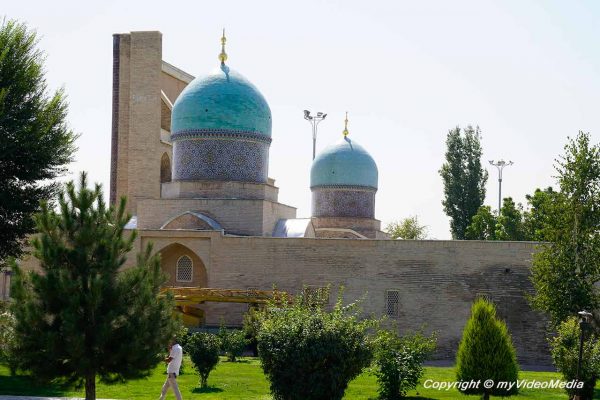
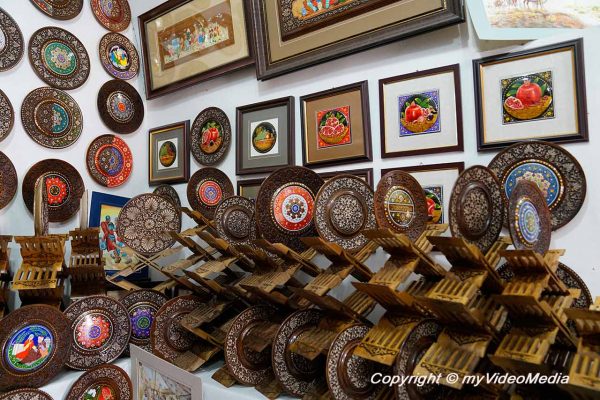
The Imam Al Bukhari Islamic institutes set up next-door is a kind of university for Islamic sciences. It should be noted that the radical Islam is heavily combated in Uzbekistan. The country pursues a secularized line. Due to the Soviet history, there are many residents without religion. The Barak-khan Madrasa is now a retail space for local craftsmen.
In the middle of the complex is the library building of the Muyi Muborak Madrasah. It contains the most valuable part of the complex, the oldest Koran, dating from the 7th century.
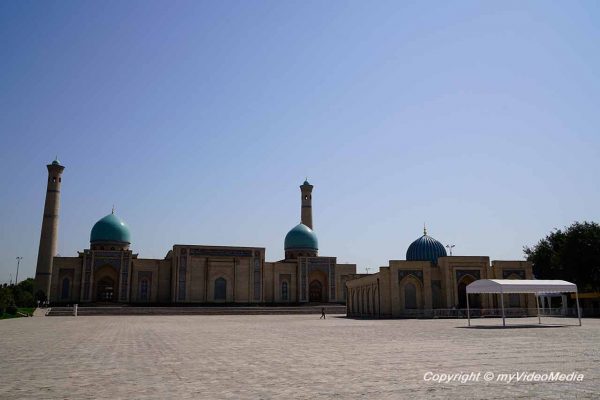
Since we are not allowed to film, we decided not to go inside. Also in the Hazrati Imam Mosque, we are denied shooting, so that we can see the building only from the outside.

We drive on to the new White Mosque. Actually, it is called Minor Mosque, after the district in which it was built. It is the largest mosque in Central Asia. Unfortunately, we are not allowed to film this beautiful architectural building inside. It has a floor area of 17,799 m².
Please watch the 4K UHD video
You are currently viewing a placeholder content from YouTube. To access the actual content, click the button below. Please note that doing so will share data with third-party providers.
More InformationEarthquake Monument
Next station is the earthquake monument commemorating the people who had rebuilt Tashkent. His Stalinist appearance is very reminiscent of the Soviet Union.
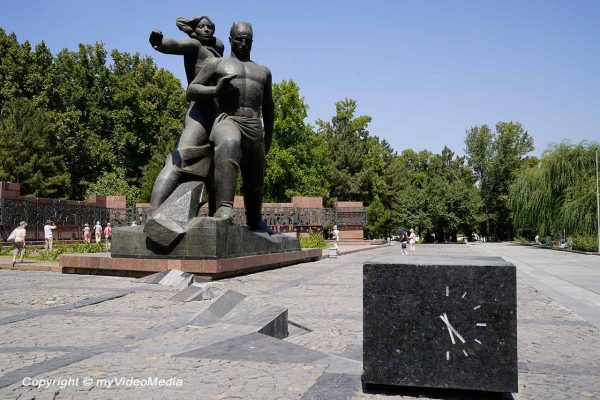
The relief in the background also represents the help of the Soviet brother states. We liked the cracked stone cube, with the date and time of the quake. 100,000 people lost their homes.
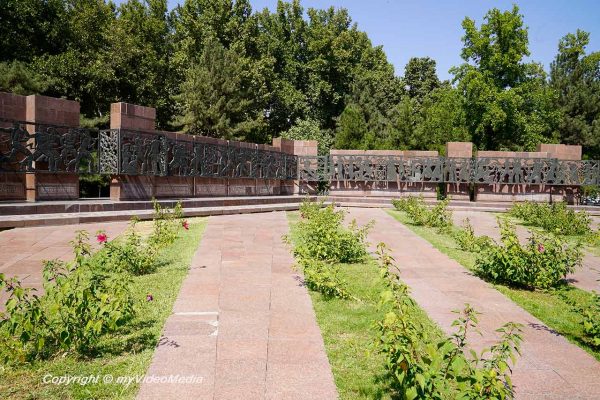
But Uzbekistan took the opportunity to build a modern city center and restore the living space with Soviet aid, in three years. A metro was planned from 1968 and opened in 1977. Since then, two more lines have been added.
Please read on > Museum, Chorsu Bazaar, Theater and 17th floor Bar in Tashkent
Pin it for later
Text, photos and video: Copyright © myVideoMedia