Isan – the original Thailand
The rush of visitors to Thailand grows from year to year, which causes some areas to be hopelessly overrun. We could see the difference very clear when visiting the Royal Palace in Bangkok in 1991 and 2015.
But they still exist, the original regions that are not yet well known to tourists. One region is the Isan, the northeastern region of Thailand, also called Isaan.
The Isan is often referred to as Thailand’s poorhouse. Economically, the region is characterized by agriculture, mainly by rice cultivation. Actually, the region is not particularly suitable for agriculture, as many areas can easily be flooded. The soil is thus very saline, but also drought can often occur. Today one also produces silk and tempts to strengthen the economic power with the help of the tourism in the region.
Please watch the 4K UHD video!!!
You are currently viewing a placeholder content from YouTube. To access the actual content, click the button below. Please note that doing so will share data with third-party providers.
More InformationIn recent years, the Isan has caught up economically strong and migrant residents have partially returned. In spite of the above, Isan is the most authentic region in Thailand for us. Life is more peaceful and people are much more connected to nature, as in other parts of the country.
Population
The economic weakness might be the reason that the Isan was settled relatively late.
To date, little is known about the original settlement of Southeast Asia. There were three big migration flows. The first came from Sri Lanka and India, the second from Polynesia and the third from the north, from China. Isolated archaeological finds, such as in Ban Chiang, already state a settlement 3500 years ago.
The Isan finds its entry in the history books only with the Dvaravati culture, between the 6th and 11th centuries. As of the 9th century, the Cambodians dominated when the old empire Funan disappeared. In 1354, Lan Xang was founded in the region of present-day Laos. The Isan served as a buffer zone between Lan Xiang and the kingdom of Ayutthaya. As of 1694, Lan Xang disintegrated into three single kingdoms. The Siamese kingdom Thonburi, the precursor of today’s Thailand, brought them under its control. After an unsuccessful rebellion in 1828, the Siamese deported more than 100,000 Laotians into the territory of Isan.
In this respect, it does not surprise that the Laotians represent the ethnic majority of the population in Isan today. Due to the strong connection to Thailand, the Laotians in Isan also differ from the Laotians in today’s Laos.
10% of the population, especially in southern Isan, are ethnic Khmer.
National Park Pha team
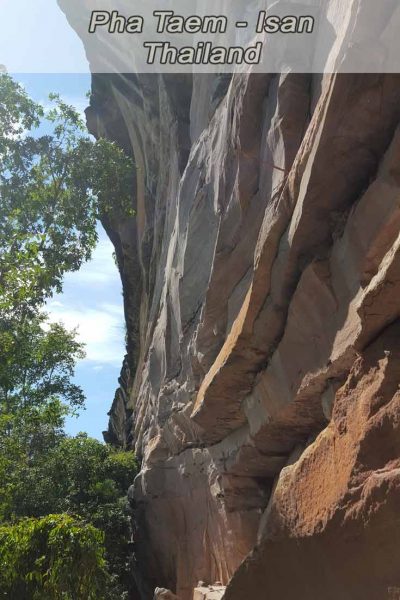
The National Park Pha Taem is located in the province of Ubon Ratchathani, about 100 km east of the city of the same name. Pha Taem is considered as the cradle of Isan and also houses testimonies of an early culture.
It lies on the banks of the Mekong, which forms the border with Laos to the east on a length of 63 km. The park covers an area of 340 km² and is crossed by numerous sandstone rocks.
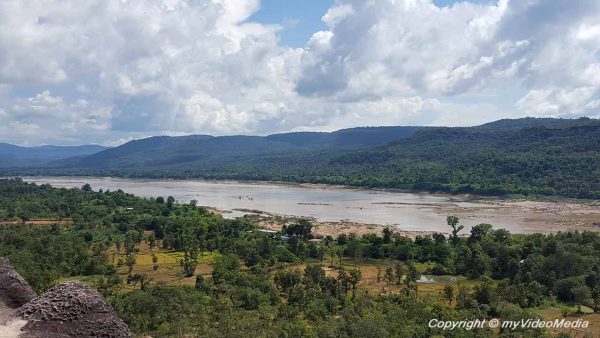
A spectacular sandstone cliff releases the view over the entire river valley.
The biggest attraction is the petroglyphs of Pha Taem. One estimates that the paintings date back 3000 – 4000 years ago. At the foot of the cliff, early inhabitants of this area have recorded their lives for later generations in the form of more than 300 petroglyphs. In addition to humans and animals, tools for fishing are also presented.

Impressive are the depictions of elephants, the Mekong catfish, dogs, and humans. It turns out that not hunter-gatherers traveled here, but that settlers were sedentary. Obviously, they already had enough time to study art. The numerous handprints are probably the precursors of “selfies”.
But even science does not know all the facts. It remains to be clarified whether these settlers are ancestors of the Khmer, the Cham, the Laotians or a completely different ethnic group.

Beside the rock paintings, you see also the Sao Chaliang, striking rock formations. Wind and erosion have formed mushroom-shaped sandstone needles with flat rocks at their tops. One has the feeling to walk through an oversize mushroom cultivation.
In this landscape high above the Mekong, you feel that you are almost alone on this earth and nature is untouched.
The park is open daily from 6-18 o’clock. The visitor center from 8:30 -16: 30. An ideal time to visit is the cool season from October to February.
Two Color River
At the confluence of the Mun River and the Mekong, the two different-colored water mingle in a huge river landscape, where trees also protrude from the water.
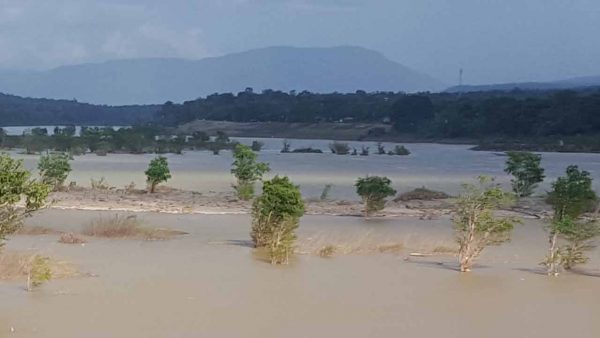
Downstream, the Kaeng Tana National Park includes high cliffs, the Tana rapids, and some waterfalls.
More travel tips for Isan:
- If you visit the province of Udon Thani between October and February, you should drive early in the morning to the Red Lotus Lake in the Kumphawapi district. It is an uplifting feeling to drive by boat on the 36 km² lake through a sea of lotus flowers.
- For those who are interested in history, we recommend a visit to the prehistoric site of a mysterious advanced civilization high culture in Ban Chiang, about 50 km east of Udon Thani. Since 1992, Ban Chiang is listed as UNESCO World Heritage Site.
- Visitors to Loei Province will find Sirila Farm Tent Camp Resort the perfect place to stay in harmony with nature.
Pin it for later
Text, photos and video: Copyright © myVideoMedia