Saalfelden is a town that is heavily influenced by its schools. One such school is the HIB Saalfelden Federal Grammar and Sports School. Located below the picturesque backdrop of Lichtenberg Castle and the Hermitage on Palfen, it sits at the foot of the Steinernes Meer.
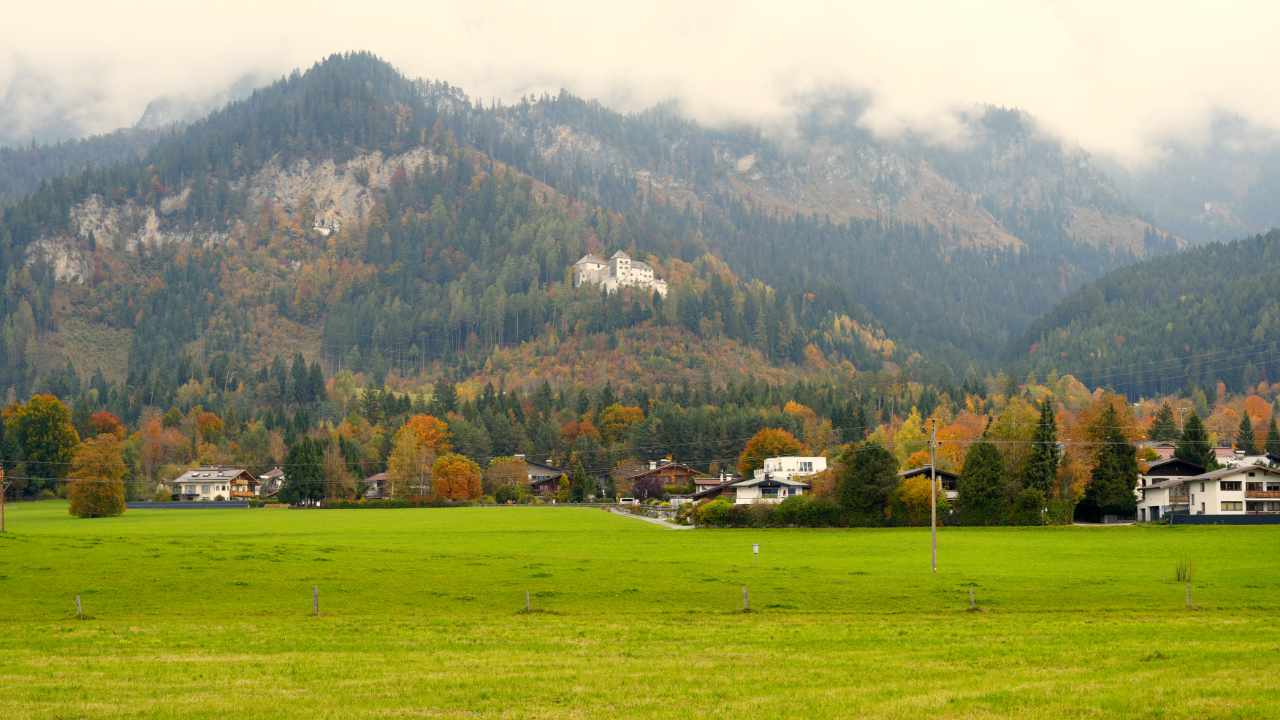
I attended the school from 1964 to 1968. This short break in Pinzgau is a good opportunity to revisit the school. I haven’t seen this place for 57 years. Back then, it was a grammar school for boys specialising in modern languages.

Since 2002, however, it has been divided into three parts and now teaches more than 800 students. There is a high school specialising in languages, a secondary school specialising in sports, and a five-year high school focusing on alpine skiing, freestyle skiing, ski jumping, cross-country skiing, Nordic combined skiing, and biathlon.
Both the school and the boarding school are now open to boys and girls. Many famous athletes have passed through its doors, including Romed Baumann, Stefan Babinsky, Thomas Dreßen, Ricarda Haaser, Florian Dagn, Lisa Hauser, Patrik Koller, Mario Seidl, Marco Wörgötter, Stefan Rettenegger, and Valentina Höller.

Not only athletes, but also entrepreneurs, politicians, journalists, scientists, and more have passed through its doors. This makes the school the second most important winter sports school in Austria after Stamms in Tyrol.
Matěj Švancer is particularly noteworthy. Born in the Czech Republic, he moved to Kaprun with his parents at the age of ten. He is a highly successful freestyler specialising in big air and park & pipe.
A well-known video of him was filmed on the school grounds and is available to watch on YouTube. Freestyle Skiing Through a School :
You can find many more videos on YouTube by searching for HIB Saalfelden.
Prof. Mag. Thomas Wieser, the friendly head of education and president of the TSC-HIB Saalfelden dance club, offered to show us around after we asked if we could film.

We learned that the former indoor swimming pool no longer exists, but several sports and training halls have been built in its place. We were shown the hall of the dance club as well as a new sports hall that can be divided into three separate halls if needed. There are several climbing walls on one wall.

The HIB also has a tennis court, a cross-country skiing center, the Felix Gottwald Ski Jumping Stadium, and its own sports field. There, we can see how eagerly and enthusiastically the students participate in sports. In addition, several other training facilities are available on the Kitzsteinhorn, in Saalbach-Hinterglemm, and in Leogang.
We set off again, as we still want to visit Lake Ritzensee. On the way, we pass the Serbian Orthodox Church, which some people refer to as the “Pearl of Saalfelden.”

In the center, we pass the middle school and the town hall. Saalfelden is also home to the HTL, founded in 1972.

When the weather is good, the center offers a great view of the Sommerstein, the Riemannhaus, and the Peter-Wiechenthaler-Hütte.

Lake Ritzen welcomes us with its relaxed atmosphere. However, our primary interest is the
Ritzen Castle Museum

Since 1968, the museum has housed one of Austria’s largest collections of nativity scenes. Most of these scenes were created by Xandi Schläffer, a renowned nativity scene builder from Saalfelden.

In addition, the museum offers a good overview of the history, culture, and customs of the region. The historical overview, complete with artefacts, extends back to the time of the Celts and Romans, and even to the Copper Age.
Minerals also provide information about the region’s geology. Rotating special exhibitions showcase, for example, paintings and artwork by well-known artists.
Particularly noteworthy among the local customs are the Tresterer, as they mainly appear in the Pinzgau region. Their costumes vary from town to town. Saalfelden, for example, has its own Tresterer group, which performs primarily on January 5th and 6th, going from farm to farm.

Text, photos and video: Copyright © myVideoMedia