Segovia belongs to the three historical metropolises around Madrid, next to Avila and Toledo.
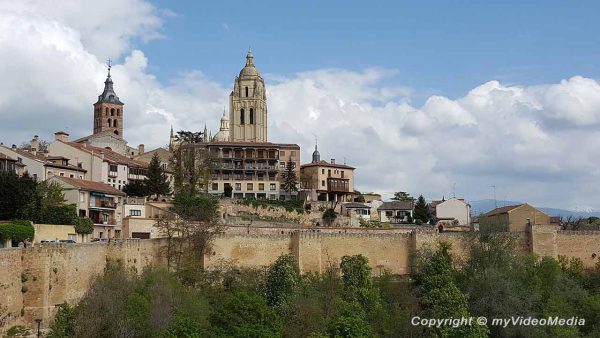
Segovia has a long and varied history that began in the 1st millennium before Christ. From here, the Vaccaei, who settled here already in Celtic-Iberian time, organized their resistance against Romans.
The Romans expanded the city into an important military base. After the decline of the Roman Empire, Segovia became part of the Visigoth kingdom. From 13th to 15th century, Segovia was the royal residence.
Roman Aqueduct
We leave the Plaza Mayor via Calle Cronista Lecea and continue via Calle Serafin, Calle San Facundo, and Calle San Augustin.

We see the mighty Roman aqueduct already from afar.
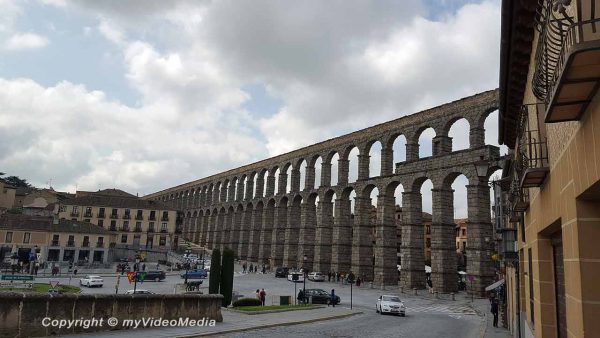
The construction of the Segovia aqueduct was started in the 1st-century A.D. by order of Emperor Domitian and was completed under Emperor Trajan. The aqueduct supplied the city with fresh water from the mountains of the Sierra de Fuenfria, 17 kilometers away.
It was in operation until 1974. The lower row of arches is 18 m high, the highest point is 28 m high. The length is 728 m with 167 arches. The aqueduct consists of 24400 Granite stone blocks that are filled in the core with a mixture of boulders and mortar.

The Segovia Aqueduct is the most important Roman building on the Iberian Peninsula. Since 1985, the Aqueduct and the old city of Segovia belong to the UNESCO World Heritage Sites.
We go back through some side streets until we reach the Calle Juan Bravo.
Hotel Real Sirenas
At the reception of our hotel, Hotel Infanta Isabel, we got the tip, to go to the sister Hotel Real Sirenas.
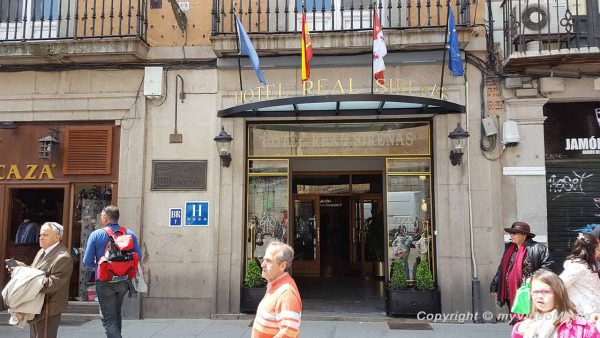
The Hotel Real Sirenas features a rooftop terrace, from which one has a magnificent view of the rooftops of Segovia. Of this, of course, we have convinced ourselves personally and can confirm this.
You are currently viewing a placeholder content from YouTube. To access the actual content, click the button below. Please note that doing so will share data with third-party providers.
More InformationMany thanks the Hotel Real Sirena which grants us the access, although the terrace had been under renovation.
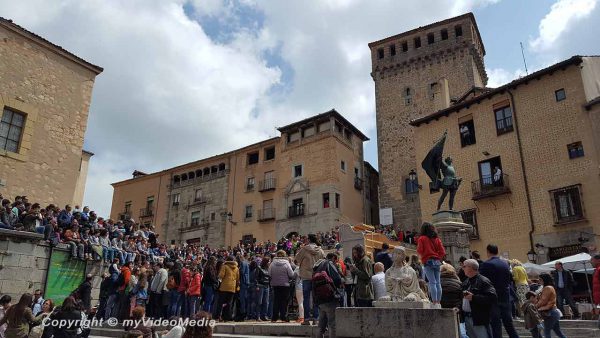
In front of the Iglesia de San Martin, the hustle and bustle of the Puppet festival is in full swing again, so that we have trouble to come back to the Plaza Mayor again.
Once more, we meet the brass band there which we had already seen on the day before. But this time, some members walk on stilts.

We decide to visit some more deserted side streets and go to the Iglesia de la Trinidad and then to the Iglesia de San Esteban.
In former times, the guild meetings took place in the pillared loggia of Iglesia de San Esteban.

On the opposite site is the episcopal palace, Episcopal de Segovia.
We continue through the Paseo de San Juan de la Cruz and arrive at Calle Pozo de la Nieve. From the Mirador del Jardin de Fromkes we have a beautiful view of the valley de Rio Eresma.
Below us is the Real Casa de Moneda de Segovia, the former mint, and the Iglesia de la Veracruz, a former Templar church, and the Monasterio de Santa Maria del Parral.

Alcazar de Segovia
The former royal castle, the Alcazar de Segovia, lies on a ledge and in the direction of the city, it is protected by two mighty towers and a moat. Unfortunately, the towers are surrounded by scaffolding due to renovation works. We have planned to visit the Alcazar the next day.
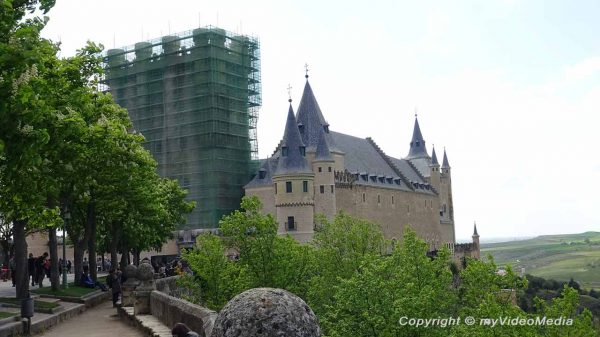
That’s why we go through Ronda de San Juan, back to the Jewish quarter.

From afar we see the still snow-covered slopes of the Iberian mountain range. The ski slopes are well recognizable.
Meeting Blanca
In the evening, we go to a restaurant where we enter into conversation with Blanca and her friend. When Blanca learns about our activity, she is so excited that she necessarily wants to invite us for the weekend to her home and her parents, to show us the real Spain. Unfortunately, this is due to time constraints not possible, so she brings us even serenaded.
On the way back to the hotel, we admire again the illuminated cathedral.
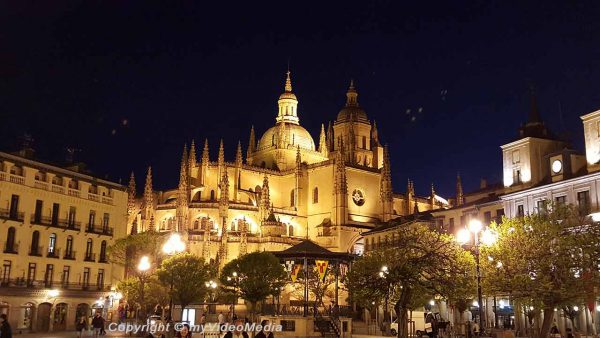
See also Segovia Cathedral and Jewish Quarter
Pin it for later

Text, photos and video: Copyright © myVideoMedia
Looks beautiful, Madrid and surrounding areas are definitely on my list! I’d particularly love to see Segovia Cathedral.
Thank you very much for your comment. Segovia is definitely worth a visit. I would even recommend to stay a bit longer that you do not to miss the Aqueduct and the amazing Alcazar