For a long time, we were looking forward to the visit of our blogger friend Mandy . As it is a sunny day, we use the opportunity to give her a small overview of Trier. The city on the banks of the Moselle is the oldest city in Germany.
Historical overview
Already 3000 years BC, people from the Neolithic Age settled in the area of Trier.
Trier, the name of the city, derives from the Celtic tribe of the Treveri. The Treveri lived in this area already centuries before the Romans. In the course of the conquest of Gaul by Julius Caesar, the Romans occupied the area and subdued the Treveri. Under Emperor Augustus, in 16 BC, the Romans founded the city Augusta Treverorum (English: the City of Augustus in the land of the Treveri).
Not least because of the strategic location, the important north-south connection to the Rhine, the Roman city became a metropolis of the province of Gallia Belgica. The Romans also brought the viticulture and thus wealth to the region.
The city was surrounded by mighty walls. Testimonies of this time are the Amphitheater and the Porta Nigra. From 293 to 392, Trier was the residence was Roman Emperor. Emperor Constantine the Great had his seat of government here for several years. During this time enormous building complexes which at least fragmentary survived the time to this day were built, such as the Basilica of Constantine and the Imperial Baths.
Please watch the 4K UHD video!!!
You are currently viewing a placeholder content from YouTube. To access the actual content, click the button below. Please note that doing so will share data with third-party providers.
More InformationFrom 367 to 392 AD, Trier was the largest city north of the Alps and metropolis of the West Roman Empire, with more than 80,000 inhabitants. After Constantine had moved his residence to Constantinople, Trier remained the seat of the Gallic prefecture.
Vandals, Huns and Franks dominated here later. Also the Vikings destroyed Trier two times. To that Electors and bishops took on the power. In the 30-year war, Spanish and Frenchmen overpowered the city.
The conflicts with the French continued until 1797 and Trier finally became French. In 1814 Prussian troops occupied Trier. Between 1918 and 1930, a French occupation reigned in the city. Later, National Socialists and Americans took over the power. In 1945, France took the place of the Americans as occupying power. Within the following decades, Trier became the most important French military base in Germany. With up to 21,000 soldiers, Trier was the second largest garrison in the world after Paris. In August 1999 the last French soldiers left Trier.
Since 1946, Trier belongs to the federal state Rhineland-Palatinate. University and technological high school form an important backbone of the infrastructure today.
City Walk with Mandy in Trier
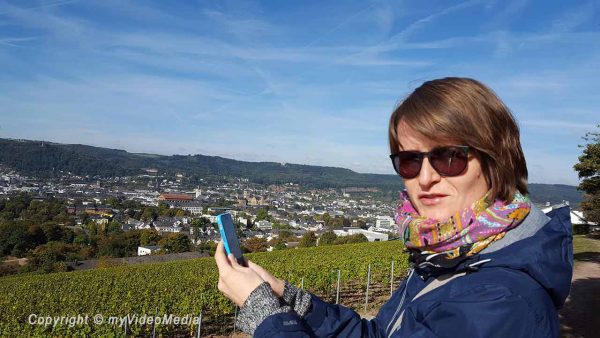
We start our tour with Mandy at the Petersberg, a hill east of the city center. From the visitor terrace, one has the best overview of the city. Besides the view of the famous sights, you can take a look in the Roman amphitheater.
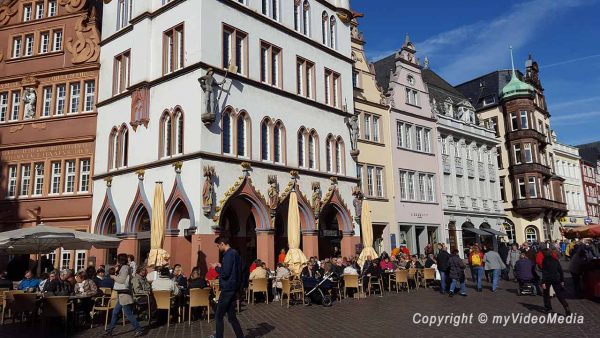
Afterward, we drive to the center of the city and start at the main market. With the erection of the column cross in 958, this square became as a market square. In the Middle Ages, one built the trapezoidal market square around the column cross. The picturesque backdrop of the medieval house facades remains in memory.
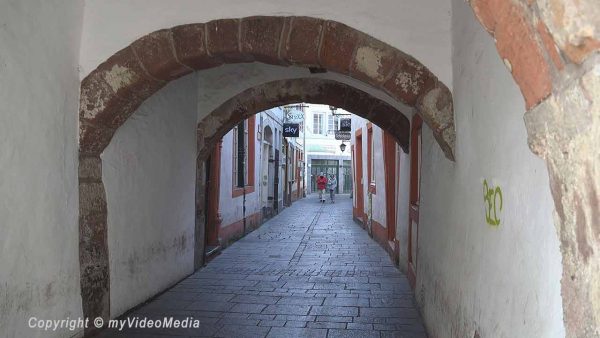
On the way to the Porta Nigra via the Simeonstrasse, we pass the Judengasse, one of the entries to the Jewish quarter.
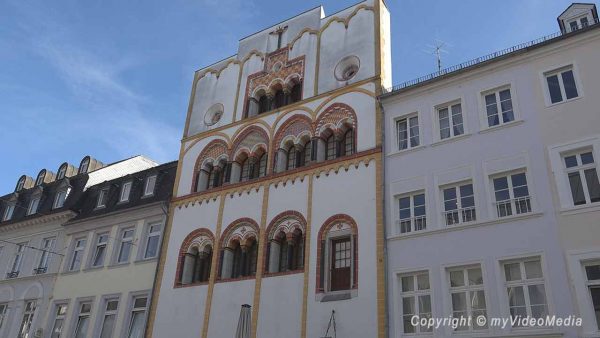
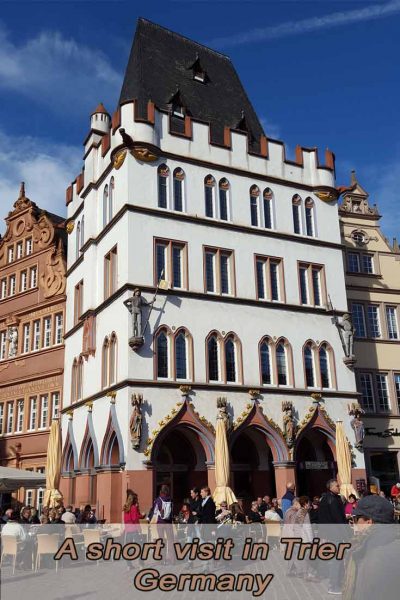
A few meters further, on the opposite side you can see the House of the Three Magi, Dreikönigenhaus. Built in 1230 by a lay judge as a residential tower. The main entrance was on the upper floor, accessible only by ladder or wooden staircase.
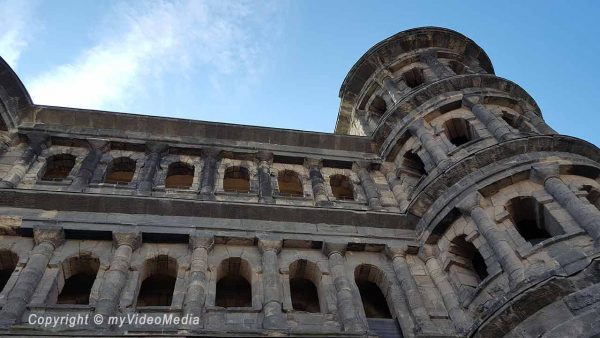
The Porta Nigra, the northern town gate of the Romans, is the only almost complete received city gate. The Porta Nigra is the emblem of Trier. It impresses because of its huge dimensions, 36 m wide, 29.3 m high, and at the towers 21.5 m deep. The Romans built the Porta Nigra without mortar. The huge white sandstone blocks held together by iron cramps.
In the Middle Ages, it was converted into a two-storey collegiate church. Around 1060, a monastery building, the Simeon’s College (German: Simeonstift) was added next to it. The cloister in the courtyard is the oldest cloister in Germany. Today, the Simeon’s College houses part of the Municipal Museum.
We walk back in the direction of the main market and visit the High Cathedral of Saint Peter. It is the oldest bishop’s church in Germany. The present cathedral is only a part of the former Roman church, built on the foundations of the private quarters of the imperial family. Presumably, the building dates back to Helena, the mother of Emperor Constantine, who was already baptized at an early stage. Trier was the center of her life until, at the age of 76, she traveled to Jerusalem to undertake excavations. Her head is today revered as a relic in the Trier Cathedral. Over the years, the church complex was destroyed and rebuilt.
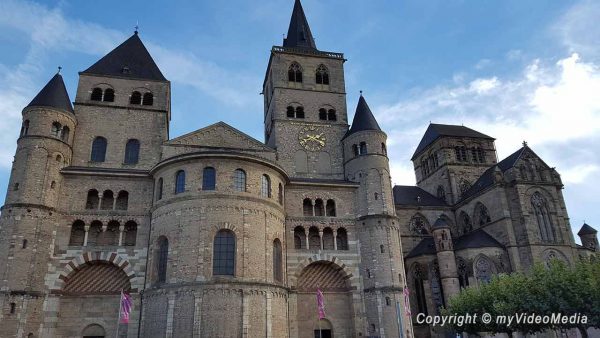
Next to the High Cathedral is the Church of Our Lady, built in 1260 above the eastern part of the ancient South Church. It is one of the oldest Gothic churches in Germany.
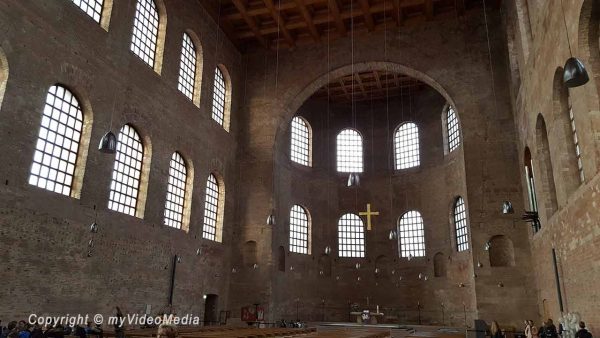
After a short lunch, we visit Basilica of Constantine, the former Roman imperial throne room of Emperor Constantine. Today it is a Protestant church.
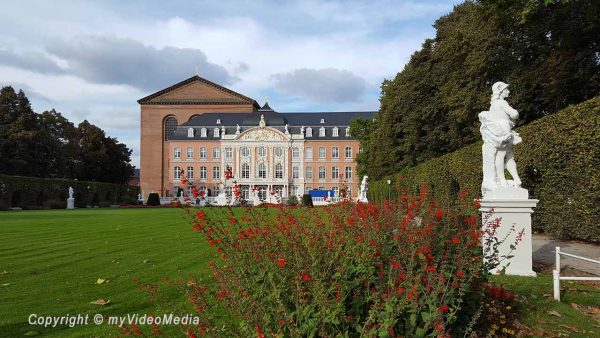
Attached to this is the Electoral Palace, the residence of the Trier Electorate in the 17th century, with the Palace Garden.
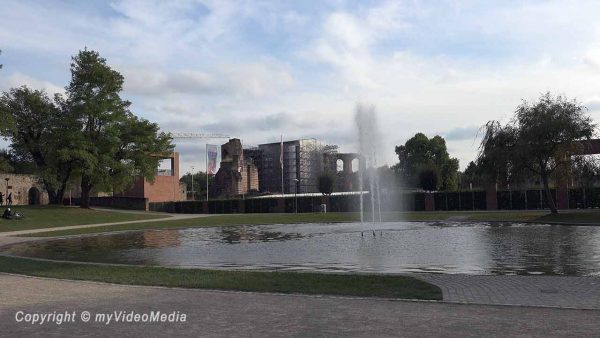
The Imperial Baths lie at the end of the palace garden. These are the remains of a late ancient Roman bathing complex.
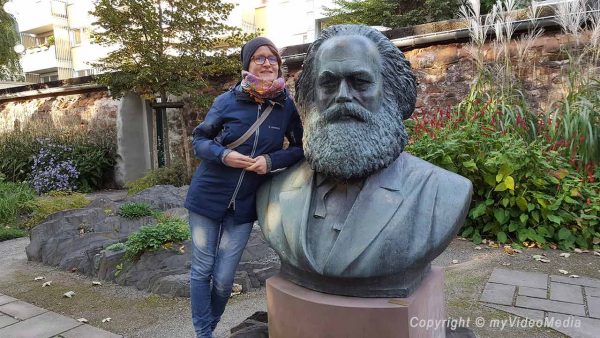
On the way back we take a look at the Roman excavations at the Viehmarkt. We end our tour with the visit to the birthplace of Karl Marx, which is a museum today.
But Trier still has to offer much more. In and around Trier, 9 of the Roman and medieval cultural monuments belong to the UNESCO world cultural heritage. In any case, a further visit is worthwhile.
Pin it for later
Text, photos and video: Copyright © myVideoMedia