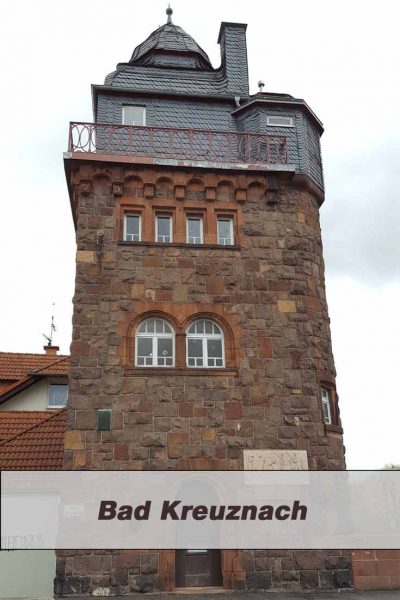
Bad Kreuznach is a spa town in Rhineland-Palatinate with about 50,000 inhabitants.
Historical overview
Already among the Celts, Bad Kreuznach was at the junction of various roads of the Romans. Later, the Romans expanded the town to an important border fortification against the Teutons. In 500, Bad Kreuznach became the royal court of the Franconian empire.
In the Middle Ages, one discovered salty springs, which were later used for the production of salt. Today, they form the basis for curative treatment. After the discovery of radon, a former mine shaft is used for therapy.
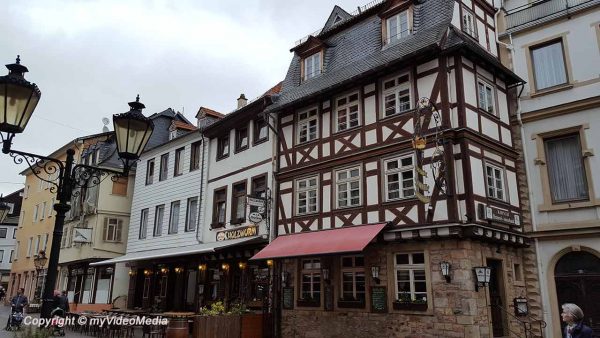
The first trade guilds that today are still reflected in street names, were formed in the Middle Ages. The architectural style of the old Neustadt is still strongly influenced by the Medieval times. Plague, leprosy, and dysentery claimed many victims in the cities. Inheritance disputes of different earls occurred on a daily basis. At that time there was already a significant proportion of 5-6% of the population that was Jewish. But also the first attacks took place.
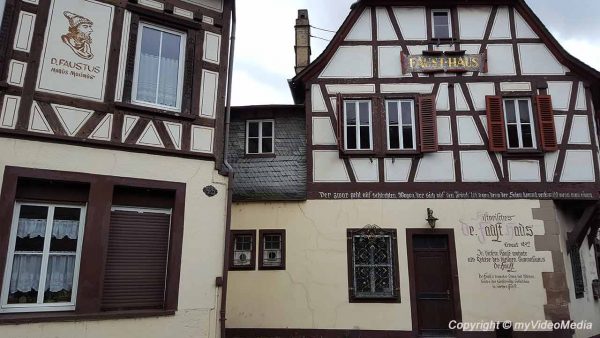
At the beginning of the modern times, master Faust who was immortalized by Goethe stepped on the plan in Bad Kreuznach. He was appointed headmaster of the Latin school in Bad Kreuznach. But after accusations of abuse to boys, he fled from the town. His well-preserved residential building serves as a wine tavern today.
In the Thirty Years’ War, Bad Kreuznach was occupied repeatedly. The total population decreased from 8000 to 3500 citizens.
The Nine Years’ War was followed by the Spanish and Austrian War of Succession. Again and again, floods of the Nahe river caused serious damage to the city.
During the transition from the 18th to the 19th century, the French occupied Bad Kreuznach, only briefly interrupted by Prussian and Austrian troops. Napoleon Bonaparte also visited the city. During the wars of liberation in 1814, Field Marshal Blücher installed his headquarters here. Until the Congress of Vienna, a Bavarian-Austrian Provincial Administration Commission ruled the country. Thereafter, it passed to the Kingdom of Prussia.
In 1843, Karl Marx married in Bad Kreuznach. During the First World War, Emperor Wilhelm II moved his headquarters to Bad Kreuznach in 1917. In the Weimar Republic, the French ruled here again. During World War II Bad Kreuznach was the seat of an Army High Command. All Jewish citizens in the city were deported to Theresienstadt. Despite intense bombings, the peaceful surrender opposite the US Army prevented the complete destruction.
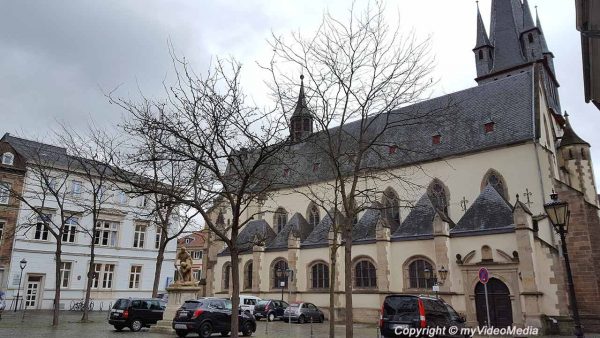
Since then, the city recovered from economic setbacks. In 2009, the federal government awarded Bad Kreuznach the title “place of diversity”. Three Catholic dioceses and three Protestant national churches have their seat here.
Our walk in Bad Kreuznach
Unfortunately, the weather during our visit did not meet our expectations. Still, we have gained an impression of the tolerant diversity in the city, determined by the spa guests and refugees. The old Neustadt architecture presents itself as a medieval town, but has many public WiFi zones, such as at the egg market.
We start our tour at the Kornmarkt (grain market), right next to the pedestrian zone. It is market day and the vendors sell fresh fruit, vegetables, and other agricultural products. A main part of the rich product range comes from regional production.

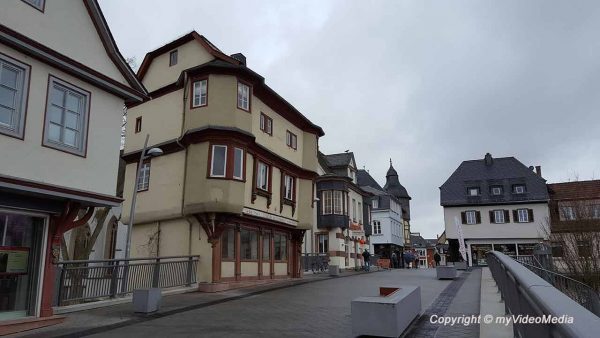
In the extension of the pedestrian zone is the bridge over the Nahe with its famous bridge houses, built directly on the pillars. The bridge houses are the landmarks of the city, something like that is unlikely to exist twice. The various arms of the Near and small channels between have given Bad Kreuznach the epithet “Little Venice”.

Above the Nahe river raise the remains of the old castle, which now house conference hotel and a restaurant with panoramic terrace. On the opposite river bank, beautifully preserved half-timbered houses limit the streets.
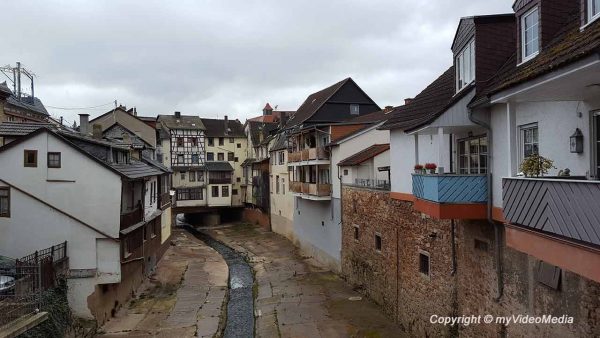
The old Neustadt is separated by the Ellerbach. On both sides of the creek are many remarkable houses, which stand out due to projecting upper floors. We walk through the narrow streets and admire the architecture repeatedly until we reach the Faust House.
Please watch the 4K UHD video
You are currently viewing a placeholder content from YouTube. To access the actual content, click the button below. Please note that doing so will share data with third-party providers.
More InformationWe cross the bridge over the Nahe in the Wilhelmstraße and are rewarded with a beautiful view of the bridge houses.
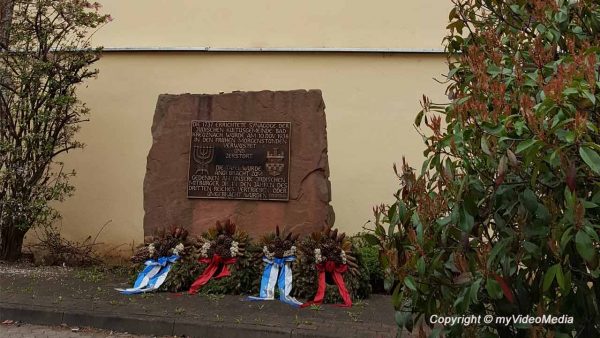
At the crossroads Mühlenstraße and Fährgasse, one had set up a memorial place for the Jewish victims of the National Socialism. It stands on the site of the synagogue, which was destroyed.
Pin it for later