Nantes, the former capital of Brittany, is a French city at the muzzle of the Erdre and the Sèvre into the Loire.
Already Celts and Romans settled in the region. The Bretons came from the British Isles, presumably in the 5th and 6th century. They founded a kingdom which was later destroyed by Charlemagne. The result was a number of duchies. The Duchy of Brittany kept its independence up to the 15th century. Anne of Brittany (1477 – 1514) was born in Nantes and shaped the history of this region as a new future Queen of France.
In 1460 a university was founded in Nantes. The port of Nantes became the most important port in France, last but not least through the flourishing slave trade. The War in the Vendée, which was tantamount to suicide, altered the national consciousness of the Breton’s sustainable. After the second world war, one declared Nantes the capital of the Pays de la Loire region and Loire-Atlantique department.
Today the port has lost his meaning. Nantes houses 55.000 students today. An airbus plant offers 10.000 jobs. Jules Verne was born here and has further bequeathed his imagination to the next generations which is still highly influential on artistic creativity of this city.
The history of the region, the cultural understanding of its people and its artistic creativity making of Nantes an up-and-coming and economically successful city.
Please watch the 4K UHD video
You are currently viewing a placeholder content from YouTube. To access the actual content, click the button below. Please note that doing so will share data with third-party providers.
More InformationWe start a first exploration of the old town near the tourist office in front of the Castle of the Dukes of Brittany, see separate video.

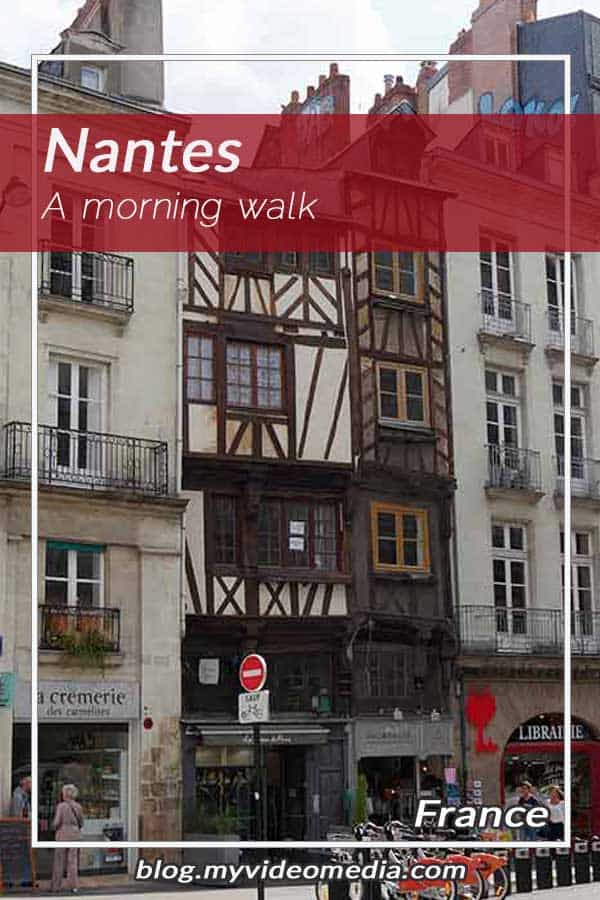
The Rue du Chateau and the Rue de la Juiverie are characterized by numerous cafés and brasseries. The half-timbered buildings give the streets a medieval flair. At the Place du Pilori we stop for a small break.
The lady in the cafe Le Pilori told that this is one of the oldest cafes of the city and draws our attention to one of the art works, which can be discovered on the facades of the house walls and squares along a green line drawn through the city. The facade of the cafe is decorated with a medieval disgrace board.

Past the church of Sainte Croix we reach the Place du Change. A rain shower stopped our stroll and we enjoyed a coffee under an umbrella of a café. From the Place de l’Ecluse the Tour Bretagne (Brittany Tour) stabs us in eye; it is the tallest building in the city.

Past the City Hall, we come to Nantes Cathedral where the parents of Anne of Brittany are buried in an ornate grave. Beside the cathedral you can still see the various street levels of the city over the ages.
Impressive administrative and government buildings frame the Place Maréchal Foch. Via the Course Saint Pierre we go back to the Castle and take a look at the LU Tower. It is the emblem of the former biscuit factory Lefèvre-Utile, better known as LU.

Our morning walk ends at the statue of Anne of Brittany.
See also
Pin it for later
Text, photos and video: Copyright © myVideoMedia