Ho Chí Minh was born as son of a teacher in poor conditions on May 19, 1890. But already in his early youth, he developed an aversion to the French colonialists.
A peasant demonstration in Hue, where he acted as interpreter, ended in the hail of bullets of French soldiers. As rebel he was expelled from school and went to Saigon, where he signed up on a ship to get to know France.

During the next years he also went to New York, Boston and London, before he returned to France again. There he joined the Socialist Party of France. He and his comrades-in-arms published a petition in 1918 that demanded more rights for the colonies in Indochina. In 1920 Ho Chi Minh was among the founding members of the French Communist Party.
After a stay in Moscow, where he studied at the Communist University, he went to China. At the Whampoa Military Academy in Guangzhou he gave lectures on politics. Later, he was a leading coauthor of a guide for communist insurgencies. Afterwards, he was sentenced to death in absentia by the French colonial authorities.
In 1941, he traveled back to Vietnam and founded the Viet Minh, the League for the Independence of Vietnam. They fought against the Japanese and French occupying powers.
Supported by the national Chinese, Ho Chi Minh exclaimed the democratic republic of Vietnam in Hanoi on September 2nd, 1945 after the Viet Minh had taken the cities of Hanoi, Hue and Saigon.
Please watch the 4K UHD video!!!
You are currently viewing a placeholder content from YouTube. To access the actual content, click the button below. Please note that doing so will share data with third-party providers.
More InformationWith the bombardment of Haiphong by French troops where 6,000 civilians have become victims, the Indochina war began in 1954 and ended with the departure of the French.
The Geneva Geneva Conference brought a cease-fire, which provided a division of Vietnam at the 17th parallel. After two years, a government for the entire Vietnam should be elected.

But the US never felt tied to the agreement and thwarted the election because they feared that whole Southeast Asia could become Communist. Ho Chi Minh was always the driving force for the unification of Vietnam.
When the United States intervened actively in 1965 in the fighting, which led to the Vietnam War, Ho Chi Minh planned the Ho Chi Minh trail through Laos.
This traffic system, also known as Truong Son road ensured the military supplies of the South to the North. Ho Chi Minh died in 1969 and has not experienced the independence of a united Vietnam.

His persistent farsighted commitment to his country and his personal modesty, that he not only preached but also exemplified, resulted in a wide popularity among the people. So it is not surprising that he is revered as the father of the nation, and the admiration for him still lasts today.
Ho Chí Minh House
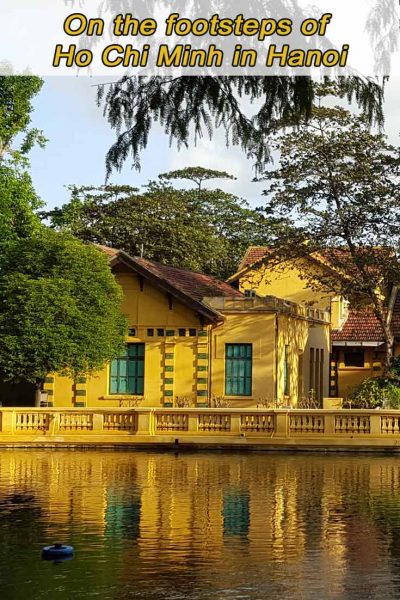
Right next to the government building, built in the colonial style by the French, Ho Chi Minh had lived and worked in several small sparsely furnished rooms.

Today, you can have a look through the windows.

The property is located on a small pond in a beautiful location.
Later, Ho Chi Minh had built a new house on the other side of the pond. It can more likely be described as small.

Transparent glass walls give anywhere insight from outside. On the ground floor is a conference room.
On the first floor are the living and sleeping areas, and a small office.

Next to the building there is a small pavilion which served as guest accommodation. Again, a glimpse is offered through the windows everywhere.
Ho Chí Minh Mausoleum
The mausoleum for Ho Chi Minh, built in the style of the Stalin Mausoleum on Red Square in Moscow, was built at the edge of a large parade ground (Quang truong Ba Dinh).
It contradicts his last will, because he wanted to be incinerated and his ashes should be spread over Vietnam.

Ho Chí Minh Museum
Not far away is a colossal museum, erected to honor Ho Chi Minh.

Apart from symbolic representations of stages of his life, such as his parents’ home you will find here extensive documents on his work.

Newspaper clippings and original documents, as well as extensive photo material. But worth seeing are mainly original movies that are broadcast on screens.
One Pillar Pagoda
Next to the museum you can see a small temple, the One Pillar Pagoda (Chùa Mot Cot). It is one of the oldest pagodas in Hanoi and a landmark of the city.

It was built in 1049 by King Ly Thai Tong and originally stood on a pole. In 1954 the pole was beyond redemption and replaced by a concrete column.
Please read on > Temple of Literature
Text, photos and video: Copyright © myVideoMedia
Great post and videos about the Ho Chi Minh complex. I agree there are many thing to see and history lessons to learn there. I like this post of you. Thank you very much!