Two parallel one-way streets characterize the cityscape of Osh. The Lenin Avenue runs from south to north and the Kurmanjan-Datka Street from north to south.
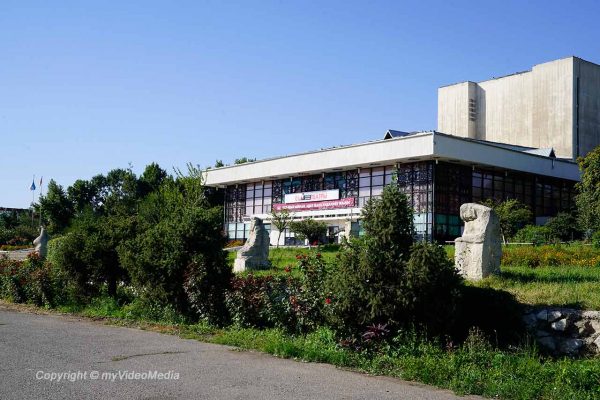
We begin our stroll through the city of Osh at the Kyrgyz Drama Theater on Lenin Avenue. For us, it is not quite clear whether the building serves only as a theater or also as a concert hall, opera and cinema.
In the next crossroads, the Bayalinova is a Demir Bank. The cash dispensers (ATM) accept also international credit cards here. We walk along Lenin Avenue and pass a number of small shops.
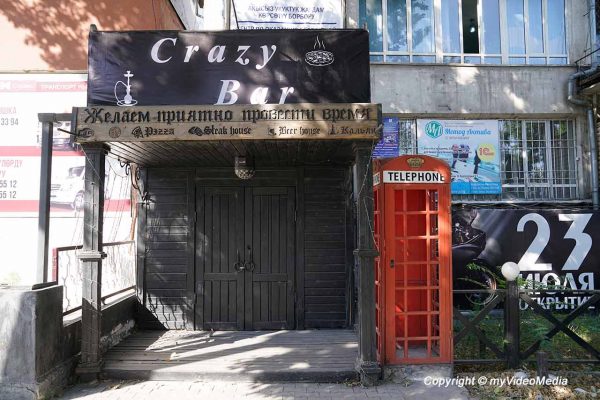
As a British telephone booth got here, will be a mystery to us. Although the houses show a little need for renovation from the outside, the inside is very modern.
Please watch the 4K UHD video!!!
You are currently viewing a placeholder content from YouTube. To access the actual content, click the button below. Please note that doing so will share data with third-party providers.
More InformationAfter a few hundred meters we pass the Kirov Secondary School No. 4. It seems to be a fairly large school, with 3,000 pupils. Opposite is the old town hall, today the municipal court. At the crossroads, to Gapar Aytiev we come across the Asian bank.
Almost every cross street offers a nice view of the Sulaiman-Too.
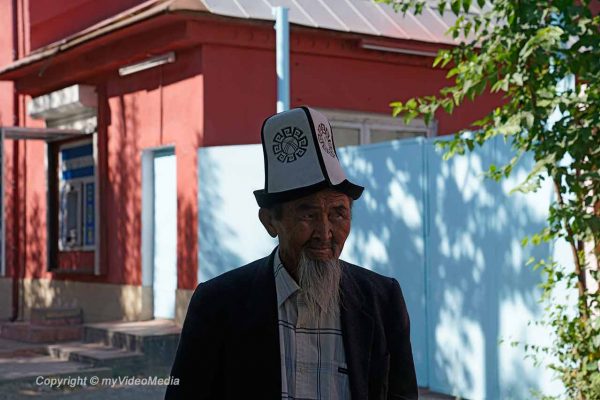
The Kyrgyz men with their headgears were proud when we photographed and filmed them.
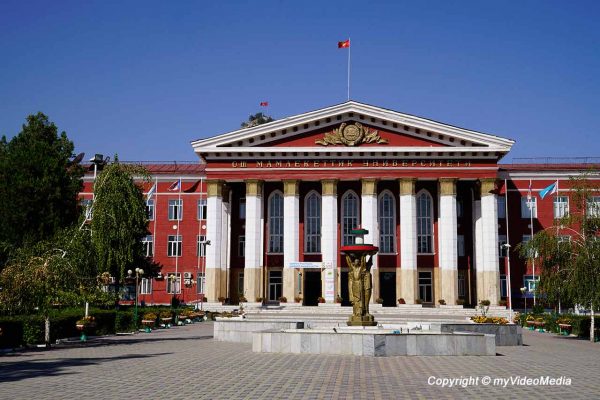
One of the most prominent buildings of the city stands on the left side of the street now, the university. The red buildings whose entrance with its column portal, following the Greek style, determines the street in this area. On the opposite side is the entrance to an amusement park, which we will visit on another day. Further northwards is the Academy theater.
We arrive just in time to see a photo shooting. As we start filming, the young women who assist the photographer turn to us. They wave and smile into the camera and are obviously pleased to be once in front of and not permanently behind the camera.
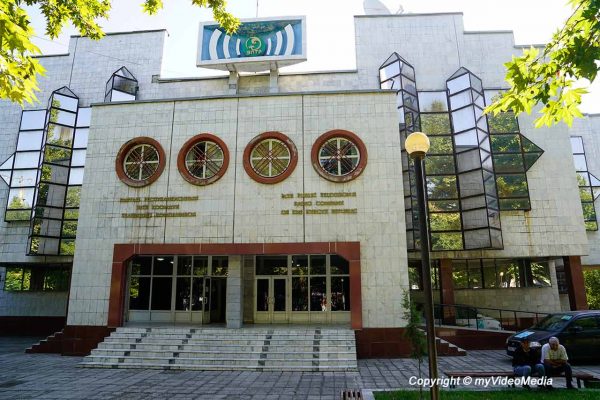
To the north are the regional headquarters of the Kyrgyz Telecom and the Public Television and Radio Company.
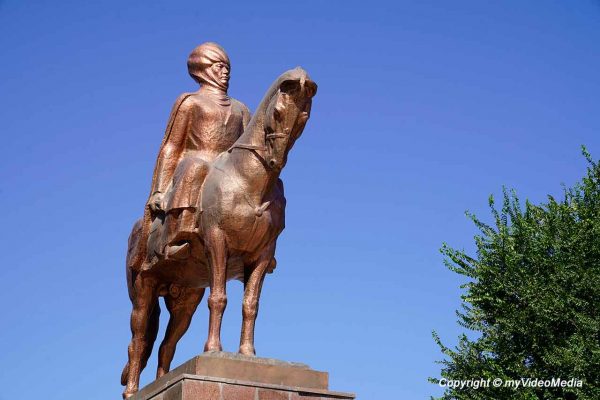
On the left side of the road is a small park with the statue of Kurmanjan Datka, after which the parallel road is named. She lived from 1811 to 1907 and was also recognized as a ruler in Bukhara and Samarkand. Even so, she had to convince her people of the sovereignty of the Russians.
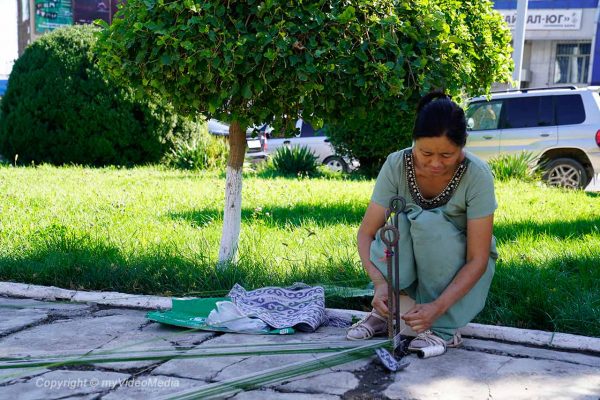
In the park, a woman with her children has set up a workplace and weaves different fabrics and ribbons.
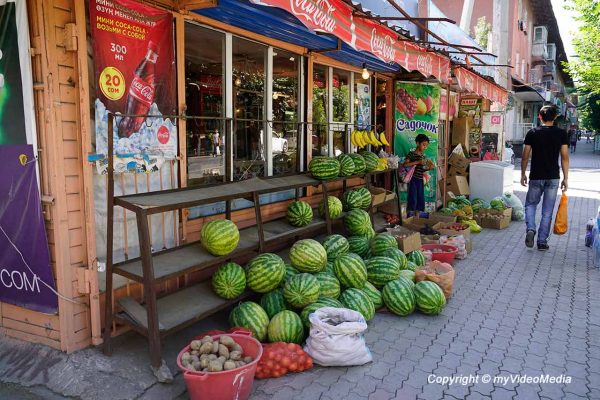
Further right we would reach the bazaar, but we will visit it later. We turn left into Alisher Navoi and then into Kurmanjan-Datka Street. Everywhere you can buy fresh watermelons.
By the way, one should never eat watermelons and then drink water. Nausea, vomiting, and even fever may be the consequence.
In front of the library, one has laid out a pretty little park with the statue of a musician. We watch the people and are happy if they let themselves be filmed.
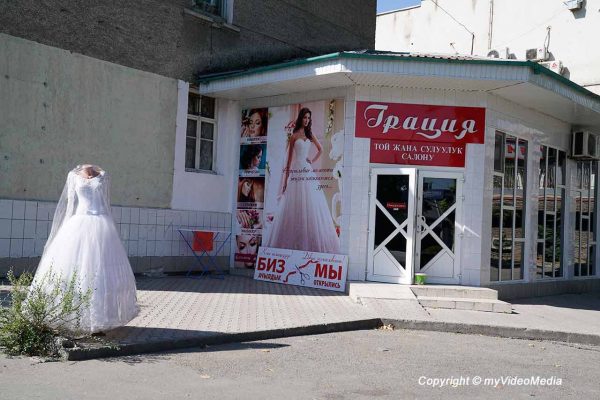
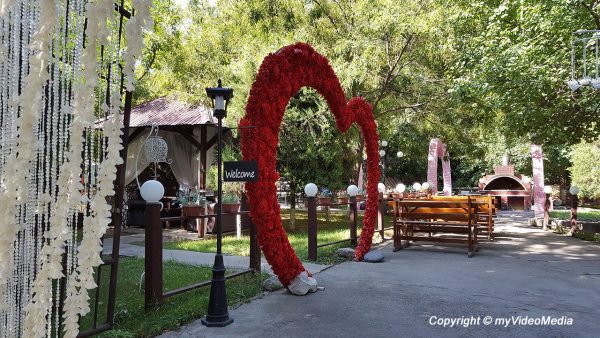
In the meantime, we have understood that the wedding is the most important event in the life of the Central Asian people. We see bridal fashion stores at almost every corner. The decoration of a restaurant demonstrates the focus on the special needs of wedding guests.
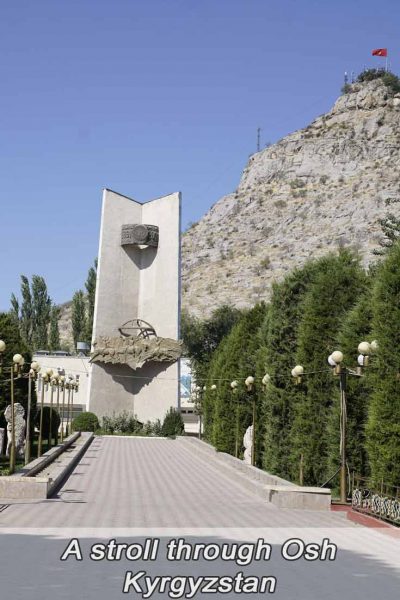
Just beside, at the foot of the Sulaiman-Too hill is the National Museum. Among other things, one exhibits the petroglyphs that were found here.
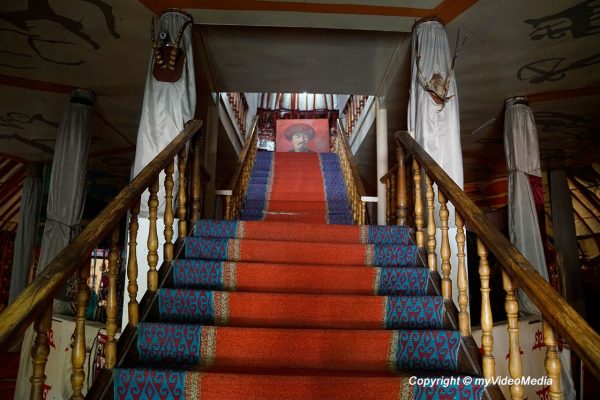
We meet our friend Eithne again. Together we visit a three-story yurt. It is a kind of museum of local history and culture and shows what is important to the Kyrgyz people. From the third floor, you have a nice view of the park.
After this visit, we go to the Jayma bazaar, considered one of the largest in Central Asia.
Tip:
You like to experience the best of Osh in a short time? Reserve your place at the Osh Free Walking Tour
Please read on > Wedding Season in Osh
Pin it for later
Text, photos and video: Copyright © myVideoMedia