The Aachen Cathedral, also known as St Mary’s Church, is the bishop’s church and, next to the town hall, the city’s most significant landmark.
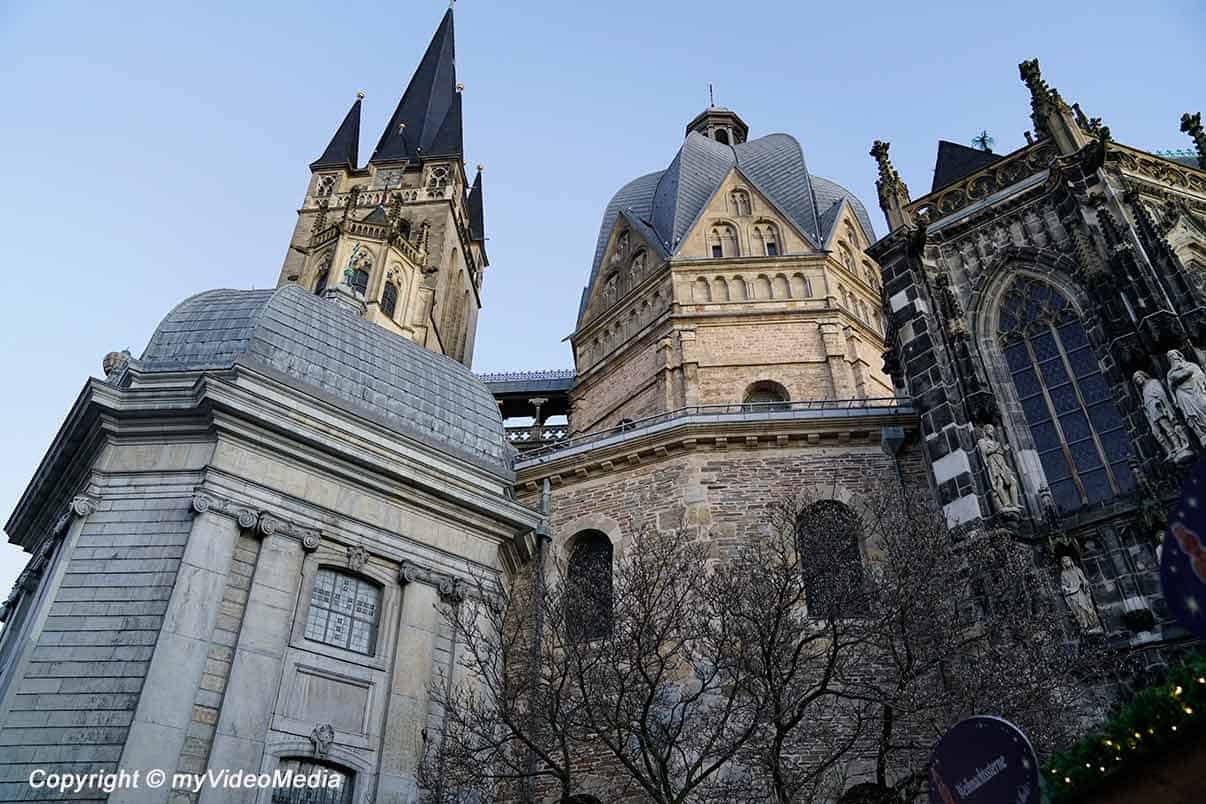
The cathedral was built by Charlemagne, who had the central building, the Carolingian octagon, and the western part built as the Palatinate Chapel of the Aachen Royal Palatinate.
The foundation stone was laid in 795, the completion in 803. Later, one added the Gothic choir hall and the various chapels, grouped around the octagon. The cathedral stands on the remains of a Roman thermal bath.
From 936 to 1531, the cathedral was the coronation site of Roman-German kings. Today it is a bishop’s see and place of pilgrimage. Since 1930 it serves as a cathedral.
Westwork
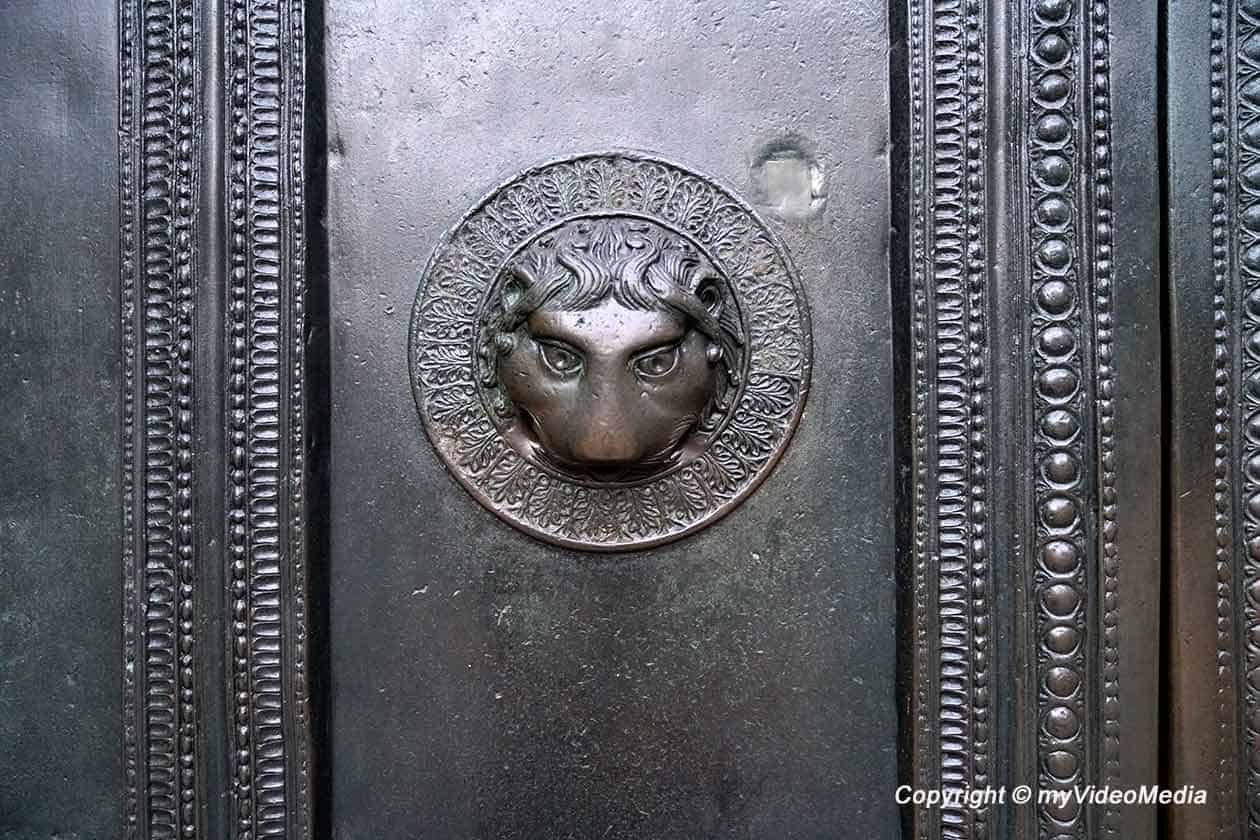
The main entrance is a 4.3-ton bronze door, the Wolf’s Door, cast around 800 in Aachen. One of the joints is still an original 1200-year-old ball bearing!
However, one usually enters the Aachen Cathedral via a side entrance. In the vestibule, is a bronze she-bear, dating back to the 3rd century BC. The byzantine style she-bear originates from Rome.
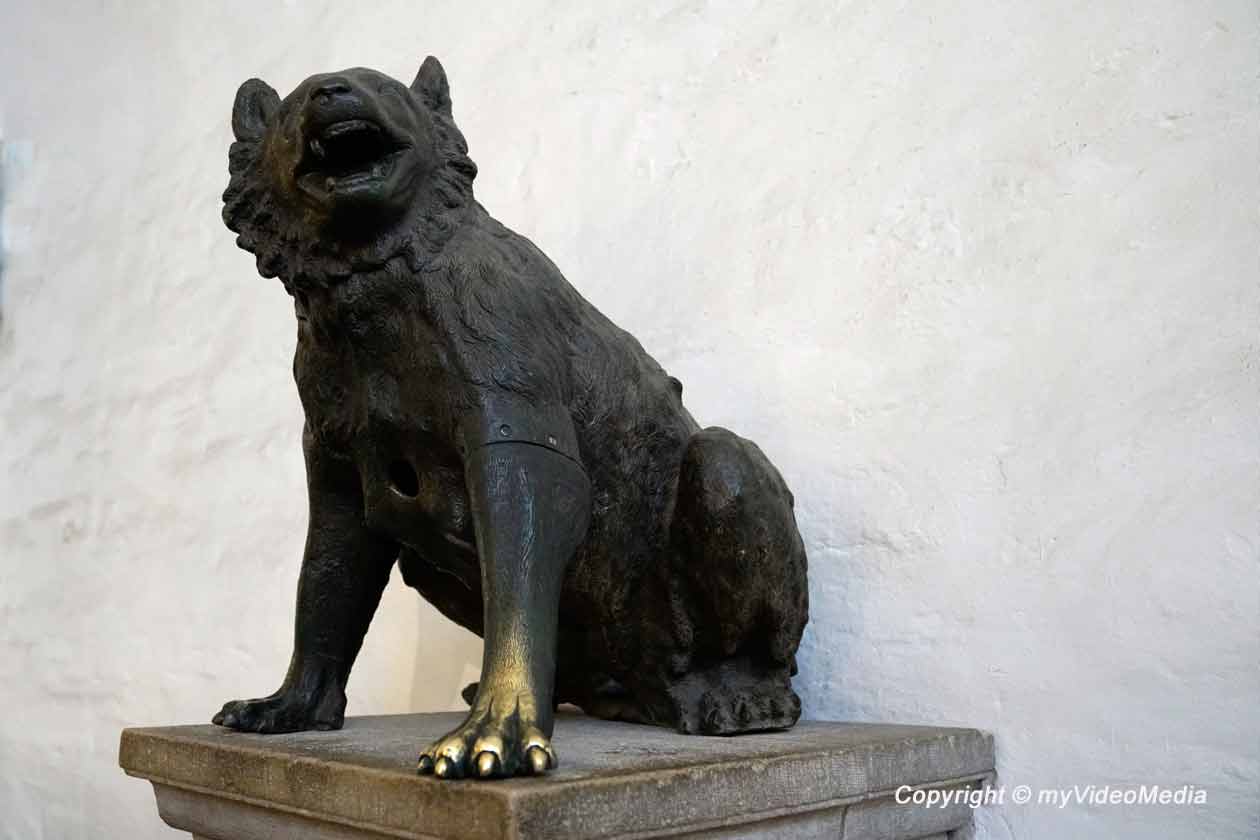
Together with the lion’s heads on the entrance door, they show the will of Charlemagne from Aachen to create a second Rome and a new Roman Empire.
The Octagon
Then you enter the central area, the octagon with a dome height of 31 m and a two-story perimeter colonnade. The ideal dimensions of the octagon are based on the dimensions of ancient Jerusalem.
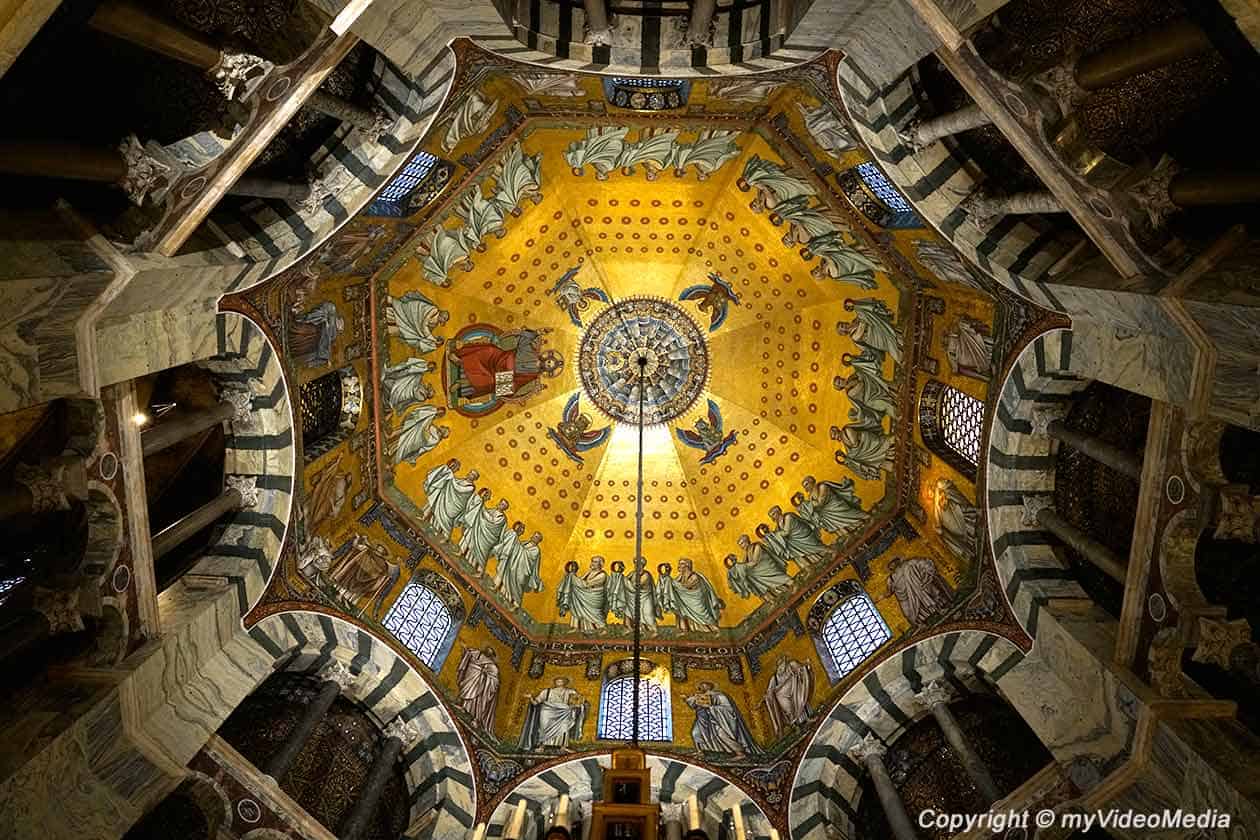
The dome mosaic was recreated in 1880/81 in the Neo-Byzantine style by the Belgian architect Jean-Baptiste Bethune and the Venetian workshop of Antonio Salviati.

In the center of the dome hangs the Barbarossa chandelier, a wheel chandelier on a 27-meter chain. It was commissioned and donated by Emperor Frederick I, called Barbarossa, between 1165 and 1170. The Barbarossa Chandelier symbolizes the city wall of Jerusalem.
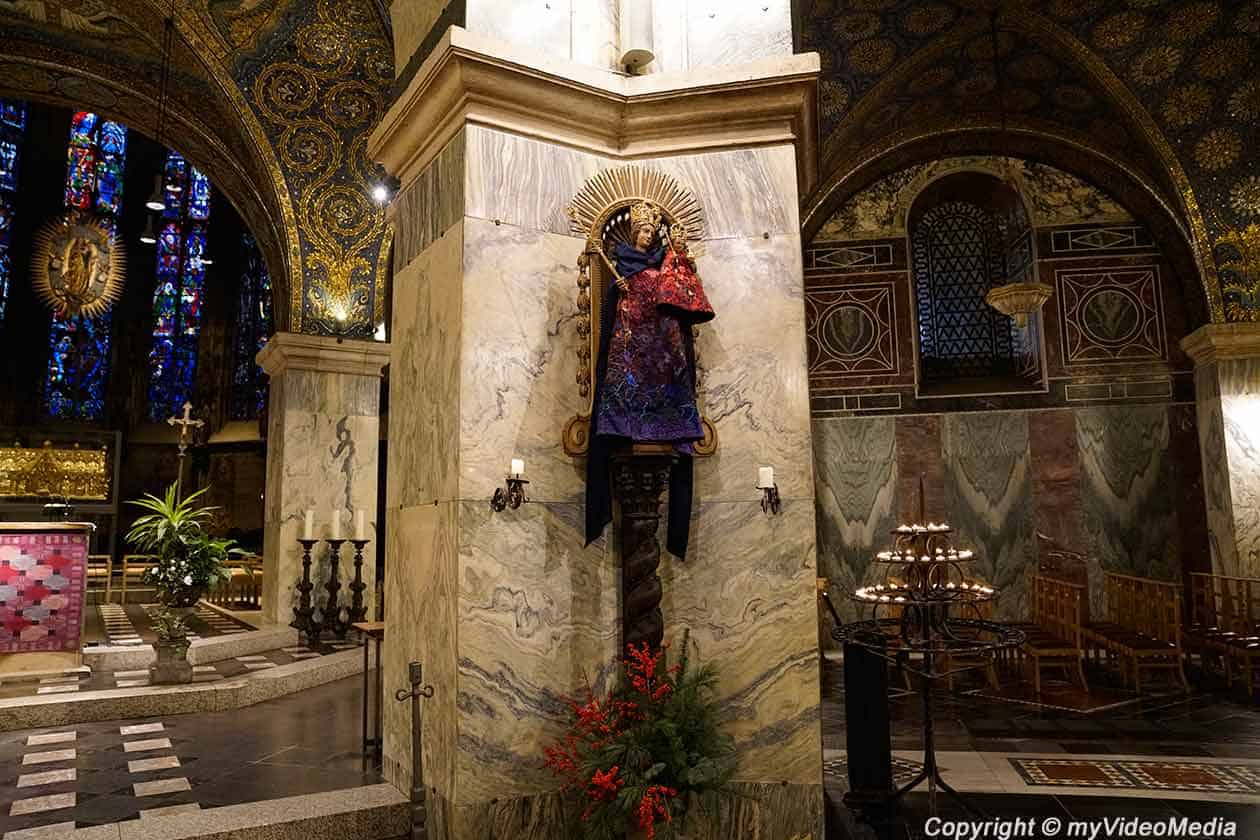
On a pillar next to the altar there is the miraculous image of the name-giving Madonna and Child.
High altar and Gothic choir hall
At the end face of the octagon is the sanctuary and, behind it, the choir hall with its phenomenal glass windows. It was built in the 14th century to keep the relics.
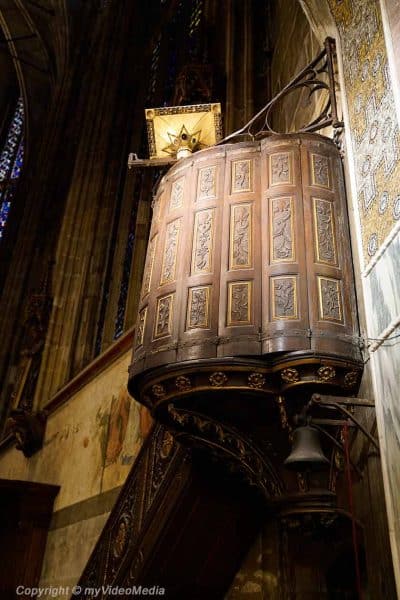
The pulpit (Ambon), manufactured between 1002 and 1014, was donated by Heinrich II. After completion of the choir room, one moved the Pulpit of Henry II, with its filigree work made of agate, ivory, and copper, as well as a large number of precious stones to the south side of the choir room.
Many altars have already been erected in the cathedral, some of them donated or destroyed in the event of catastrophes. After all that, one had set up the original altar, made of marble slabs from the time of Charlemagne again. The front now adorns the Pala d’oro (covered during our visit). Five of these gold reliefs were probably created in Fulda around 1020 and are probably a foundation of Otto III. Emperor Heinrich II had added the remaining seven panels.
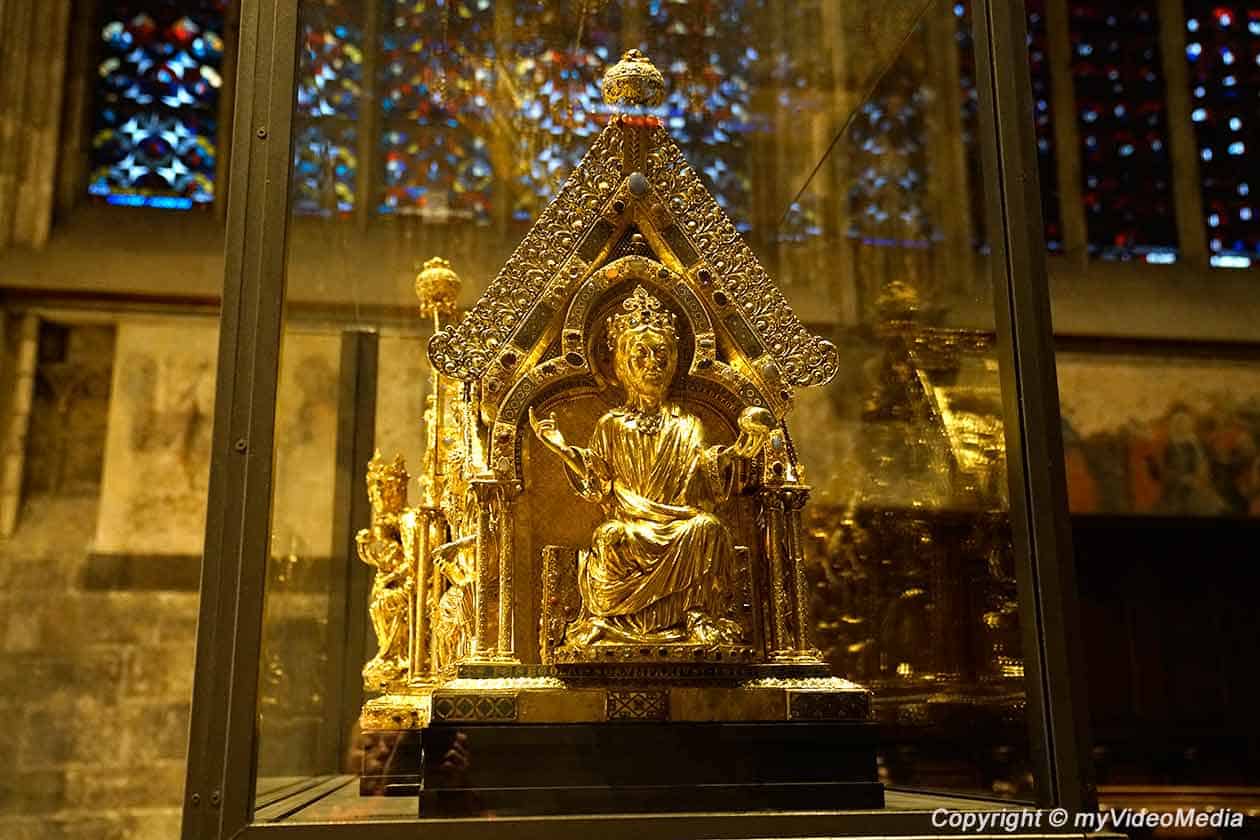
In the Gothic choir hall, you first find the Shrine of the Virgin Mary, a reliquary, once made in Aachen. It was commissioned by the Aachen chapter of the monastery, in 1220. The shrine contains the spiritual treasures of the cathedral. The four major relics are the swaddling cloth, and loincloth of Christ, Mary’s dress, and the decapitation cloth of John the Baptist.
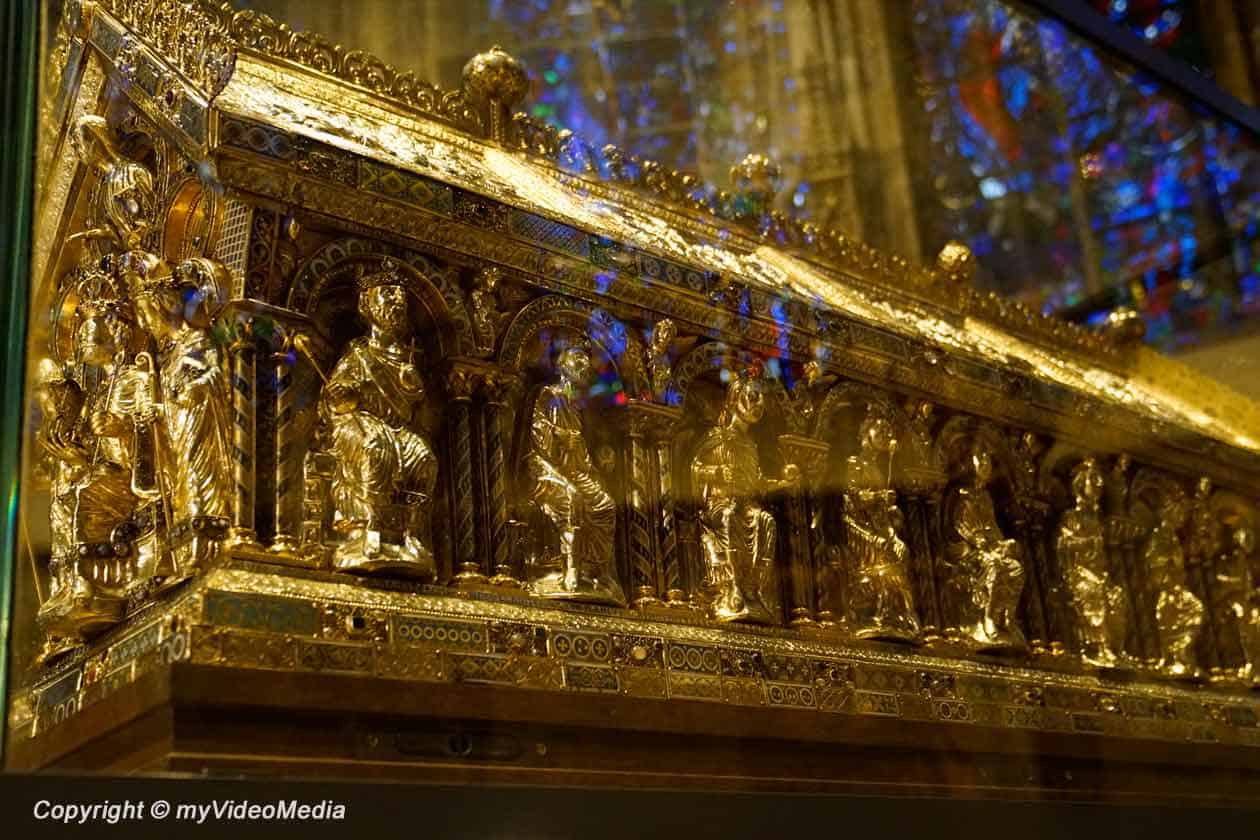
In the background is the Shrine of Charlemagne, made by Aachen goldsmiths, in 1215. On request of Emperor Frederick Barbarossa, the Archbishop of Cologne canonized Charlemagne, in 1165. However, Rome did not recognize the canonization. One permitted a veneration only in places strongly connected with Charlemagne, such as Aachen. On 27 July 1215, Frederick II sealed the bones of Charlemagne in the shrine. The longitudinal walls do not depict apostles or saints, as expected, but eight kings of the Holy Roman Empire each, as descendants of Charlemagne.
Between the two shrines is the Grave of Emperor Otto III. A marble tomb slab, made in 1834, covers the red sandstone sarcophagus. The bones of Emperor Otto III, however, were lost during the transfer to France.
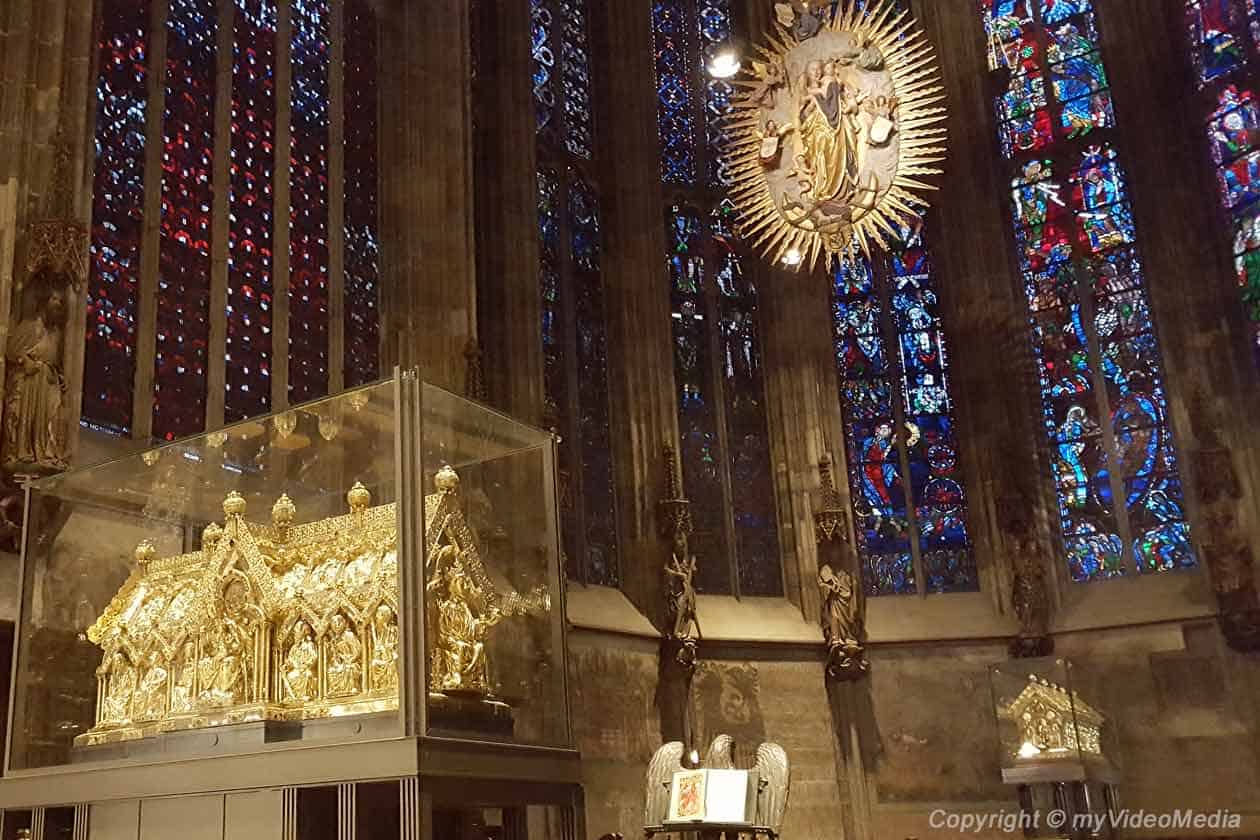
Besides, you see the eagle lectern, cast from brass, in 1450. It serves as a bookend for the gospel.
The wall paintings show the letters A.E.I.O.U. ( Austriae est imperare orbi universo ) of Emperor Frederick III.
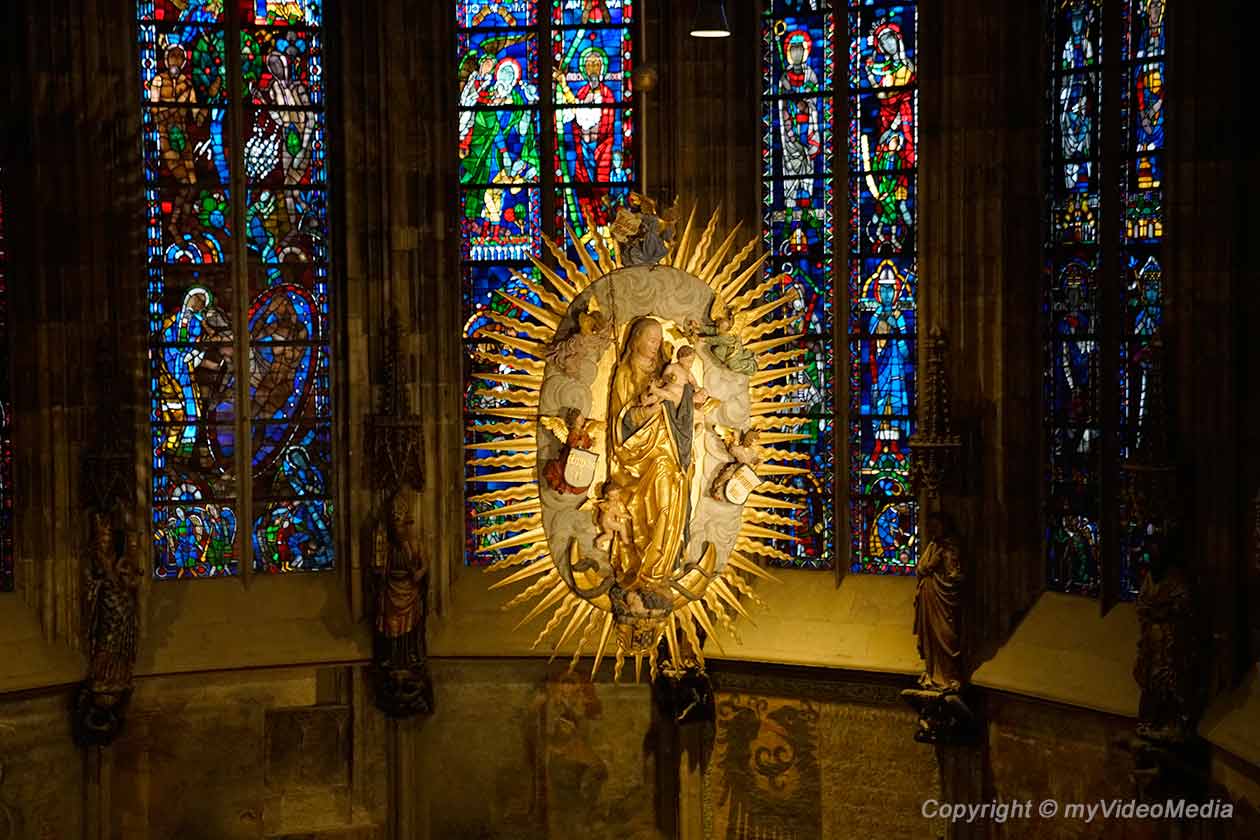
Above everything hovers the Sunburst Madonna, created in 1524 by the Maastricht sculptor Jan van Steffeswert. It is one of the most significant assets of the Aachen Cathedral Treasury.
Sixteen-sided outer structure
A sixteen-sided outer structure encircles the Carolingian octagon. The ground ambulatory has cloister vaults, from where you can reach the surrounding chapels.
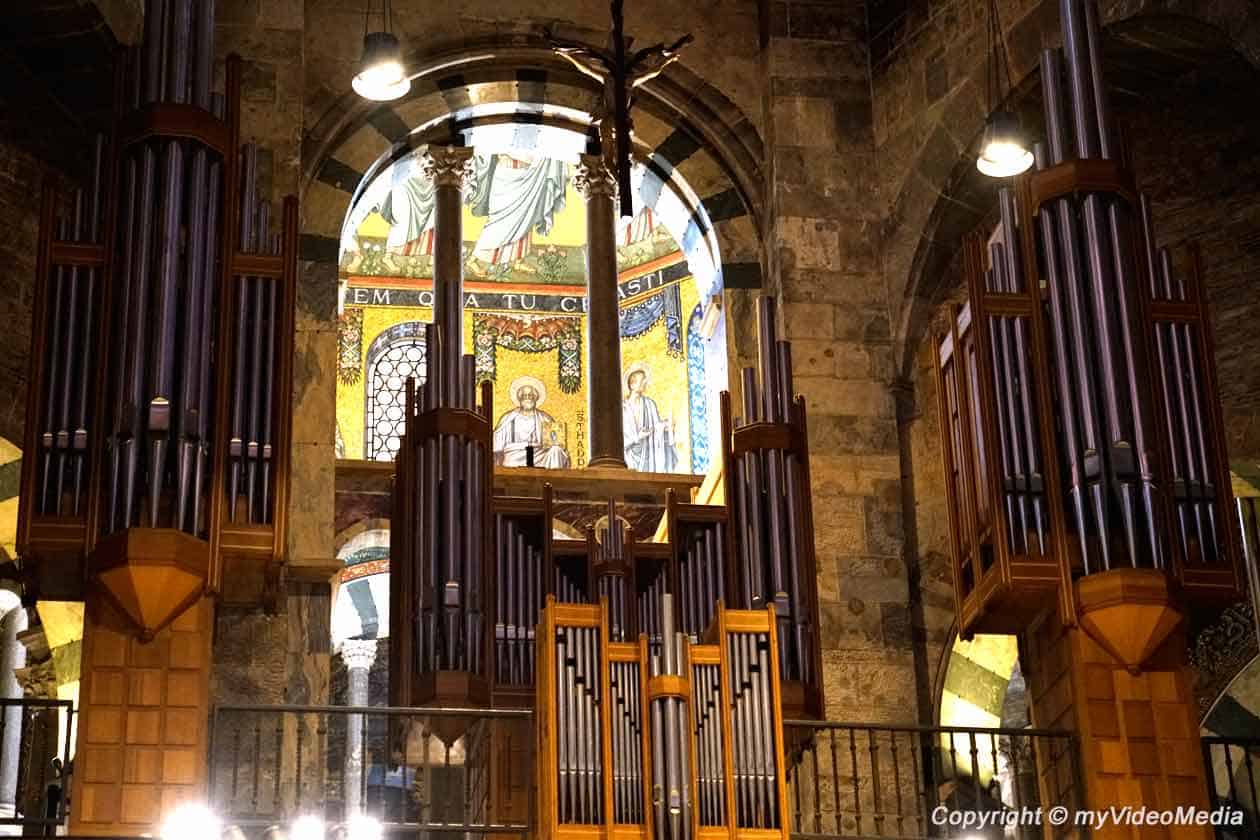
On the upper ambulatory, it forms a high gallery, called Hochmünster. A large multi-part organ is next to the famous king’s throne.
Throne of Charlemagne
The ascent of the throne built of marble slabs was probably the desire of all rulers in Europe between 936 and 1531. After their anointing and coronation, 30 German kings took their seats here at the main altar. However, it is not known whether Charlemagne already sat on this throne.
Please watch the 4K UHD video
You are currently viewing a placeholder content from YouTube. To access the actual content, click the button below. Please note that doing so will share data with third-party providers.
More InformationIn any case, a visit to the cathedral is an incomparable experience. Nowhere else has European history been shaped as much as in this place.
The Aachen Cathedral has been a UNESCO World Heritage Site together with the cathedral treasure since 1978.
Pin it for later
Text, photos and video: Copyright © myVideoMedia