Today we meet with our friend Jose Gomez, whom we have already met in Madrid a year ago. He traveled specially from Madrid to show us the beauty of his native city.
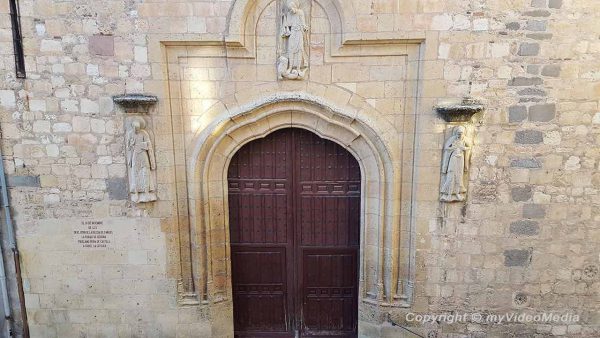
While we are waiting in front of the hotel, a plaque at the adjacent Iglesia de San Miguel attracts our attention. It is reminiscent of the 13th of December 1474, on that day Isabella the Catholic was proclaimed Queen of Castile at the Plaza Mayor.
The original coronation church fell victim to the flames, however, a pavilion in the middle of the square marks the spot where once stood the church.
Alcazar of Segovia
After arriving and the welcoming of Jose, he drives us directly to the Alcazar of Segovia, the Royal Palace. It is one of the most beautiful castles in Spain and was an inspiration for Walt Disney’s Cinderella Castle.
In the American musical drama film Camelot from 1967 with Richard Harris as King Arthur, Vanessa Redgrave as Guenevere and Franco Nero as Lancelot it served as Joyous Gard, the French castle of Sir Lancelot.
The Alcazar is located on a narrow ridge between the rivers Eresma and Clamores. Already in Roman times existed a fortress at that place. Due to steep rock walls, a moat was required only on one side.
Please watch the 4K UHD video here
You are currently viewing a placeholder content from YouTube. To access the actual content, click the button below. Please note that doing so will share data with third-party providers.
More InformationHistory
The Alcazar of Segovia was built in the 11th century by order of Alfonso VI. It was built as a typical Spanish Palazzo, with a rectangular room in the middle, adjoined by square rooms to the right and to the left. Over the years, the Alcazar was repeatedly extended.
In the Middle Ages, Alcazar was one of the preferential residences of the King of Castile. In 1471, Isabella the Catholic rode from here to her coronation at the Plaza Mayor. In the 15th century, King John II build the Donjon, a square, 80-meter high tower decorated with twelve individual turrets.
King Philip II added the sharp slate spires, a symbol of the castles in Central Europe, after his marriage to Anna of Austria. After the royal court moved from Segovia to Madrid, the Alcazar served as a state prison, until Charles III founded the Royal Artillery School here in 1762.
In 1862, a fire destroyed the roofs and parts of the interior. Twenty years later started the restoration which took 14 years. In 1896, King Alfonso XIII handed the Alcazar over to the War Department for the exclusive use of the Artillery Corps.
Inside the Alcazar of Segovia

We go through the park and reach the moat and the entrance gate. The tour starts in the Throne Room with artfully crafted Gothic-Mudejar plasterwork at the ceiling. The walls are covered with velvet.
During a visit, one should not forget to take a look at the ceilings, because one finds the beautiful Mudejar coffered ceilings and rich plaster work also in the further rooms, like in the bedrooms and changing rooms.
The Galley Room is named after its old moulded ceiling resembling the hull of a ship upside down. It was built by Queen Catherine of Lancaster in 1412.

The Pine Cone Room was built by order of Juan II. It is named after the carvings on its molded ceiling, that resemble pine cones.

Particularly noteworthy is the Hall of Kings with 56 gold statues of the kings of Asturias, Castile and León.
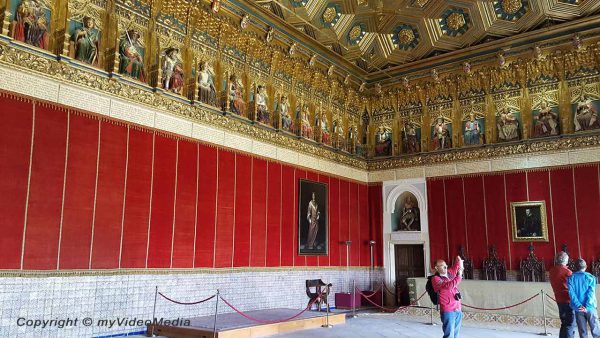
The Cord Room is named after the Franciscan cord that adorns its walls. According to legend, it was built in the 13th century by order of Alfonso X as a sign of repentance for his excessive pride.

He allegedly said “If I had created the world, it would have been better,” and in in the following night, a part of the Alcazar collapsed, due to a storm. In the fire of 1862, the Cord Room was destroyed and rebuilt later with reference to drawings.
The Chapel was one of the first parts of the castle. It keeps many old Altars and paintings, like the Epiphany dating from 1600, painted by Bartolomé Carducho, which could be rescued from the 1862 fire.
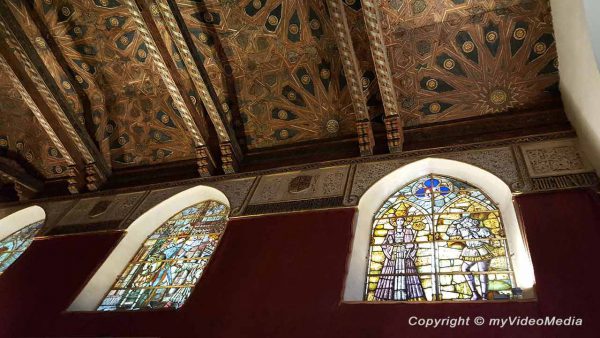
In the chapel, the wedding of King Philipp II and Anna of Austria took place. The Armory holds a collection of weapons and armor dating from different times.

The adjacent terrace at the top of the rocky ridge offers a panoramic view over the valleys of the rivers. We briefly visit an exhibition of defense technology and the subterranean dungeon.
The Alcazar of Segovia opens in summer (April) until September from 10:00 to 19:30 and in winter (Novembers until March) from 10:00 to 18:30.
The surroundings of Segovia
We drive through the valley of Clamores, from where we have a wonderful view of the cathedral. Then it goes to the Mirador de la Muralla, a viewpoint on a hill with spectacular views of the city walls, the Jewish Quarter and the Cathedral.
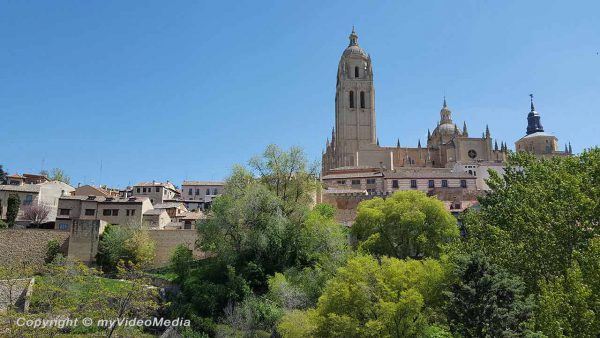
On the way to the Casa de la Moneta de Segovia, the Royal Mint, we make a stop to enjoy the panorama of the city with the Sierra de Guadarrama in the back.

We had planned to have lunch at the restaurant of the Royal Mint, but unfortunately, it was closed.
So we drive on, with a brief stop at the foot of the Alcazar.

While driving through the city, we can see the impressive aqueduct again from different perspectives.

Then we drive up the hill to the hotel Parador de Segovia. From Parador De Segovia you have a wonderful view of Segovia, the aqueduct, and the Sierra de Guadarrama.
The restaurant offers delicious food and of course the local specialty suckling pig is served. At the end of the day, Jose brings us back to our hotel. It was a pleasure for us to see him again and we would like to thank Jose again for this wonderful day.
Pin it for later

Text, photos and video: Copyright © myVideoMedia