When we arrive at Alexanderplatz, the first spring sunshine awaits us.
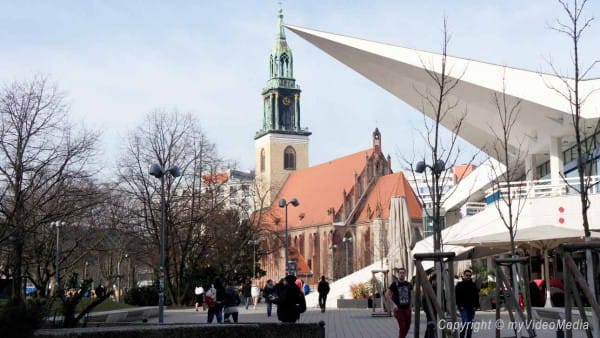
We watch the life a little, but stay only briefly. On the way to Nikolai quarter we pass the “Red City Hall”, the seat of the Berlin Senate and the Governing Mayor of Berlin.
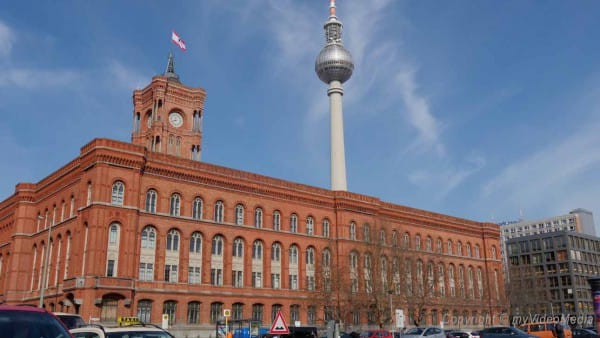
The back is determined by the Molkenmarkt, the large surface area determines the construction process. To the left is the Local Court of Berlin-Mitte. Right besides, the old town hall which was built as an extension of the city hall. The Nikolaiviertel is to the right.
Nikolaiviertel- Nicholas’ Quarter
The Nikolaiviertel is regarded as one of the oldest quarters of Berlin. In the 2nd World War it was destroyed almost completely in bomb raids and street fights. For the 750th anniversary of Berlin in 1987, the quarter was rebuilt. The St. Nicholas’ Church with the Wappenbrunnen (foundation fountain) to commemorate the founding of Berlin, give the impression of an idyllic medieval city, although no building is older than 40 years.
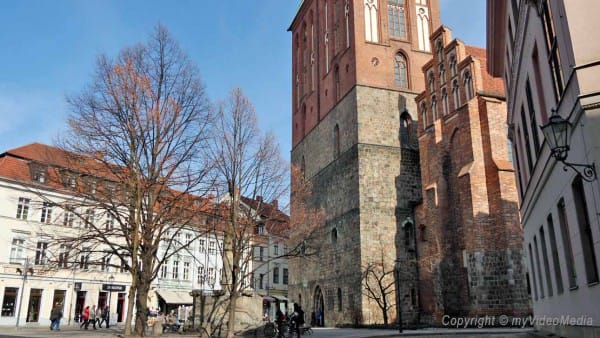
The Ephraim-Palais with its extensive gold ornamentation was built by Veitel Heine Ephraim. He was a financier of the wars of Frederick II. By inferior coins he scored high profits, but contributed to a sharp rise in inflation.
Please watch the 4k UltraHD video Alexanderplatz to Potsdamer Platz
You are currently viewing a placeholder content from YouTube. To access the actual content, click the button below. Please note that doing so will share data with third-party providers.
More InformationDuring reconstruction, the building was constructed using original parts, 12 m from the original site. Today it is a museum and part of the Berlin City Museum Foundation.
Mühlendammschleuse
The Mühlendammschleuse combines the original settlements Coelln (the oldest part of the city of Berlin) and Nikolai. Built as dam, it was later rebuilt to mills that grind grain. Later, sawmills were built. In the 16th century the sluiceway was set up. It allows the sailing around of the mills in the Spree. Due to the ever-growing ships and increasing ship traffic the Mühlendammschleuse was built around 1894.
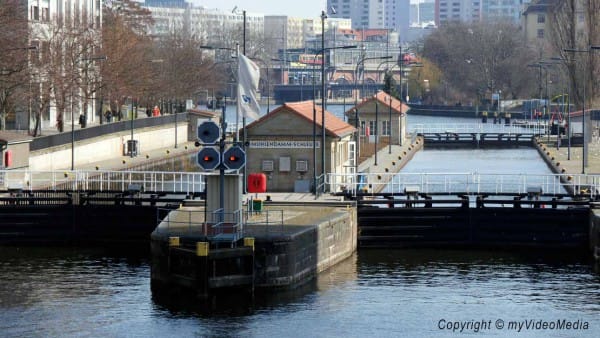
Today’s double sluice was set up in 1936.
Gendarmenmarkt
In 1688, the square was created according to plans of Johann Arnold Nering in the middle of Friedrichstadt. Elector Friedrich III., the later King Frederick I settled the French immigrants (huguenots) who had fled before the French revolution, here. He also assigned the area for the church building to the Lutheran and French reformed community.
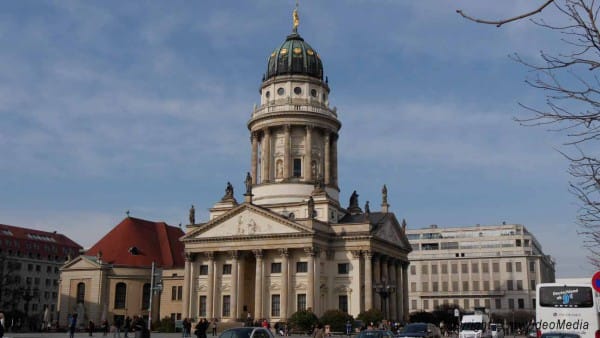
In 1799, the square was named in memory of the stables of the cuirassiers of the “Gens d’armes”. It was the most exclusive Prussian cavalry regiment which had his garrison here. The square was rebuilt as of 1976.
Ritter Sport
West adjacent, is the Ritter Sport store, where you can let yourself mix your individual chocolate.
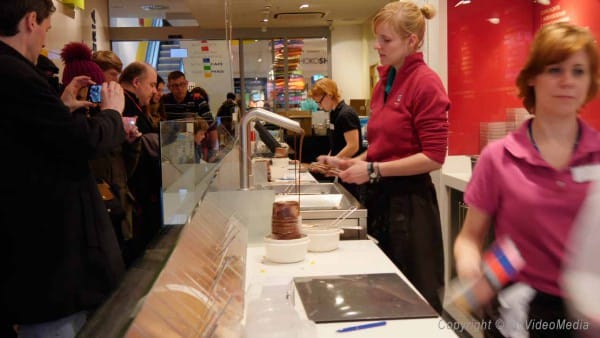
Here, the chocolate flows from the tap.
Fassbender & Rausch
Fassbender & Rausch can be found in the immediate vicinity. It describes itself as the biggest chocolate house of the world.
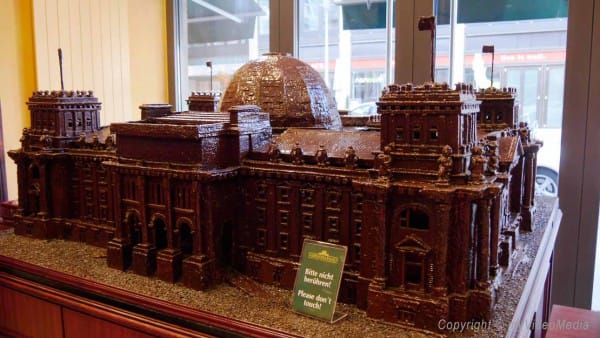
Here you will find the sights of Berlin modelled in chocolate.
Checkpoint Charlie
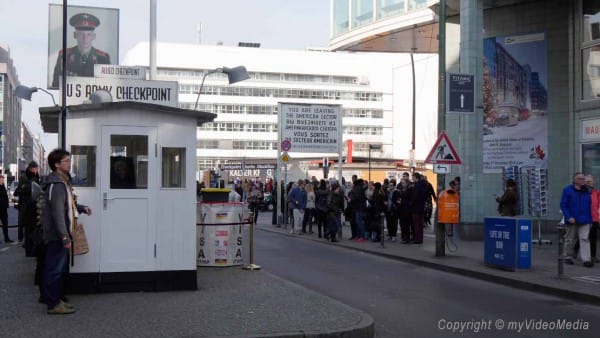
Checkpoint Charlie is located just a few blocks further south. Where once American and Soviet tanks confronted each other, is now a tourist hot-spot. Here, you can be photographed with actors in American uniforms.
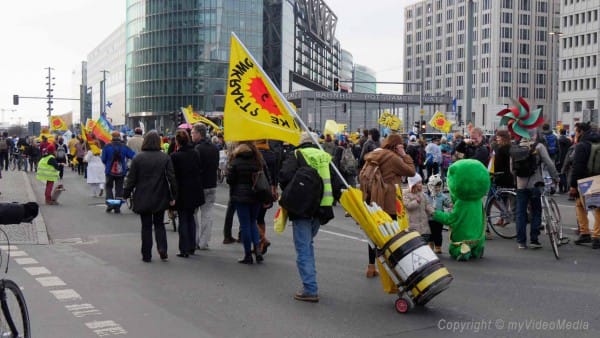
Passing the Museum of Communication, the Square of the popular uprising in 1953 in front of the Federal Ministry of Finance, the Berlin Mall and the German Bundesrat, we reach the Leipziger Platz. It has been redesigned just like the adjacent Potsdam Square after the reunification. During our visit, an anti-nuclear demonstration on occasion of the anniversary of the Fukushima catastrophe took place.
Potsdamer Platz – Potsdam Square
Potsdamer Platz is marked by the Bahntower, PWC office tower, the Kollhoff Tower and Beisheim Center with the Ritz-Carlton Berlin and Berlin Marriott International. The adjacent Sony Center also plays an important role here, of course. Below ground level is the station Potsdam Square.
Text, photos and video: Copyright © myVideoMedia