We enter Angkor Thom via a causeway, which is lined with Devas and Asuras, carrying a Naga.

At the end of the dam is the Victory Gate, built in the typical Bayon style with faces in all four directions. Laterally are guardian figures, elephants with three heads and three trunks. They represent Airavata, the Elephant who bore the creator god Indra.

Our guide takes us upwards to the the side of a rampart, when he discovers a Gibbon. He has high respect for it, because usually these monkeys are not native here. The Gibbon jumps from the tree and runs directly in our direction. Although the Gibbon shows us his the teeth, it runs past us and climbs up the gate.

A small path through the bushes leads down the rampart. Our guide has prepared himself with a stick and pokes into every foxhole at the wayside to see whether a cobra is therein. But everything is all right.

A dead straight avenue leads to the Terrace of the Elephants. The 350 m long balustrade is separated by a terrace in the middle, with stairs leading up. It was the place, where king had inspected the parades.
The royal family and other dignitaries had to spread out at the side of the balustrades. Behind it is a hidden gate that leads directly to the king’s palace.
Please watch the 4K UHD video!!!
You are currently viewing a placeholder content from YouTube. To access the actual content, click the button below. Please note that doing so will share data with third-party providers.
More InformationSince stone buildings were reserved for the gods, the palace was built of wood and is now fully weathered. At its place are only trees and shrubbery.
To the right of the avenue is the Royal Pool.

To the left is the pyramidal Phimeanakas, the celestial temple of Angkor. It is reported, that at least the dome was coated with gold (Golden Tower).

We continue to Baphuon. It was set up by King Udayadityavarman II, as a state temple in the center to the former capital Yaśodharapura, around 1055.

After the collapse of the central temple tower, one built gigantic lying Buddha out of it.

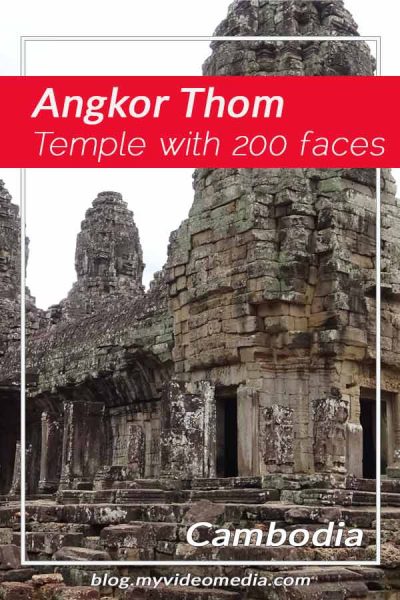
Then we reach the Bayon. It was built by King Jayavarman VII as the state temple in the center of the new capital Angkor Thom.

Originally the temple had about 49 perhaps even 54 towers, of which 37 exist today. Most of the towers carry 4 faces in all four directions.
Approximately 200 faces, that are about to 7m high, embellish the temple. They symbolize Bodhisattva Lokeshvara, also known as Avalokiteshvara, the God of Compassion. It is assumed that the facial features are modeled on these of Jayavarman VII.

However, the temple of Angkor Thom has a special meaning, due to the numerous reliefs, representing the everyday life of the Khmer.

Overwhelmed by all the impressions we return to the hotel.
See also
- Ta Keo Temple and the End of the Khmer Empire
- Angkor Wat – the most famous Temple in Cambodia
- Preah Khan – the holy city of victory
Pin it for later
Text, photos and video: Copyright © myVideoMedia