Barrio de La Latina, the name of the neighborhood in the center of Madrid goes back to Beatriz Galindo. Born in Salamanca, she was a writer, teacher, humanist and also interested in physics and mathematics.
Beatriz Galindo was one of the most educated women at her time. In addition, she was very charitable, what she could afford due to her wealth.

After she taught Queen Isabella of Castile and her children in Latin, she was nicknamed La Latina. She was one of the first women who was active in public life already during the Renaissance.
Beatriz founded schools and hospitals in Spain, among others the Hospital of the Holy Cross (Santa Cruz de Madrid) in 1506. This justified her charitable reputation and the neighborhood where she once lived was named after her.
Please watch the 4K UHD video
You are currently viewing a placeholder content from YouTube. To access the actual content, click the button below. Please note that doing so will share data with third-party providers.
More InformationLa Latina is one of the oldest section of Madrid, with narrow streets and large squares. Here you find the perfect combination between tradition and modernity, a neighborhood that has something to offer for everyone.
Teatro real
The tour with our guide Verónica Walde starts at Teatro Real. The theater was opened in 1850 by Isabella II and soon became one the most important stages of Europe.

During our visit, a huge screen and big speaker towers had been installed on the balcony of the west facade. Everyone could listen and watch parts of the opera program. The acoustic quality was excellent.
Palacio Real de Madrid
On the opposite side is the Palacio Real de Madrid – the Royal Palace. Verónica gives us a short historical overview of Madrid.

Until the 18th century an Alcazar, a Moorish castle castle, stood on the place of the present palace. It was destroyed by a fire in 1734. After the War of the Spanish Succession, the Bourbons came to the power.
Philip V now wanted to have a palace coequal to the Escorial palace of the Habsburgs. He commissioned Juan Bautista Sacchetti and Francisco de Sabatini with the construction. But it was King Charles III who first moved into the building in 1764.
Laterally next to the castle is the Almudena Cathedral (Santa María la Real de La Almudena) and in between the Plaza de la Armeria.
Almudena Cathedral
The construction of the Almudena Cathedral was started in the 18th century. However, it was only completed in 1993 and inaugurated by Pope John Paul II and raised to the Episcopal Church. Since the diocese foundation in 1885 till this time, the Iglesia de San Isidro was the cathedral. Many Madrilenians still regard it as their cathedral.
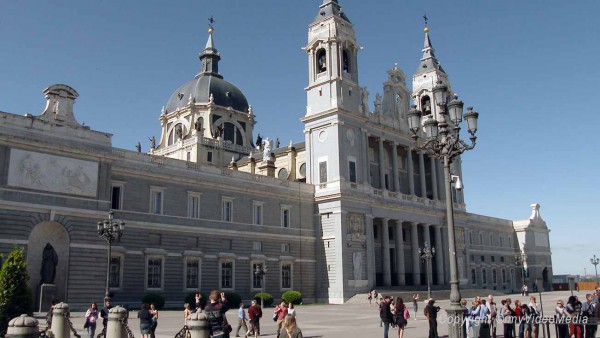
Behind the “new” cathedral in the Cuesta Ramon you can see a part of the castle walls of the Alcazar.
Opposite, on the other side of Calle Bailén, you will find the Palacio de Abrantes which is now used as an Italian Cultural Institute.
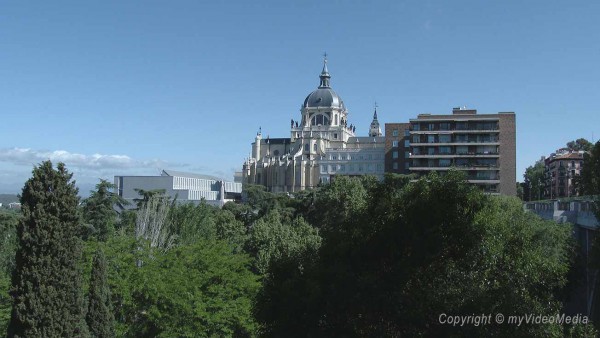
After crossing the Viaducto desde Beatriz Galindo you have a nice view over the Casa de Campo, a recreational area of Madrid, which formerly served as a hunting ground of the royal family, and the Cathedral de la Amudena.
In addition, you can see the newly built Museo de las Colecciones Reales. The royal collection includes 154,000 paintings.
Plaza de la Paja
We reach the Plaza de la Paja. First we see the Colegio Público San Ildefonso. Every year, children of this school sing the numbers at Spain’s greatest lottery event “El Gordo de Navidad”.

On the other side of the square is the Palacio de los Vargas, from one of the richest dynasties Madrid.
As landowners they were often richer than the king and served as financiers.

In front is the sculpture El lector – the reader. El lector was created by the artist Félix Hernando García in 1997 and is characterized by its realistic representation.

The Capilla del Obispo forms together with the Iglesia de San Andrés a common church complex. It stands on the site where the Holy Isidor once lived and died.
Originally the chapel was built by a nephew of the Vargas family as a tomb for the Holy Isidor early 16th century, who was, however, buried later in San Andrés.

The Capilla del Obispo was then used as a family vault by the family Vargas. The chapel, a national cultural property since 1931, is privately owned, but when the door is open, you should have a look inside.
If you walk around the church complex, you will find yourself at the Plaza San André. To the left is the entrance of the church and right besides the Museo De Los Orígenes in the Casa de San Isidro.
The building was demolished in 1972 and faithfully rebuilt. Today it houses the Archaeological Museum of Madrid.
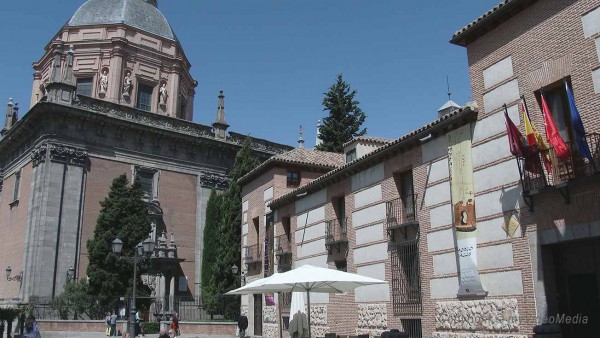
Turning your eyes toward the west, you see the Basilica San Francisco el Grande. It was built in 1774, at the site where Saint Francis of Assisi reportedly had lived. During the Civil War it was badly damaged and subsequently served as a hospital and barracks. It was provisional restored in 1970.
The Basilica San Francisco el Grande has the third largest dome in Europe and a number of particular artworks by Goya, Velázquez, Francisco Bayeu and Francisco de Zurbarán inside.
Mercado de La Cebada
Mercado de la Cebada is one of the largest markets in Madrid and known for its 6 red domes. It was founded in the 16th century. 1868 the architect Mariano Calvo Pereira built a hall based on a steel construction.

In 1958, it has been replaced by the present hall.

Unfortunately, we arrived only shortly before end so that the shopkeepers were all busy with cleanup.
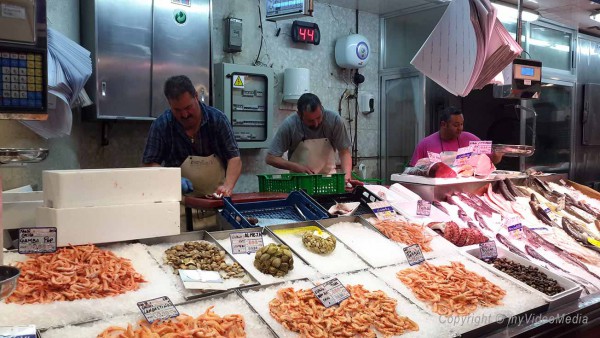
Nevertheless, we were able to gain an overview of our product range. Especially the fresh seafood looks very appetizing.
Iglesia de San Pedro el Viejo

The Iglesia de San Pedro el Viejo was built by Muslims who had converted to the Christian faith.
Numerous spectators come to the annual procession where the statue of Maria Santísima del Dulce Nombre is carried over the small staircase via the steep steps to the road.

The church is one of the oldest in the city, probably from the 12th century. The Moorish bell tower fits architecturally into this period.
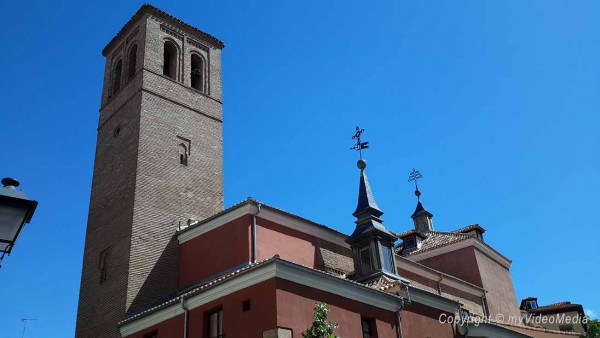
Verónica leads us via the Calle Nuncio and the Plaza Puerta Cerrada to the
Iglesia de San Isidro
This church was the temporary cathedral of Madrid until 1993. It was built in 1620, after Maria de Austria had provided a large sum in her will, to built a new church on the site of the demolished church of the parish Peter and Paul.

At the beginning of the Civil War the church burned down completely. After the war it was rebuilt as faithfully as possible again and completed in the 1960s.

Our tour continues via the Plaza de la Provincia, through the Calle de la Bolsa, on the Plaza de Jacinto Benavente and the Plaza de Angel. Then we turn into
Calle de las Huertas
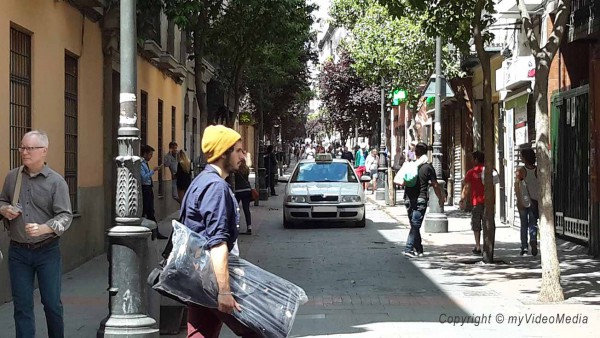
Here we find plenty of Taperias, bars, cafes and restaurants.
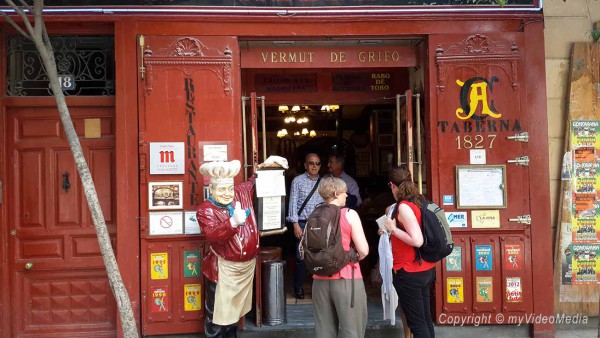
But also the Convento de las Trinitarias Descalzas de San Ildefonso where Miguel de Cervantes the creator of Don Quixote is buried.

We accompany Verónica up to the Plaza de Platerias where our paths separate. We thank her for the interesting, pleasant guided tour where we got a lot of information about Madrid, especially the Barrio de la Latina, a neighborhood which we will visit once again in the evening.
Pin it for later


Disclosure : We were kindly invited by Tourist Office Madrid and as always, all opinions about our experiences are our own!
Text, photos and video: Copyright © myVideoMedia