Toledo is the capital of the Spanish province of Toledo and the autonomous region of Castilla-La Mancha.
Together with Segovia and Avila, it is one of the three historic royal cities around Madrid.
Historical overview
From 1087 to 1561, Toledo was the residence of the Kingdom of Castile and capital of Spain. The city experienced its greatest splendor under Charles V (Carlos I), who became king of Spain in 1516 and Emperor of the Holy Roman Empire in 1515.
No ruler has ever dominated over such a big area before. It covered large parts of Europe and extended to the colonies in America and the Philippines. The silver and gold cargo loads granted the emperor gigantic inflows of capital, but they were not sufficient to finance its wars.
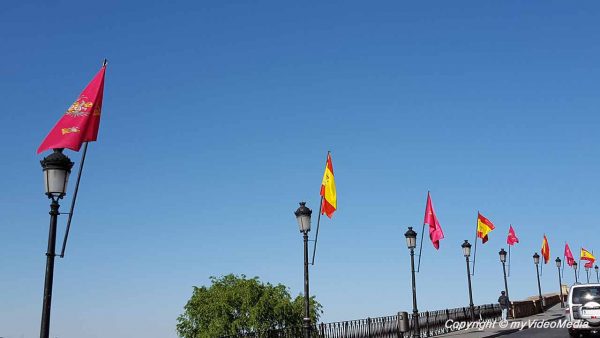
The Protestant movement started in the empire and the imperial estates protested. This also had an impact on the relationship between Emperor and Pope. Uprisings in Toledo and Valencia had to be suppressed to maintain the own power.
The real problem was King Francis I of France, who would have liked to become emperor himself. He allied himself with the Ottomans and almost overthrow the imperial kingdom when the Ottomans were at the gates of Vienna. Peace came only after Charles’s death.
Already under the rule of Charles, one made plans to built the Alcazar of Toledo, that dominates the entire upper town today.
Toledo today
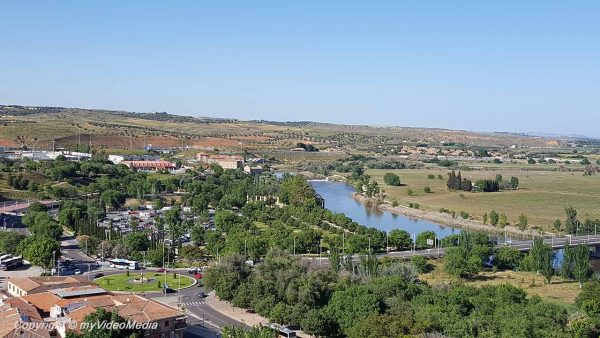
Toledo lies on an approx. 100 m high mountain, framed on three sides by the River Tagus. The river has cut deep into the rocks of the southern Meseta high plateau and was originally spanned only by two bridges, Puerta de Alcantara to the east and Puente de San Martin to the west.
To the north, the mountain falls steeply and is fastened by defense walls. The main access to the town is the Puerta de Bisagra, next to our hotel, El Hostal Puerta Bisagra.

After check-in, we go up the hill through Calle Real del Arrabal and pass another city gate, the Puerta del Sol.
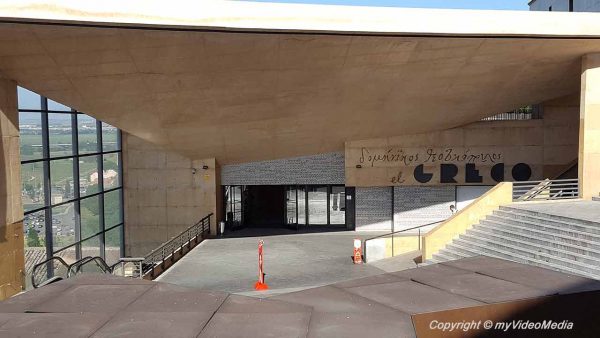
Then we follow the Calle Gerardo Lobo up to the Congress Center of Toledo. From here we have a nice panoramic view of the northern plain.

Calle Armas leads us to the Plaza de Zocodover, the busiest square in the city. It was always the center of the social life, as a horse market, as a bullring, or for solemnities. It was also the venue of the inquisition and site of the executions.
Please watch the 4K UHD video here
You are currently viewing a placeholder content from YouTube. To access the actual content, click the button below. Please note that doing so will share data with third-party providers.
More InformationWith its many restaurants, it serves as a meeting place and resting place for tourists today. We admire the beautiful facades of the stately homes and the Arco de la Sangre (Gate of the Blood), which was the only access to the city during the Roman era.
The constructions date back to the Arab period, which used the Plaza de Zocodover as a livestock market and called the entrance “Bab-al-Yah” (Gate of the Horses).
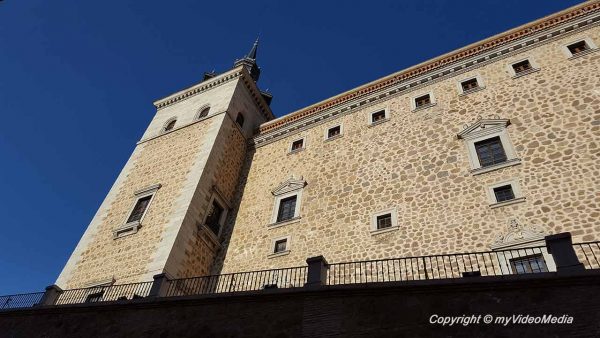
The Cuesta Carlos V leads directly to the Alcazar. If you stand in front of it, it is hard to guess its dimensions.
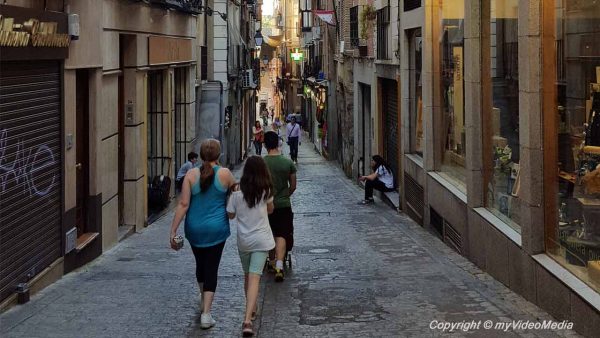
Through narrow lanes, we reach the Teatro de Rojas and the Plaza del Ayuntamiento. The Catedral de Santa Maria of Toledo dominates the square.

On the opposite site is the town hall and on the southern side is the palace of justice. In front of the Town Hall, an artist built a basin of water. The water periodically drains and flows in again. Metal symbolizes organic material on the ground.

It is already dark when we return to the Plaza de Zocodover.
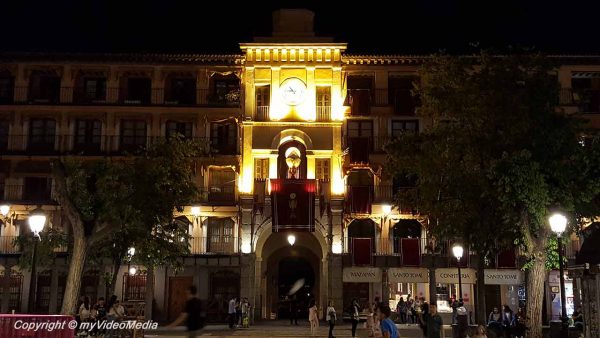
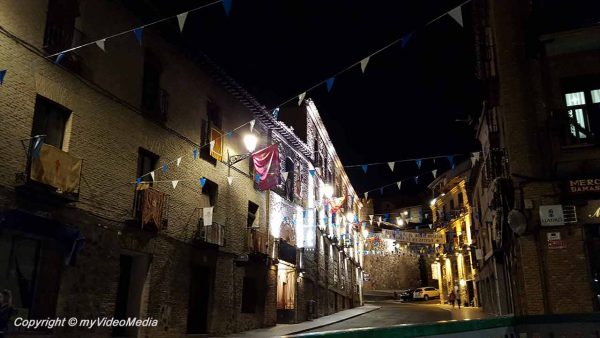
From there we go back to the hotel. At the Puerta de Bisagra we end the evening and enjoy the illuminated medieval world.
Please read on > Alcazar of Toledo
Pin it for later

Text, photos and video: Copyright © myVideoMedia