Ho Chi Minh City has more than 7 million inhabitants. It is the economic center of Vietnam. The title of this article, city walk in Ho Chi Minh City, is a little broadly formulated, then said more exactly it is only a tour by the center. Unfortunately, we cannot go to important districts like Cholon, the former China Town, because of lack of time.
History
Probably in the first half of the first millennium, the Khmer had built a fishing village here. After the conquest of Champa, the kingdom of Cham, the Vietnamese advanced further south. The Nguyen dynasty, who had their seat in Hue, dominated the region.
In 1771, Nguyen Phuc Anh fled from the Tay Son Rebellion to Saigon before and made the city the capital of his dominion. He fortified the city with walls and ordered the construction of the citadel. With the help of the French, he defeated the Tay Son Uprising and returned to Hue as Emperor Gia Long. Saigon remained an important trading center in the south.
In 1859, the French marched into Saigon. In 1862 they declared the town as the capital of the colony French Cochinchina. The dissatisfaction of the Vietnamese population grew in the 20s and 30s and manifested itself in frequent strikes.
The Japanese occupied Vietnam in 1941. At that time, the American Office of Strategic services already supported Ho Chi Minh in the fight against the Japanese. The Viet Minh was founded. The Allies wanted to reintroduce the old colonial system after the proclamation of the armistice in 1945. But Ho Chi Minh wanted an independent Vietnam. September 2nd, 1945, Ho Chi Minh proclaimed the independence of Vietnam.

France acknowledged the independence. But after the arrival of the British in Saigon on 13 September 1945, they changed their opinion again. The British should disarm the Japanese in the south. After a dispute about taxes, the French began an attack on Hai Phong on 23 November 1946. 6,000 people died. Now the Viet Minh began the armed struggle against the foreign domination with an attack on the French garrison in Hanoi on 19 December 1946. On May 8, 1954, the Viet Minh defeated the French troops in the Battle of Dien Bien Phu and the Geneva peace negotiations started.
Vietnam was divided along the 49th degree of latitude, and the Allies established the regime of Ngo Dinh Diem in South Vietnam in 1955. Saigon became capital. After two years, one wanted to hold elections throughout Vietnam. But the government in South Vietnam and the Americans did not sign the agreement.
The Viet Cong was founded in 1960. It consisted of the most different partisan group but was dominated by the Communist Party.

The Vietnam war had started. The tanks of the North-Vietnamese defense forces broke through the fence of the Presidential Palace in Saigon on April 30th, 1975.
On 2 July 1976, the reunification of North and South Vietnam took place. The official name is now the Socialist Republic of Vietnam.
A new horror suffused the country
At the withdrawal of the Americans, 138.000 south Vietnamese were evacuated, most of them to Guam.
In Vietnam, 165,000 people died in re-education camps. 200,000 people, mostly former military personnel were executed. 50,000 (especially Chinese from Cholon) were murdered in the so-called New Economic Zones. About 2 million tried to leave the country as Boatpeople, many of them died.
The USA accepted 883.317 refugees and further 800.000 found a place in other countries. In addition, there were about 400,000 refugees from Laos and Cambodia.
Only in 1986 with the Doi moi reform, the country has brought itself back to normal. Doi moi included a series of economic reforms, resulting in a strong economic growth. The relationships with the western foreign countries had also increasingly improved.
Today, hardly anyone in Vietnam talks about politics, but one learns when a Vietnamese refugee in the US has earned a fortune and then returned to Vietnam. Especially when he then imports his luxury cars with the help of corrupt officials tax-free. And this in a country that requires 70 – 80% import tax for cars manufactured abroad.
Our city walk in Ho Chi Minh City
We start with our city walk in Ho Chi Minh City at the Reunification Palace. It got its name after the reunification of North and South Vietnam. The regime of South Vietnam once built it as an independence palace on the grounds of the Norodom Palace. It was the former residence of the governors general of Indochina.

You can visit the interiors, unfortunately, we just arrived during the lunch break. It should last for two hours. But we do not have that much time.

We go to the cathedral. To the left, we see the shining glass façade of the American Center. In the park in front of it, students wait for buses and some spend their lunch break here.

The brick building of the neo-Romanesque cathedral Notre-Dame is also called Notre-Dame of the East. For the Catholic population, it seems to be a favorite place for weddings.

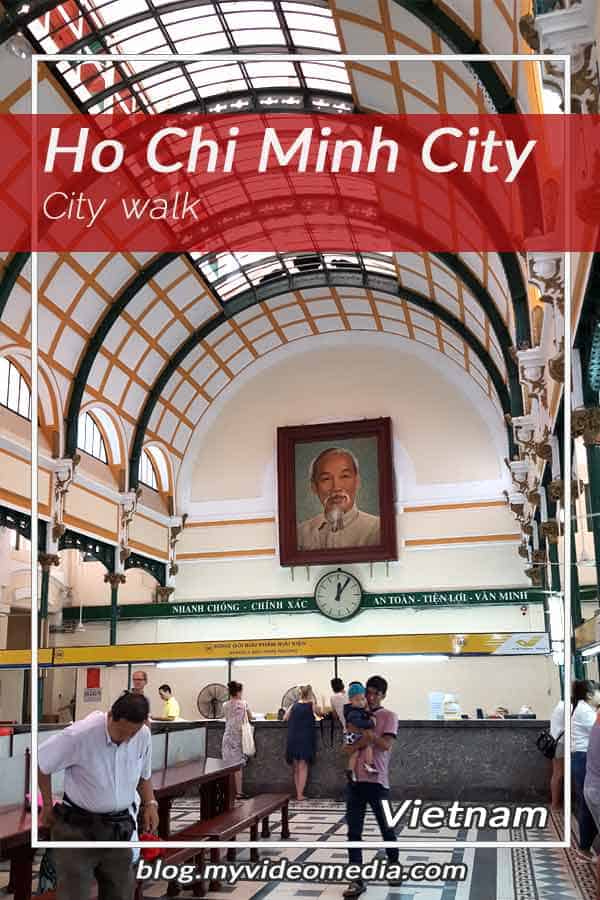
The Saigon Central Post Office is on the opposite side of Cong xa Paris. Gustave Eiffel, the builder of the Eiffel Tower in Paris designed the building which opened in 1891. Inside the building, the time seems to be standing still, it is almost in its origin status. Only a painting of Ho Chi Minh decorates the front of the counter hall.

We walk south, along the Dong Khoi. Another glazed high-rise of a telecom company stretches out against the sky.
At the Lahn Than Ton, we turn right and reach the old town hall of Saigon, which today houses the People’s Committee. The building forms the front part of the Nguyen Hue, that looks more like a square than a street. The large open space between two double lane roads is a space for various activities.
Please watch the 4K UHD video here!!!
You are currently viewing a placeholder content from YouTube. To access the actual content, click the button below. Please note that doing so will share data with third-party providers.
More InformationIn the meantime, one replaced the famous statue in front of the old town hall, that showed Ho Chi Minh with a child in his arms. Today you see a statue of Ho Chi Minh, that greets statesmanlike from its base, looking to the other end of Dong Khoi, which meets directly on the Saigon River.

We turn left into the Le Loi, towards the Opera of Saigon and arrive at a large construction site. A fence protects the subway construction at Lam Son Square. But we still have a nice view of the opera and to the left of it the Saigon Continental Hotel, the first address in Ho Chi Minh City.

On the opposite side of the Opera House is the Caravelle Hotel Saigon. During the Vietnam War, it was usually occupied by Western war correspondents.

In the Nguyen Hue, a couple dances during a photo session. Others make photo shoots for their wedding album.

Here, you only find a few remnants of the old Saigon. The high glass towers expand more and more, like the 265 m high Bitexco Financial Tower, with its striking helicopter landing stage on the 52nd floor. A viewing platform is on the 49th floor.

Fashionable hotels like the Saigon Hotel dominate the houses.
On the banks of the Saigon River, we observe the cargo traffic in the port of Ho Chi Minh City, the heart of the city, to which it owes its existence. But also restaurant boats for evening harbor cruises anchor here.

A modern vehicular tunnel runs under the river. Two young girls film us secretly as we handle our tripod while we are filming the surroundings. They are distracted and we film them too. When they notice it, they also laugh. So we all have fun.

A thunderstorm approaches and the rain clouds pull in our direction. Thus we end our city walk in Ho Chi Minh City and get fast on the way back to the hotel. We pass the Ben-Thanh market once again, which we had already visited the evening before.
Please read on > From Ho Chi Minh City to Noa Ninh – Mekong Delta
Pin it for later
Text, photos and video: Copyright © myVideoMedia
so great and very detail. Thank you went to VietNam.
Thank you very much for your positive feedback. We are glad that you like it.