The Domus Aurea, the Golden House was built by Emperor Nero, as his palace in the center of Rome.

At the time of Nero
At the time of Nero, the palace extended from the Palatin up to the Esquilin, a part of the Caelius was also included. In the center, where the Coloseum stands today, was a large artificial lake.
The area encompassed 80 ha. A number of jokes about the megalomania of the emperor circulated in Rome .
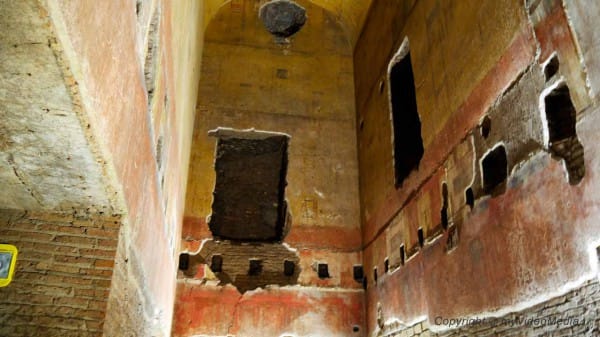
The previous palace, the Domus Transitoria, was still under construction when the great fire of Rome in AD 64 destroyed it.
Please watch the 4k UltraHD Video
You are currently viewing a placeholder content from YouTube. To access the actual content, click the button below. Please note that doing so will share data with third-party providers.
More InformationInterior of Domus Aurea
After the fire in the Domus Aurea in the year 104 AD, the interiors, columns and sculptures were taken away and reused elsewhere.
The palace was filled with soil to create a foundation for the Baths of Trajan. The Colosseum was set up on the place of the lake.
Today, only the part of the palace which was used as an entertainment area, is preserved. Most of the wall paintings were created by the Roman painter Fabullus. You still can see some fragments today.

The dome of the dining hall (one suspects at least that it was a dining hall) was made of unreinforced solid concrete. The dome was the largest of its time, until it was surpassed by the dome of the Pantheon. The dome rested on an octagon.

On the south side, the room offered a clear view of the lake and the garden. From the north side, an artificial waterfall splashed through the room.
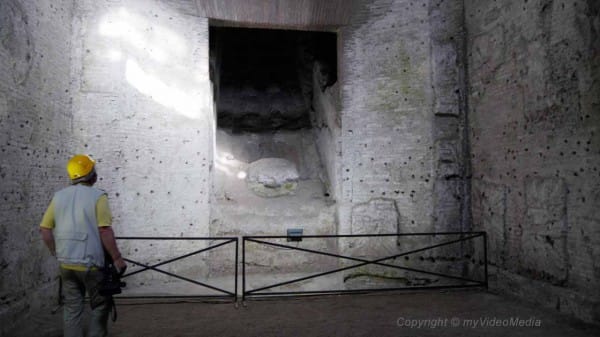
Many areas were covered with marble, of which nothing remains. The private rooms were gilded, hence the name Domus Aurea.
Today’s situation
The rooms appear like cellar vaults, although they were light-flooded at the epoch of Nero. All the window apertures are covered by soil; in some areas halls are still filled up with soil. The enormous humidity damages the masonry and the mural paintings. This caused a vaulted passage to collapse in 2010.
By 2018, one will install a drainage system that will stop further deterioration. Then the Domus Aurea should be accessible to the public again.
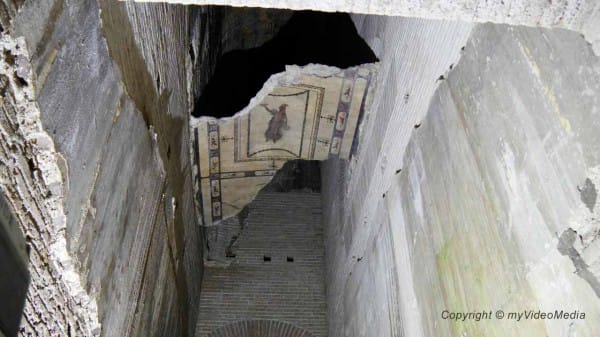
We were lucky. During our stay in Rome we visited the Domus Aurea on a Sunday. 20 minutes after our arrival was a guided tour and to our surprise everything was free because it was the first weekend of the month. The guide was very friendly and knowledgeable.
The height of the rooms and the dimensions of the halls were nearly unbelievable. The remains of the mural paintings conveyed at least an impression how it may have looked like originally.
For us, the Domus Aurea is the most impressive monument of Roman architecture, which itself can be described only by superlatives.
In 1980, the Domus Aurea was designated a UNESCO World Heritage Site.
Please read on > The Palatine and the Roman Forum
Pin it for later
Text, photo and video: Copyright © myVideoMedia