Bukhara is one of the oldest towns in Uzbekistan. UNESCO declared Bukhara the world cultural heritage, as ” the most complete example of a medieval city in Central Asia, with an urban fabric that has remained largely intact.”
History
The region around Bukhara (Buxoro), Sogdia was initially part of the Achaemenid Empire, the First Persian Empire, which was terminated by Alexander the Great. A restless phase in which small principalities and city-states dominated this part of the silk road followed. In the following 2 centuries, it came to fights with the Iranian Huns and the Göktürks again and again. The Arabs finally took on the power and advanced the Islamization in Sogdia and the Sassanid Empire. In 865, the Persian Samanids came to power and Buxoro became the capital of Transoxania and Greater Khorasan.
The Kara-Khanid Khanate ended the rule of the Samanids, who had to subordinate themselves later to the Great Seljuq Empire.
After another era of changing rulers, Genghis Khan destroyed the city. From 1238 to 1241 there was the Tarabi Rebellion, which killed tens of thousands of people. During the reign of the Timurids, with Sarmakand as their capital, Buxoro sank into insignificance. Buxoro experienced a new bloom only under the Shaybanids with the Khanate of Bukhara but disappeared with the Janid Dynasty again.
75% of the town was destroyed at heavy fights with the red army in 1920. The Miri-Arab Madras, reopened in 1945, was the only Islamic educational institution of the Soviet Union in Uzbek Socialist Soviet Republic. In 1991, Uzbekistan became an independent state.
Bukhara has more than 140 monuments from different epochs.
Guided city walk
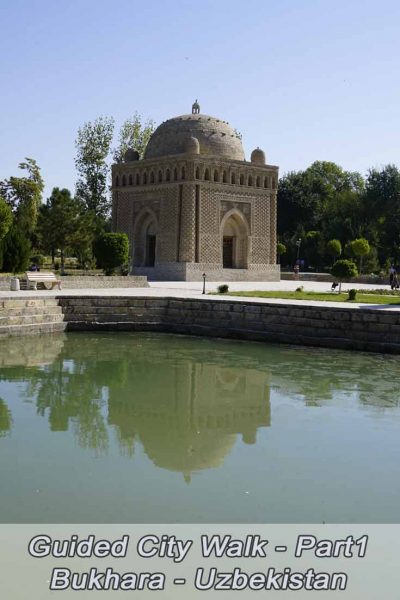
Our city walk starts at the oldest building of the town, dating from the 10th century, the Samanid Mausoleum.
Samanid Mausoleum
We are accompanied by our knowledgeable guide Gulchekhra Faiziyeva.
Please watch the 4K UHD video
You are currently viewing a placeholder content from YouTube. To access the actual content, click the button below. Please note that doing so will share data with third-party providers.
More InformationThe mausoleum is at the same time the oldest preserved building of Central Asia, that was built before 907. Architecturally, it is the continuation of the Zoroastrian fire temple. It significantly influenced the style of the subsequent buildings.
One assumes that this is the oldest Islamic dome grave ever.
Chashma-Ayub Mausoleum
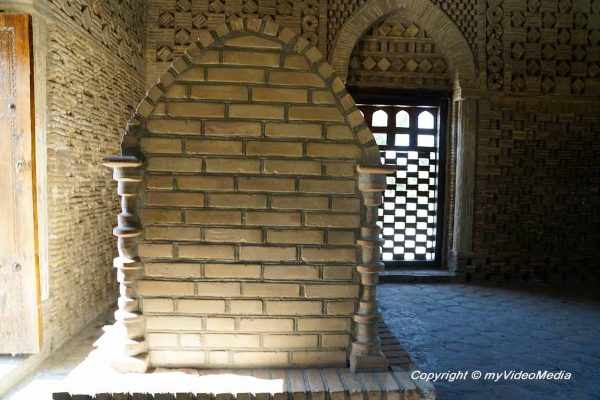
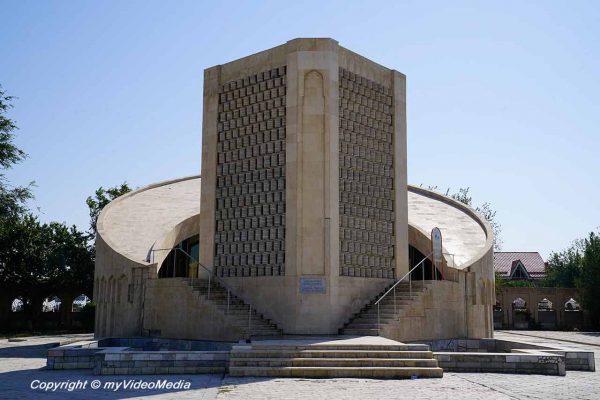
North of the Samanid Mausoleum, on the edge of the park, lies the Chashma-Ayub Mausoleum ( the dwell of Job), probably from the Timurid era. Inside is a fountain.
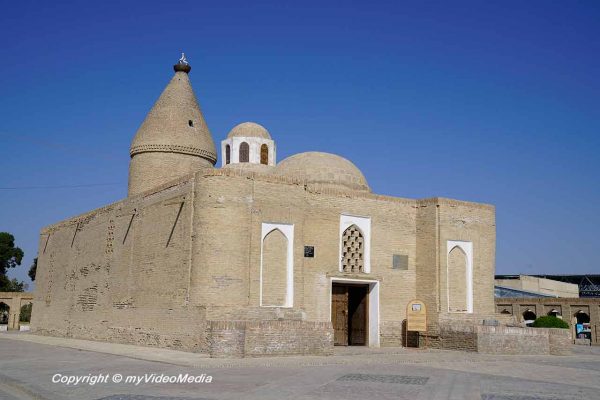
According to legend, Job was said to have beaten the dwell with a stick from the rock. Allegedly, the water has a curative effect. In 1998, opposite the mausoleum, one built a memorial and library for Ismail al Buchari, a major Islamic scholar buried in Samarkand.
Bolo Haouz Mosque
Our next stop is the Bolo Haouz Mosque. It lies opposite the Ark of Bukhara on the west side of Registan, the city’s original main square.
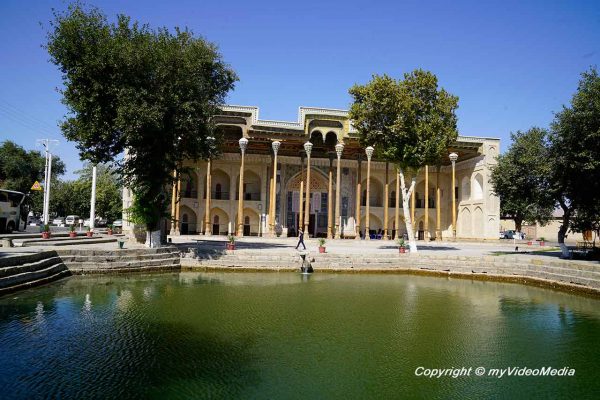
The pond in front of the mosque once served to supply the population with water. It is older than the mosque and called Bolo Haouz, children’s pond. The mosque dates from 1712, a small minaret next to it from 1917.
The mosque has a 10 m deep vestibule, which was used as a summer mosque. Ornate pillars with stalactite capitals and a richly decorated coffered ceiling make this building stand out.
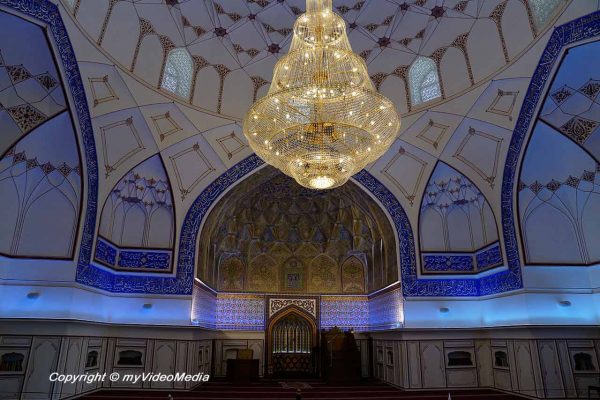
The interior of the mosque is illuminated in blue, just as many buildings in Islam have blue decorations. In Islam, the blue of the sky and of the sea is the color of inscrutability and infinity.
Ark of Bukhara
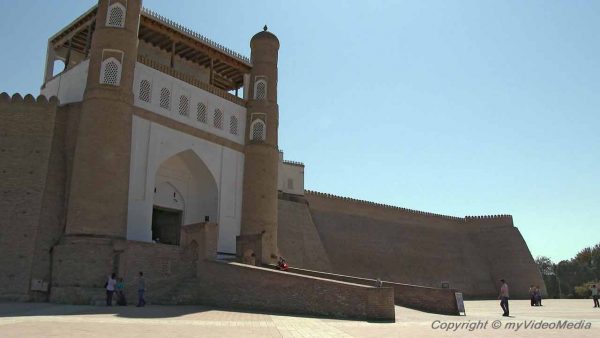
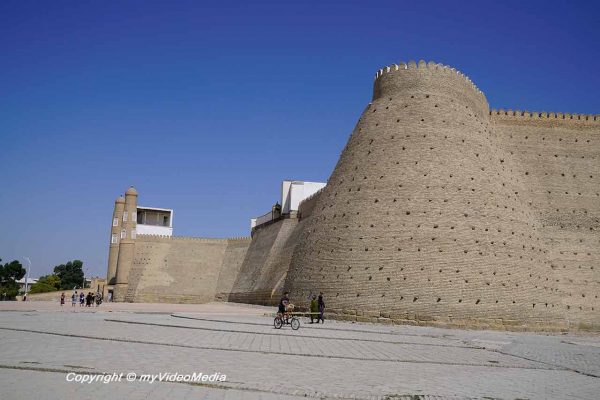
We cross the Registan and enter the Ark of Bukhara, a massive fortress. Right behind the entrance is the dungeon.
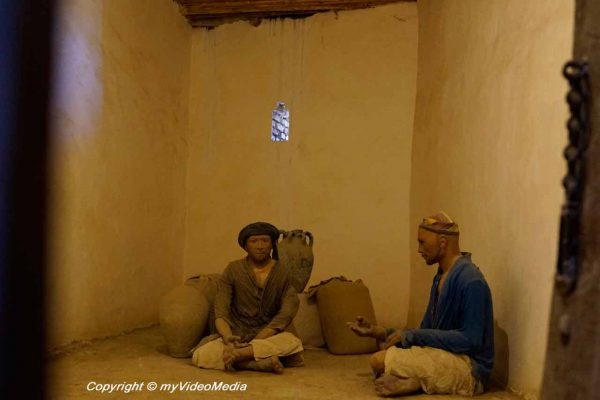
The Zindon, the former prison is a building of its own, northeastern of the fortress. Throughout history, the building has been destroyed and rebuilt several times, most recently under the Shaybanids.

At the end of the staircase is the Djami Mosque, the Friday Mosque, built in 1712. Again, we find artfully designed columns and ceilings. Afterward, we enter the throne room, where only a small part of the roof has been preserved.

So it presents itself as a large courtyard with canopies supported by columns. A staircase, guarded by a small stone lion, leads to the former treasury.
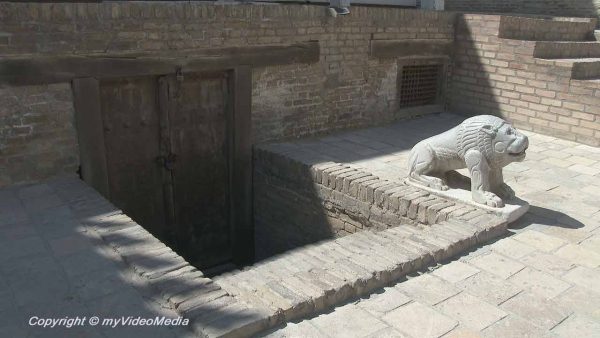
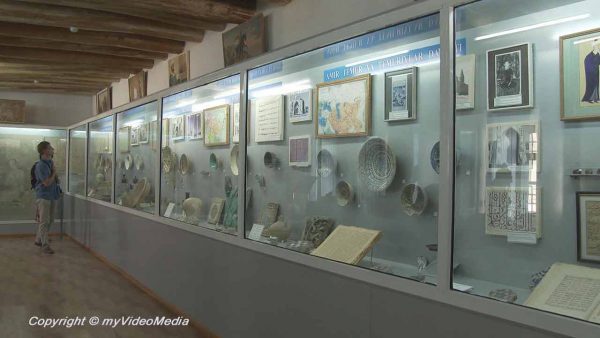
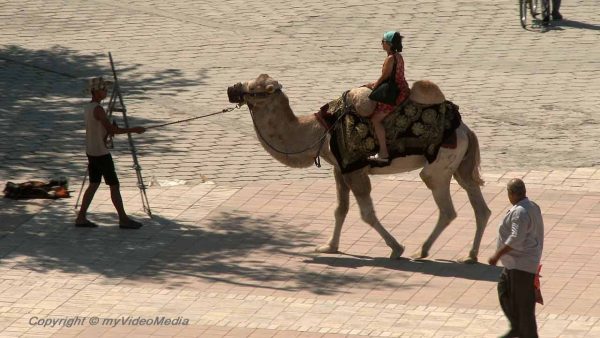
The former palace now houses a museum of regional studies. Besides to everyday objects, weapons, paintings and paintings are on display. From the platform in front of the palace, we have a very nice view over the Registan, where a lonely camel carries tourists around the square.
Back on the Registan, we marvel once again at the mighty walls of the fortress, before we continue to the center of Bukhara.
Please read on > Guided City Walk in Bukhara – Part2
Pin it for later
Text, photos and video: Copyright © myVideoMedia