After check-in at our hotel, we are on our way to explore the center of Helsinki. With over 600,000 inhabitants, Helsinki is by far the largest city in Finland.
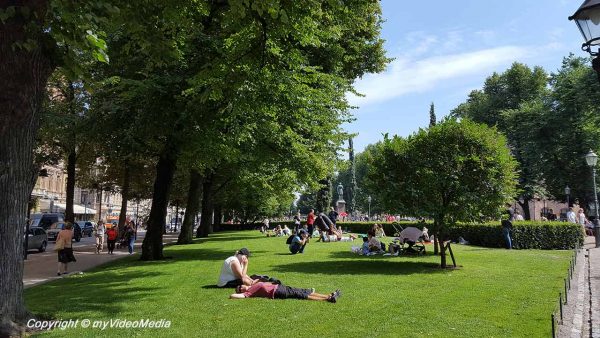
The sunshine attracts the people to stay outside and enjoy the summer. The green spaces around the Esplanadi extend from the harbor to the Svenska theaters. Young people gather here to enjoy a drink or have a chat.

Significant buildings line the side streets, the Eteläesplandi and the Pohjoisesplanadi.
All the chairs in the Cafe Kappeli are taken. On the opposite site, one prepares for the jazz concerts taking place in the late afternoon.

We walk towards the western harbor, also called Cholera basin. It got its name after an incident in 1893.
At that time, a trawler captain died of cholera during the autumn fish market and his boat was quarantined here.

To the right is a magnificent market hall, built in 1888 and very attractive to tourists. But we prefer to stroll between the market stalls in front the city hall.
You find delicious products from the region, like ready-made dishes or berries and mushrooms from the surrounding forests.

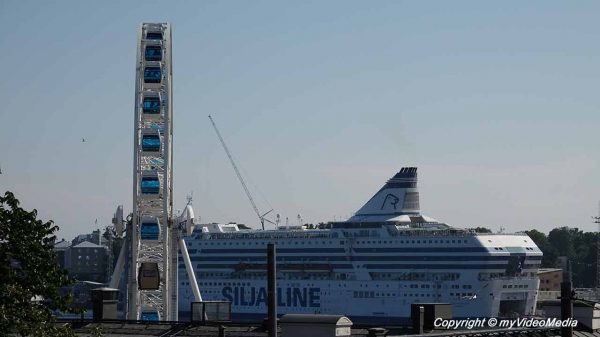
The MS Silja Symphony is moored in the port. Years ago, Ursula sailed on board of this modern ferry from Stockholm to Helsinki years ago.
We head north and reach the Helsinki Cathedral, already visible from afar.
The wide forecourt serves as a meeting point for tourists but is also the starting point for many sightseeing buses.
Please watch the 4K UHD video here
You are currently viewing a placeholder content from YouTube. To access the actual content, click the button below. Please note that doing so will share data with third-party providers.
More InformationThe Helsinki Cathedral stands on a hill and is accessible by a broad staircase. The Protestant Cathedral is characterized by its simple elegance.
From the forecourt, you have a nice overview of the Senate Square (Senaatintori) with the monument of the Russian Tsar Alexander II. On the left is the main building of the university.
Back at the port, we go east to the Uspenski Katedraali. We pass the Presidential Palace. Once the residence of Alexander II, it serves representative purposes today.

High on a rock is the Uspenski Katedraali. The Orthodox church was built in 1868. It is the largest Orthodox church in Western Europe. In former times, it was a symbol of the Russian rule over Finland.
The 13 golden domes are visible all over the city. Inside it is richly designed and decorated. Numerous icons are revered by the believers.

Between Uspenski Katedraali and the Presidential Palace is the home of the presidential guard. A changing of the guard takes place here once daily.

On the eastern harbor edge, a relaxation and entertainment area is under construction. Next to the Ferris wheel you will find a swimming pool with sunbathing area and restaurants in the future.
Back at Esplanadi, we watch the people as they enjoy the time after work on these long evenings. And we are lucky with the nice weather because one had warned us, that it often rains in Finland in summer.
We walk along the Kluuvikatu and the Aleksanterinkatu. The shops are already closed and thus the streets empty.
We discover the headquarters of Fazer, a brand known beyond the borders of Scandinavia for noble chocolates and other delicacies.
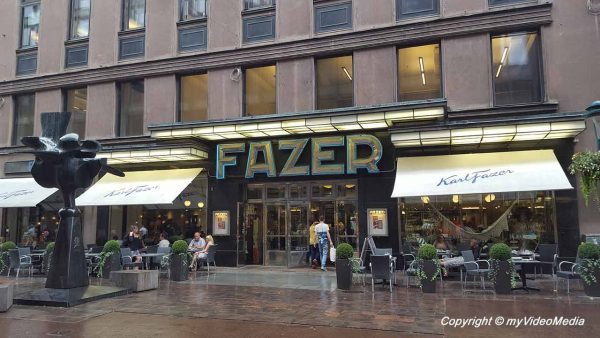
In front of the entrance stands a monument with the corporate symbol, a cock. In 1991, on occasion of the centennial anniversary of the company founding, one set up the Fazerin kukko, created by the sculptor Björn Weckström.
At the base of the monument is a relief with the portrait of Karl Fazer, the founder.
Please read on > Helsinki City Tour
Pin it for later

Text, photos and video: Copyright © myVideoMedia