Linz, the capital of Upper Austria lies at the exit of the valley, which was cut by the Danube River through the Bohemian Massif.
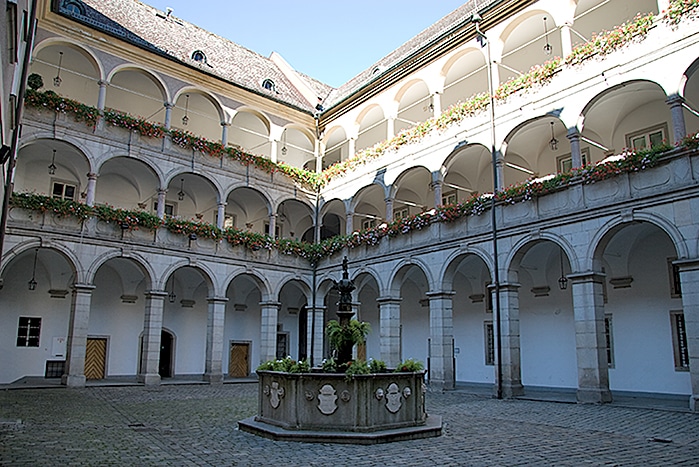
The old town of Linz is known for its Baroque houses and backyards of the Renaissance. One of the beautiful is the courtyard of the Landhaus, the seat of the Upper Austrian State Assembly.
The Kremsmünsterer Free House (Free House bishop’s court) was in the possession of the Emperor Frederick III until 1493. According to legend, Friedrich III died here.
In 1507 it was bought by the Kremsmünster Abbey and is still the seat of the Bishop of Linz.

In the immediate vincinity of the main square are the former residential buildings of the famous sons of the town, Adalbert Stifter and Johannes Kepler. In the StifterHaus one can find the Adalbert Stifter Institute as well as the Upper Austrian Literature House.
Please watch the video here
You are currently viewing a placeholder content from YouTube. To access the actual content, click the button below. Please note that doing so will share data with third-party providers.
More InformationIn the neighboring old cathedral, Bruckner was working twelve years as organist starting in 1856. The famous organ was named after him.
Already the Celts settled in Linz. During the Marcomannic Wars, the romans founded the fort Lentia. Afterwards, Linz belonged to the Bavarian dukedoms until 1210. Due to the occupation of Vienna by Matthias Corvinius, Linz was royal seat under Friedrich III.
He expanded the castle which had been built on the site of the Roman fort. The motto of the House of Habsburg, the letters A.E.I.O.U. are engraved at the Friedrichstor.

St. Martin’s Church, for the first time documentary mentioned in 799, was long considered one of the oldest churches in Austria in original condition.
Please read on > Linz – a city of culture
Text, photos and video: Copyright © myVideoMedia