Once more, we set off with the night bus. This time the journey leads us to Loei, 520 km north-east of Bangkok. We have a first class ticket for 430.- Baht per person (around € 12.-)
Despite the late hour, there is a busy hustle and bustle at the bus station Morchit. Talking with hands and feet, we get to know the stops of our bus. The 10-hour journey is calm and relaxed. On the way, we get something to eat. The rest of the time we try to sleep, which we succeed.
We reach Loei at 4.00 hours in the morning. But no one is there to pick us up, despite a previous announcement. We try to call all the relevant telephone number available, but everyone refers to someone else. Nobody can help us. At 7.00 clock finally appears a minibus with a driver and a tourist guide. Supposedly he was informed too late that we had already arrived. Glad that everything seems right again, we believe his excuse this time.
Chao Por Kud Phong temple and Kud Phong park
We start our tour in Loei and reach the Chao Por Kud Phong, a Chinese-Buddhist temple in the center of the town. Almost all the inhabitants of Loei are Buddhists. In a small pavilion is a golden column. We suspect it is a city pillar to protect the city and the inhabitants, similar to the one we have alreadyseen in Wat Chedi Luang in Chiang Mai.
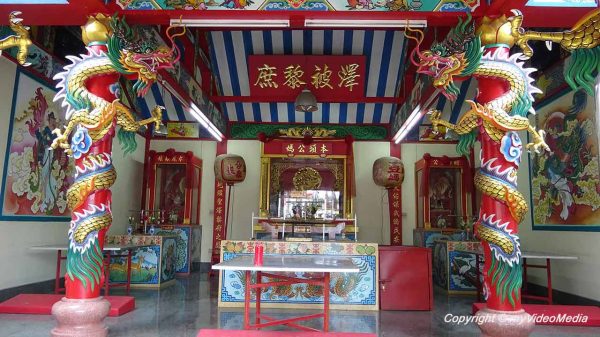
The temple is decorated with carved snakes and garuda, which is regarded as a royal emblem for the incarnation of Vishnu. A pedestrian bridge leads across the Loei River and we reach Kud Phong Park. Cultivated and planted with exotic plants and trees, it is the recreational area for the inhabitants of the town.

Rice mill
We continue to visit a rice mill. Rice is the capital of the region. The owner of the mill explains the functions of his machine. A series of belts drive vibrating sieves that sort the rice grains according to different sizes. The different kind of rice, like sticky rice, jasmine rice and rice for animals, get separated.
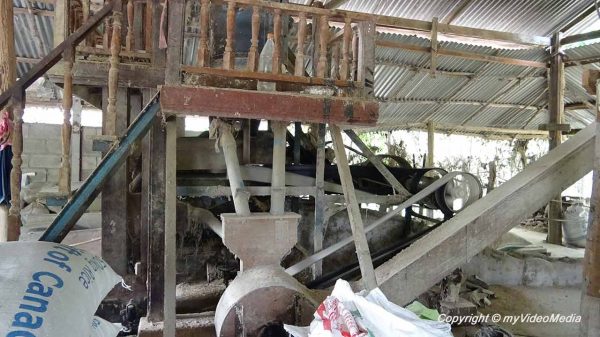
The 30-year-old mill serves 200 families who sort their crops here twice a year. As a mill owner, one already belongs to the upper class of the city and no longer has to work in the field.
The region is the world leader in the production of jasmine rice.

The owner of the mill also shows us their property, which includes teak trees and various fruits such as papaya, Chinese dragon fruit, and Rajom. They also produce curry for the local market and keep some chickens and ducks. Nowadays the farmhouse is made of stones and cement since the traditional wood construction becomes the victim of the termites. On the way home, a quiet companion joined us, who turned out to be our host for the night.
Typical residential building
In a quiet well-kept residential street, we can visit a typical house. We notice we have arrived in the countryside. It is quiet here, nature proliferates luxuriantly everywhere and there is hardly any stress. Compared to the city, the people have a better life here. The village makes a well-groomed impression, flowers bloom in the front gardens. The village won a prize of 300,000 baht at a contest, like “Our village shall become more beautiful”.

The ground plan of all houses is almost identical. On the ground floor are the kitchen, the laundry, and a storage room. There is a visitor area where one can greet guests. Besides, one still has built a bed here for the summer months.
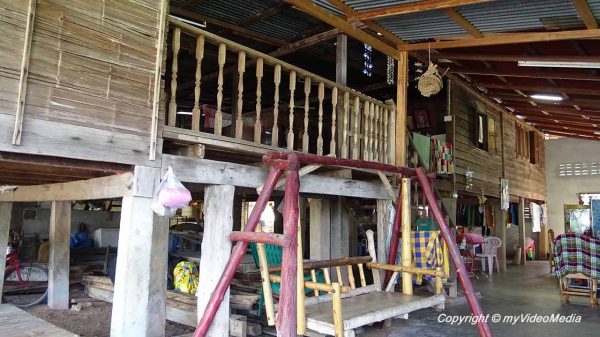
On the upper floor, a terrace serves as a meeting room and a place for the male offspring. The parents and the girls have their own separate bedroom.
You are currently viewing a placeholder content from YouTube. To access the actual content, click the button below. Please note that doing so will share data with third-party providers.
More InformationTantawangardenfood (Sunflower guards restaurant)
Located in a green natural setting on a small pond we get a wonderful lunch. We are a little exhausted from the night trip and thus not particularly hungry.

Even so, it was a pleasure to take a rest in these surroundings.
Paddy-fields
Rice as far as the eye can see. In the middle of a vast rice landscape, we learn more about the different varieties and the conditions for the harvest. One uses only organic fertilizer because otherwise, the rice is not for sale. Vast lands are harvested by machine. Small areas serve the personal use. Who does not have any land for rice is regarded as poor. The people harvest twice a year.
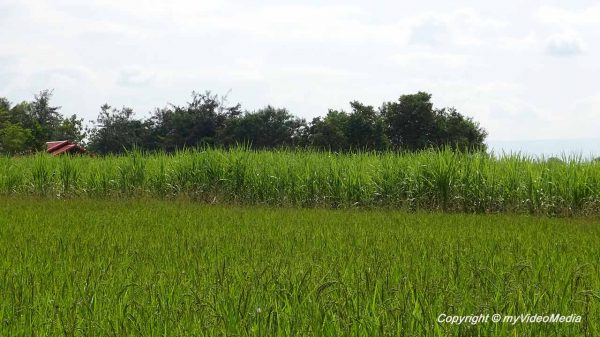
Thailand has a 35% market share. Other major rice producers are India and Vietnam.
Rubber Plantation
Last stop of our tour is a rubber plantation. 1 kg yield brings 17 – 20 Baht. After 6 to 7 years, one milks the plant for the first time. A rubber plant gets on average of 30 years old. In the hottest month of April, the harvest is stopped to spare the plant. It does not need any extra water but fertilizer. The best time to scratch the bark of the tree is around midnight.
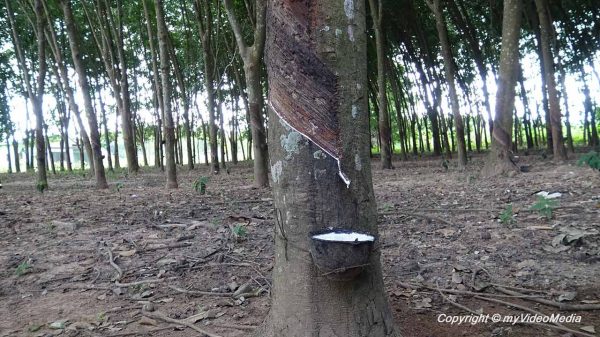
It takes two days until a pot with 1 kg of rubber is full. By means of chemicals, the rubber is converted into solid pieces, which results in a higher yield. Most rubber is meant for export.
Next -> A great place to stay near Loei – Sirila Farm Tent Camp Resort
Text, photos and video: Copyright © myVideoMedia