La Draga is a Neolithic settlement in Banyoles, which was discovered in 1990 during construction work for the 1992 Olympics. The finds date back to the 6th millennium BC. It is the oldest Neolithic village in Catalonia and the only Neolithic village of the Iberian Peninsula in a lakeside environment. A settlement can be proved over a period of 4000 years.

With the rise of the water level of the Estany de Banyoles (Lake of Banyoles), the settlement area was flooded and the finds, especially the organic material, remained in excellent condition. The excavated artifacts are carefully preserved under humid conditions, like in the lake water.
The discovery has revolutionized the understanding one had of the first Mediterranean Neolithic societies. Only few sites in Europe show a similar quality; To mention e.g Kastoria in Greece.
Please watch the 4k UHD video here
You are currently viewing a placeholder content from YouTube. To access the actual content, click the button below. Please note that doing so will share data with third-party providers.
More InformationIn the park, the reconstructions of huts and demonstrations of life in the Neolithic period bring the history to life.
At the entrance we are welcomed by Marta José Maria from Arqueolitic. We could feel Marta’s passion for archaeology and really enjoyed her explanations about the park and the excavations.
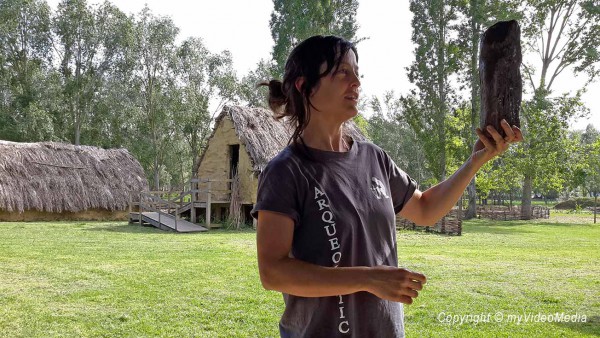
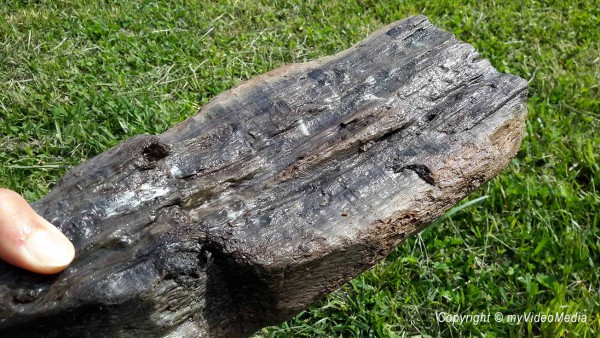
As a highlight we are allowed to hold a 7400 years piece of timber, once a piece of a Neolithic hut.
She explains the different forms of the huts, its usage and the finds. The finds range from household objects, simple tools for fieldwork to hunting weapons such as spears, bows and arrows.

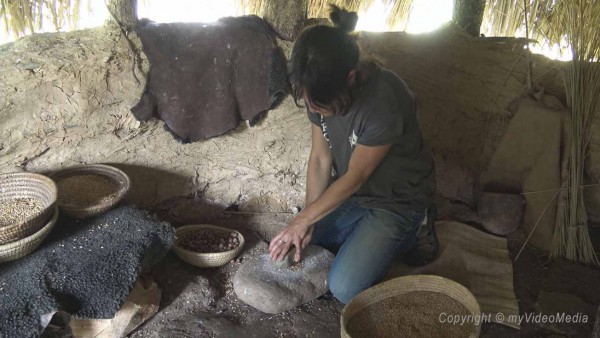
Marta vividly demonstrated some methods of food preparation. From the seeds and food particles found one can deduce the eating habits of the inhabitants.
The inhabitants were part of the Cardial Culture, or Impressed Ware Culture of the ancient Catalan Neolithic (5,200 – 5,000 BC). Their distinctive feature was a linear pattern which was imprinted in the clay with the shell of a cockle. A further characteristic feature is the round bottom of the clay pots. This is still an unsolved mystery, because in the period preceding and following it was common to have flat bottoms to ensure a stable stand.
More information about La Draga Neolithic Village Archaeological Park
Please read on > Romanesque paintings of Ravós de Terri
Disclosure : Thanks to the Tourism Board Costa Brava Girona as well as Consell Comarcal Pla de l’Estany for sponsoring the opportunity to explore La Draga. All views and opinions are our own!
Text, photos and video: Copyright © myVideoMedia