The village of Tasma is about 50 km northeast from Karakol. The women of the village specialize in the production of souvenirs made from felt. We have the opportunity to attend the “Foam, felt souvenirs master class”.
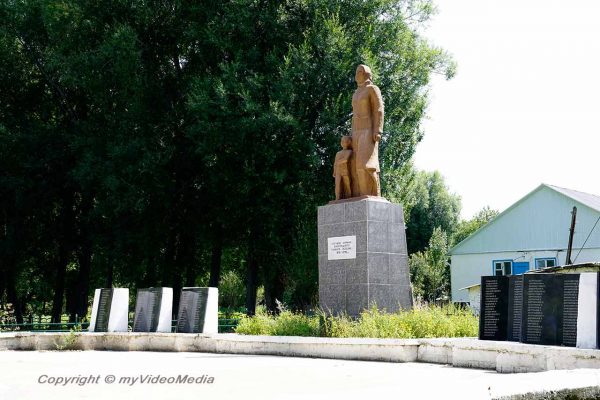
The production site for the for felt objects is right next to the war memorial.
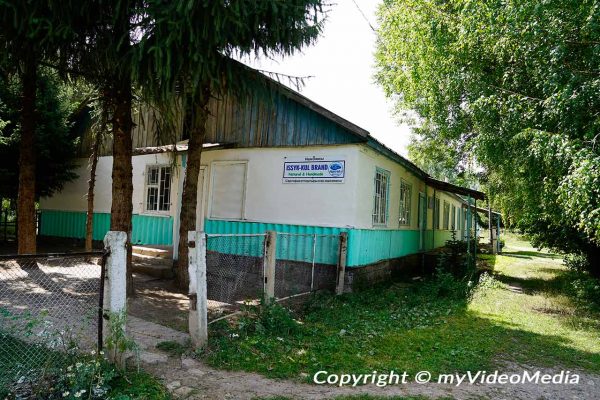
Once we arrive, we are a bit at a loss, because no one gives us an introduction. So we start filming.
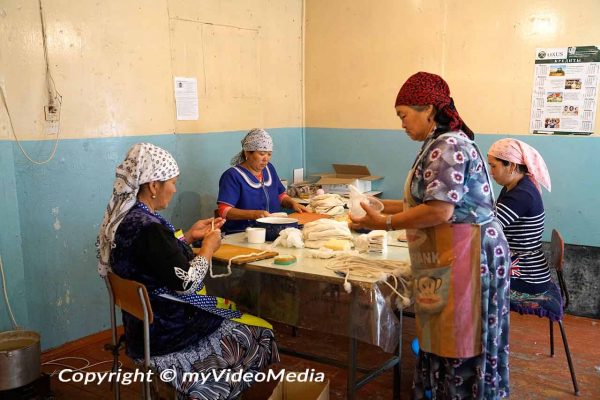
Then the boss Damira appears and explains to us the procedures.
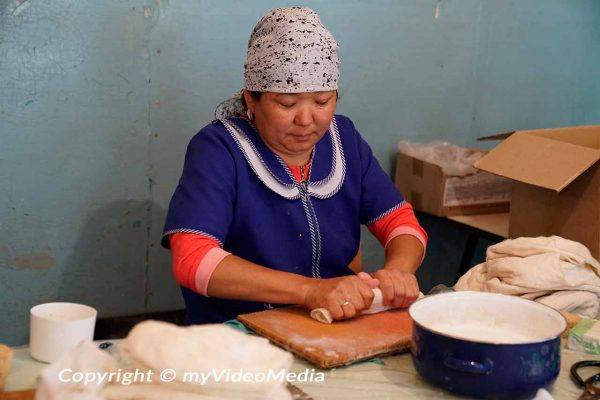
The felt is made of the wool of goats or sheep, by treating it with water and soap. Sometimes, one puts several layers on top of each other. By watering, squeezing and rolling, the felt hold together. Then it is brought in shape.
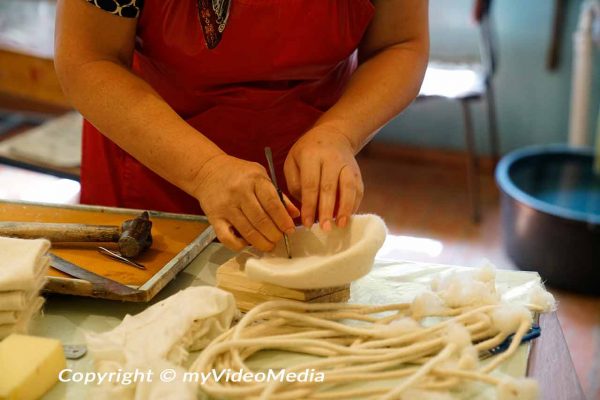
In the video, you see how one punches holes into the almost ready bag and produces and inserts a cord.
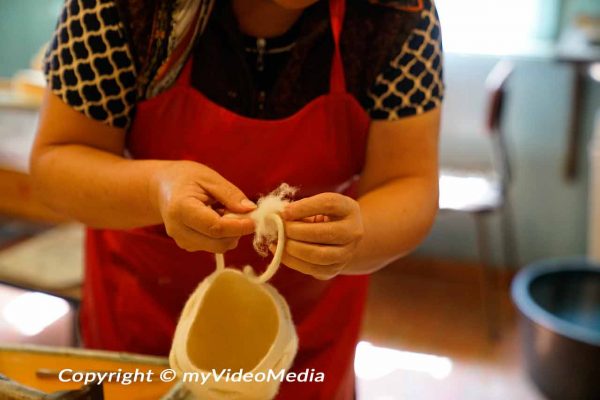
After completion, the products dry for 10 to 15 days.
In the end, we see the production of a purse made of felt. A construction drawing provides the exact data. In this case, a pretty motif is also applied. For pigmentation, one uses only natural colors, e.g. of nut, apricot, and grasses.
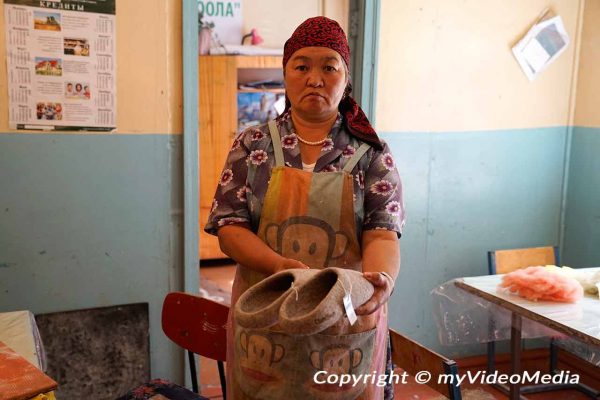
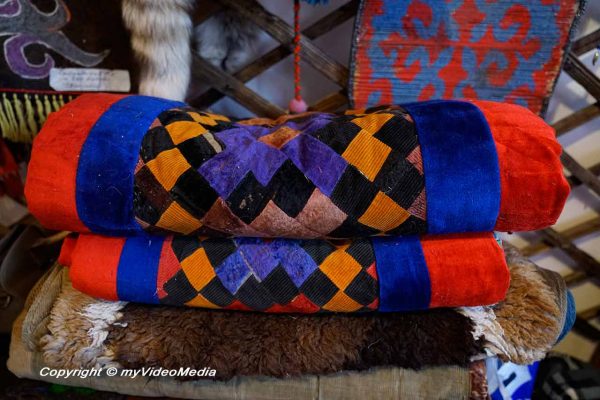
The ladies show us some other products, such as slippers, bags, pictures, and carpets.
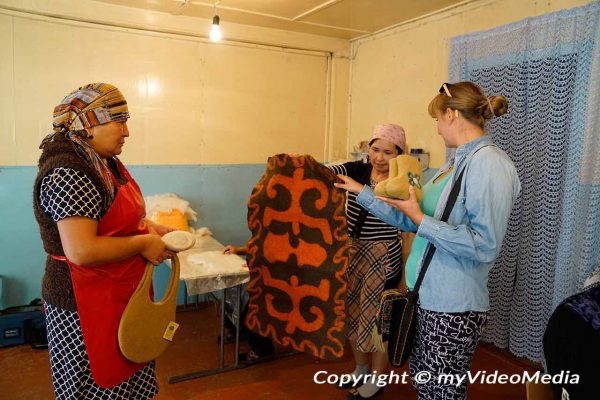
7 to 8 women work in this enterprise which was set up in 2003. Some are self-employed, but in such a small community, everyone helps everyone.
One produces mainly for the Japanese market. The bags are used to store jewelry or make-up. They are sold for Som 250.- (about € 3.00). It is an exhausting and hard work, which also requires concentration.
Unfortunately, an indisposition on my part also cast its shadows and I had to leave the room for a while because of nausea.
Damira also talked about her grandmother Tolgonai ene, who founded this craft and passed on her knowledge to Damira’s mother. Damira’s mother, as a single mother, was able to pay her debts and secure her living. We can see a picture of her in a small museum in Karakol, where we will drive afterward.
In front of the door, a huge apricot tree catches our eye. Its fruit would certainly have covered the daily needs of Vienna to produce apricot dumplings.
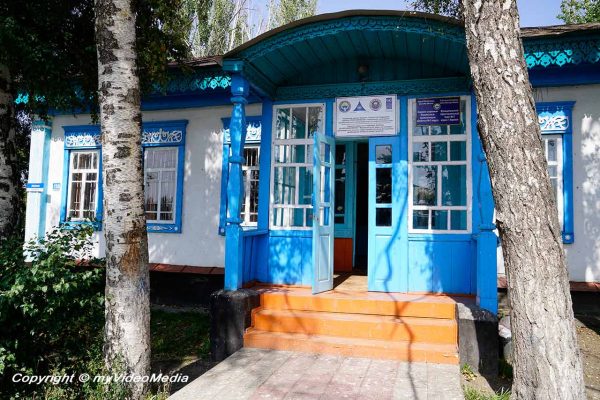
Back in Karakol, we go to the Tolgonai ene Collective People Yurt center. The image of Tolgonai ene dominates the space. Tolgonai died in 1987 at the age of 104.
Please watch the 4K UHD video here
You are currently viewing a placeholder content from YouTube. To access the actual content, click the button below. Please note that doing so will share data with third-party providers.
More InformationThe small museum also serves as a training room for the felt production master classes.
Unfortunately, I’m feeling discomfort and I have to go outside. Fortunately, we still have Uzara drops in the hotel. So the stomach problems are over the next day.
Please read on > Dungan Village Yrdyk and Family Dinner
Pin it for later
Disclosure: Our trip was organized in cooperation with Discover Kyrgyzstan, and made possible by the support of the United States Agency for International Development (USAID). All opinions are our own.
Text, photos and video: Copyright © myVideoMedia