The Museo Nazionale Romano, also known as Museo Palazzo Massimo alle Terme, is next to the central station in Rome, Termini. The archaeological collection of the museum is one of the most important worldwide.
We were fortunate to accompany a tour organized by Context Travel under the guidance of Dr. Lauren Golden. Dr. Golden guides us with enthusiasm and professional competence through the exhibition.

Already at the entrance, in front of the statue of Minerva, she gives us an insight into Roman sculpture in accordance with the Roman history, which gives deep insights into the everyday life of the romans.

The statues of Augustus shown as chief priest of Rome, the Boxer of Quirinal and the Seleucid prince count as the most important exhibits.
Both last-mentioned statues are Greek originals from the 4th century B.C. They belong to the 7 most important still preserved bronze statues worldwide.

The Roman sculptures were initially Greek copies, however, the art continued to developed . The statues got Roman facial features, since the people worshiped their ancestors busts and statues at home.
Later, the statues became part of Roman policy. Statues were erected when struggling for the power in the whole empire almost like in an election campaign.
Please watch the 4K UHD video
You are currently viewing a placeholder content from YouTube. To access the actual content, click the button below. Please note that doing so will share data with third-party providers.
More InformationIn addition to sculptures a series of mosaics can be seen on the ground floor.
On the first floor you find Roman mural paintings. Using the exhibits, Dr. Golden explained the four Roman styles. Beautiful examples from the villa of Julius Caesar villa are displayed.
Two further rooms represent the third style, which uses spatially plastic paintings, usually with a large picture in the middle and elaborate ornaments above. The ceilings were covered effortfully with marble decorations.
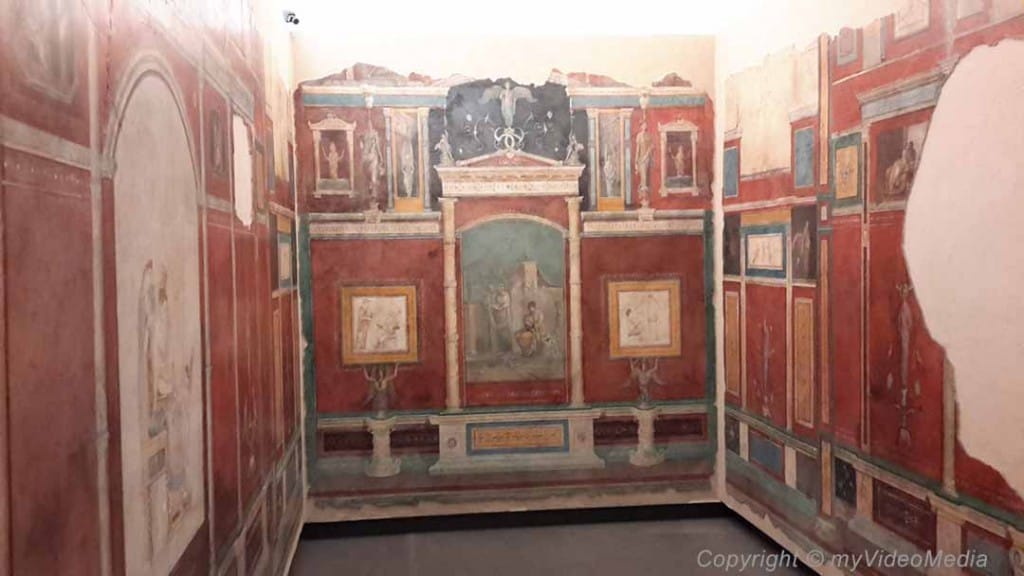
Very interesting is a dining room (party room) which was designed very dark, so that soot and other deposits were not always immediately noticeable.
Highlight of the guided is a garden landscape from the Villa di Livia (Livia’s Villa) which presumably belonged to Livia, the woman of emperor Augustus. The entire room was painted all round with plants, trees with fruits and birds. A complete, well-preserved painting of a room of this size should not be found a second time.
You find garden landscapes in each style period, but mostly they were assigned to a period only based on small details.

During this guided tour we have learned a lot from our guide and we like to express our special thanks to Dr. Lauren Golden. With her interesting stories she made the visit very vividly and entertaining.
Please read on > Visiting the Colosseum
Pin it for later

Disclosure : We were kindly invited by the Context Travel and as always, all opinions about our experiences are our own.
Text, photos and video: Copyright © myVideoMedia
Great video.
How can I contact the guide?
She does an amazing job.
thanks
Francesco
Thanks. You might get more info via Context Travel see link in the post