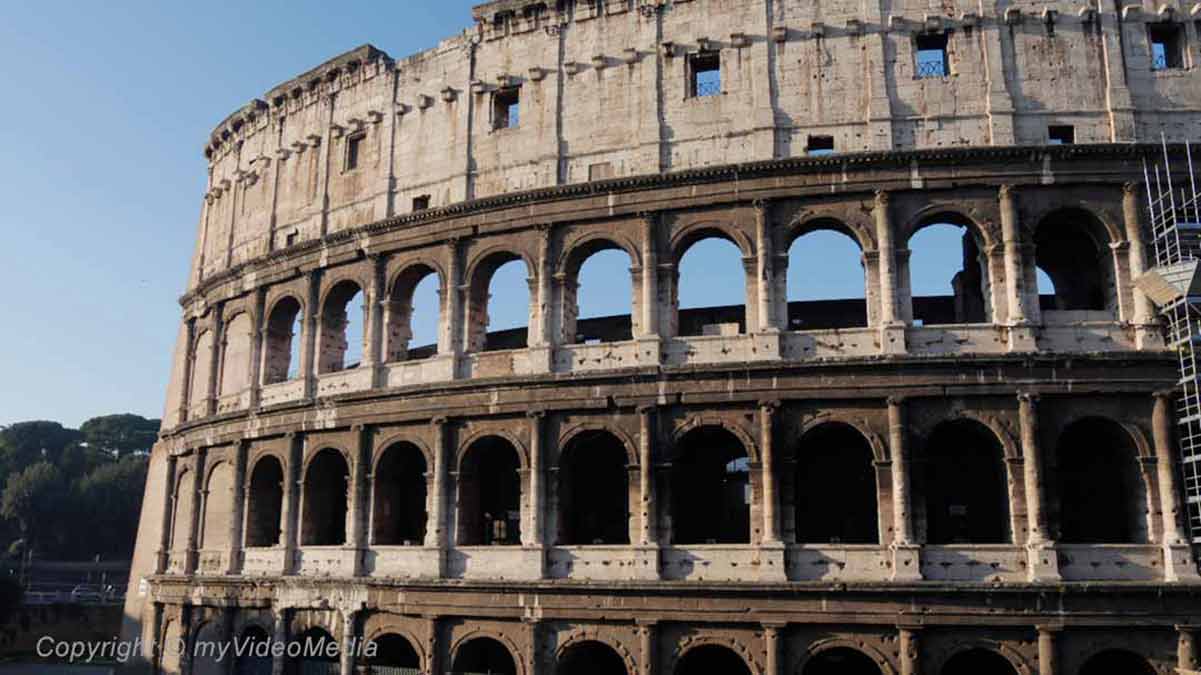
The Colosseum in Rome is the symbol for the architectural achievements in ancient Rome and at the same time landmark of the city.
The tour lasts 4 – 5 hours and includes not only the Colosseum, but also the Palatine Hill and the Roman Forum. This video shows only the first part. The small group of four participants makes the tour more a visit than a group guided tour.
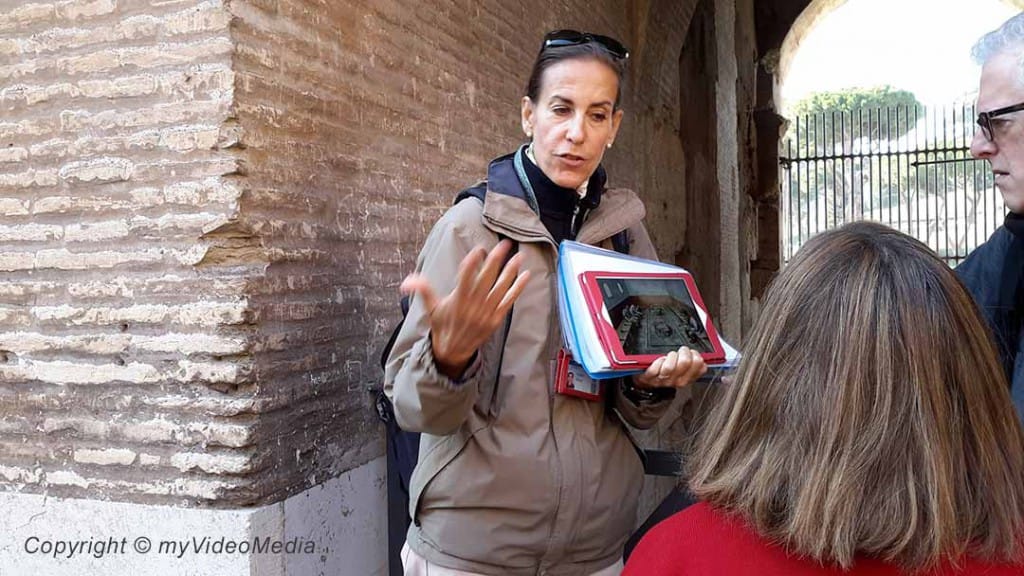
Our tour guide was Ms Livia Galante, who had previously worked here as an archaeologist. This experience enabled here not only to explain all the details of the construction, but also to answer every question in depth.
In addition, she had a thick file of printouts as well as photos on her tablet which show the buildings and their location in the different epochs, some as a 3-D model. Thus, this the tour turned out a lively and entertaining experience.
The Colosseum was built between 72 AD and 80 AD by the Emperor Vespasian, after the old one was destroyed in the great fire of Rome.
The location selected was the garden and an artificial lake around Nero’s palace, between Esquilin and Palatin (two of the seven hills of Rome), to give the people one piece of this huge palace complex back again. For the inauguration, the 100-day games were organized.
4K UHD video: Roma Antica Tour – Colosseum
You are currently viewing a placeholder content from YouTube. To access the actual content, click the button below. Please note that doing so will share data with third-party providers.
More InformationThe building had 80 entrances, 4 of which were reserved to the upper class. Thus, the arena was cleared in five minutes. The emperor had his own direct access from the Palatine so that he could appear from nowhere in the arena. The Coliseum offered space for about 50,000 spectators and was 450 years in operation.
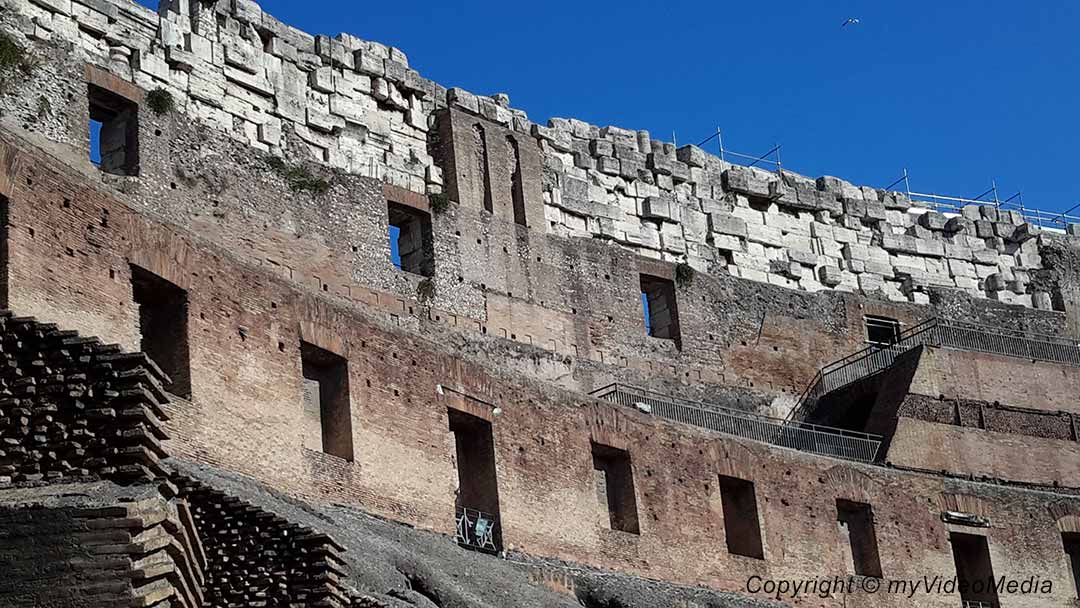
The outer walls were built with solid stone blocks. The blocks had to be lifted up by elevators to 54 m of height on the third level. The outer wall is interrupted by arches, otherwise, the building would collapse of its own weight. It had a tent roof that could be closed depending on weather conditions.
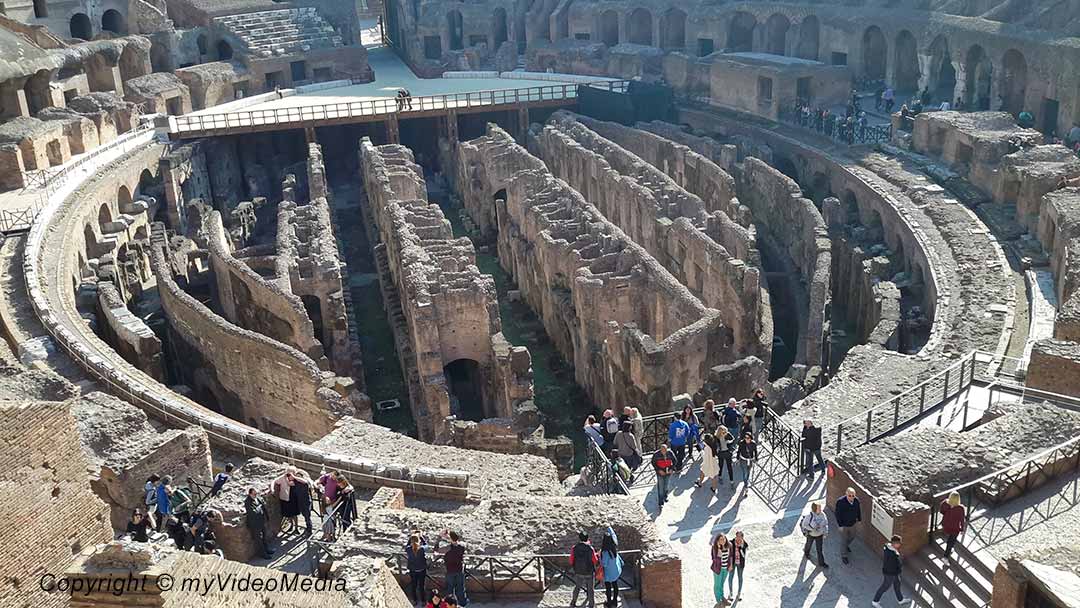
The basement, where the dungeon entrances, the cages for wild animals and the complex stage technology were concealed, was erected at a later stage. At the beginning the basement was used for naval battles.
The sealing slurry was of lower quality, one assumes that the Colosseum was not sealed against the water. The upper masonry was built with low-quality bricks as well, because this part could not be seen from below.

We learned of Ms. Galante that the Romans also used triangular bricks and already scratched graffiti in the walls that showed gladiator fights. In addition, a lot of color was used for the wall design and sculptures. Unfortunately, the color cannot be seen anymore.
Cross-shaped grooves in the walls had nothing to do with Christianity. They were used for the wall mounts of the wells. Even toilet facilities were in operation. The toilets did not have any physical separation and the use was perceived as a communicative event.
Impressed by the gigantic proportions of this building and the overwhelming amount of information we left the Colosseum, where even Christians died, but not because of their faith.
Please read on > The Baths of Caracalla
Pin it for later

Disclosure : We were kindly invited by the Context Travel and as always, all opinions about our experiences are our own.
Text, photos and video: Copyright © myVideoMedia