The Tiger Temple in Thailand was regarded as a tourist attraction for a long time. It is located northwest of Bangkok near the border to Myanmar in Kanchanaburi province.
Allegedly, the Monks got the tigers as a present from the residents and they reared them the temple. Already for a long time, the animal and species protection organization “Care for the Wild” raised serious allegations against the temple, due to not appropriate care and much more.
Tiger Temple – Wat Pa Luangta Maha Bua
Since we are in the area anyway, we use the opportunity to get a personal impression of the temple. At the entrance to the temple area, we notice an enormous concrete shell for a new temple building. Unfortunately, we miss to film it, but it is very clearly visible in Google Earth. At the gate, we were not allowed to enter with the camera and the tripod. First, we thought for security reasons, but as it turns out quickly that this was not the reason. We were quickly sent to the Tiger Canyon, a small valley surrounded by rock walls. Solid iron bars prevent the visitors from entering. Only those who pay the equivalent of € 20 are allowed to enter, but not allowed to take own photos. However, this was the reason, why we came here. We renounce this dubious pleasure and film the approx 20 tigers from outside.

We can not say whether the tigers are under the influence of drugs, to this we lack the expertise. Undoubtedly it was not enjoyable for the tigers to lie chained for around 4 hours in the midday heat. Visitors may enter together with an employee and pet a tiger, while the staff takes the photos. At least now we understand the arguments of “Care for the Wild”. We go further and find a chained young tiger guarded by a woman under a tree. She makes sure that one does not get too close and stays in an upright position. Otherwise, the Tigers could interpret this as an invitation to attack.
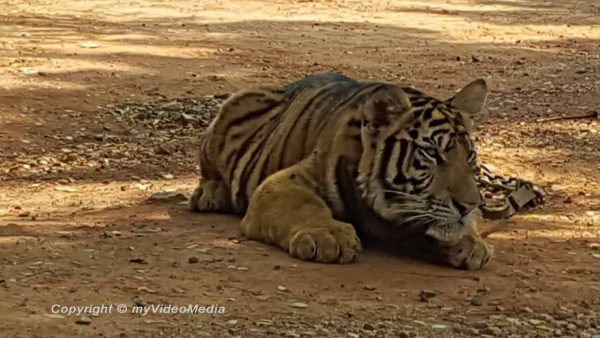
We get into a conversation with a volunteer from India who spends some months here to do something for the protection of the tigers. He tells us that approximately 140 tigers live here. He assured us that the petting zoo will be abandoned and a large outdoor enclosure for the tigers is under construction. The visitors then have the possibility to see the tigers only from a palisade walkway.
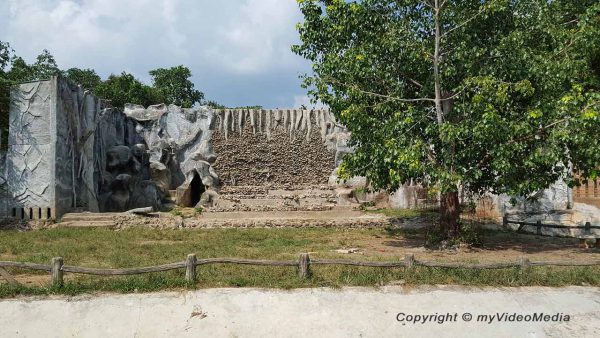
Somewhat reassured, we look at the rest of the open area, where the cattle lives together with deer and wild boar.

New developments
In May 2016 during a raid in the Tiger Temple, 40 tiger cubs were found in a freezer, and later another 30 preserved carcasses of young animals. Likewise, a Binturong (endangered civet) and a lion that had been kept in secret were found in a freezer. So far, the temple has refused the extraction of the DNA of the tigers. One wanted to know if the tigers are from Thailand. Now one knows that most of them were Bengal Tigers, which are not indigenous in Thailand. Thus, the allegations of the environmental organization Cee4life have confirmed, that illegal pet trade was operated here. The temple held its own tiger breeding station in order to supply the illegal black market.
Now the Tiger Temple is closed, hopefully forever, and the animals were distributed in State breeding centers.
You are currently viewing a placeholder content from YouTube. To access the actual content, click the button below. Please note that doing so will share data with third-party providers.
4K UHD video -> Visiting Wat Pa Luangta Maha Bua
Buddhism in the southeast Asia today
The Buddhism is often heralded as a gentle religion, but to some extent, this emerges as a facade. After a number of trips to Asia (China, Singapore, Indonesia, Malaysia, Vietnam, Cambodia), it seems to us that Buddhism, like any other religion, has a substantial need for power.
The Tiger Temple is not the only scandal temple in Thailand.
Another example is the Dhammakaya temple with the abbot Phra Dhamachaya, who shall be arrested by the police for embezzlement of billions of euros, but till now in vain. Abbot Phra Dhamachaya considers himself as to be the reincarnation of Buddha. The power of this temple now even constitutes a threat to the military junta.
How Buddhist monks behaved themselves in Tibet, we experienced already during our visit years ago.
In Myanmar it comes to genocide against the Muslim population, perpetrated by Buddhists.
In Thailand, we have found several examples, which made us suspicious. Two obvious Buddhist tour guides definitely showed impulses to proselytize and tried to convince tourists from Buddhism. When we asked, how much of the income an average person is spending per month for the temple, both in Thailand and in Cambodia, we got the answer at least 20%.
Hopefully, the development does not end like in Angkor, when the temple consumed more resources than the rest of the population was able to generate.
Text, photos and video: Copyright © myVideoMedia
Thanks so much for sharing and helping to raise awareness about the Tiger Temple. Thailand is on my list of plans, and I’m not sure I will enjoy this aspect of travel there, but I feel it is important to expose it.
Thank you very much for your feedback.
Thailand is a beautiful country and if you neglect these kind of attractions you will have a great time
How can people visit these monstrosities and think they’re such wonderful experiences? it reminds me of when we used to put black people in circuses just because of the color of their skin. When US soldiers would collect Japanese skulls in WWII as trophies. People think just because it’s an animal that it doesn’t matter. Well they thought that about the blacks and Japanese and now we know better. Animals are no different; we’re all citizens of the earth so why are we so cruel simply for entertainment? 🙁
Thanks for your comment. We couldn’t understand, why people make photos with these poor animals.
We are very happy that this came to an end. But unfortunately there are many more of these “attractions” in the world