The street life in Lhasa, the administrative capital of Tibet, China, mostly takes place around the Jokhang Temple, which is the religious center of Tibet.
The proportion of Han Chinese in Lhasa is around 20%, which is mainly concentrated on the Inner City District Chengguan.
Please watch the video – Part1
You are currently viewing a placeholder content from YouTube. To access the actual content, click the button below. Please note that doing so will share data with third-party providers.
More InformationHere, the proportion of Han Chinese is about 35%. Members of the army are not taken into account.
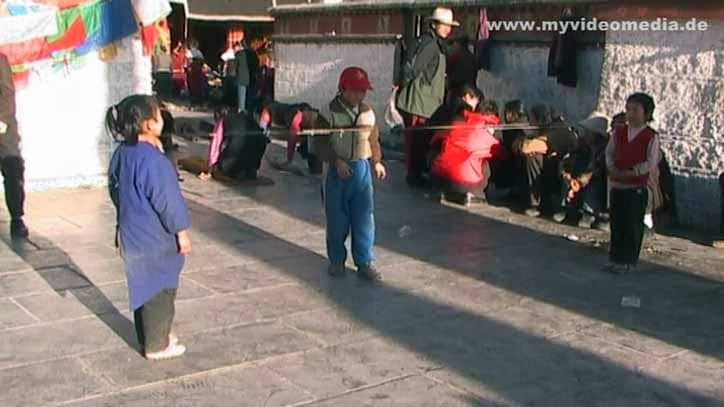
In Tibet, the everyday life and religion can barely be separated from each other, so that it does not astonish it that merchants, pilgrims and playing children casually mingle with the rest of the population.
Please watch the video – Part2
You are currently viewing a placeholder content from YouTube. To access the actual content, click the button below. Please note that doing so will share data with third-party providers.
More InformationAlong the innermost of the three pilgrim routes, pilgrims move around in the temple in a clockwise direction while walking on a 0.5 mi. long Barkhor. When in front of the temple, many throw themselves flat along the ground.
Some pilgrims also move this way from their home villages to the temple, and measure the path in the number of body lengths. Spinning the prayer drum or prayer mill means that the prayer is being read for every turn.
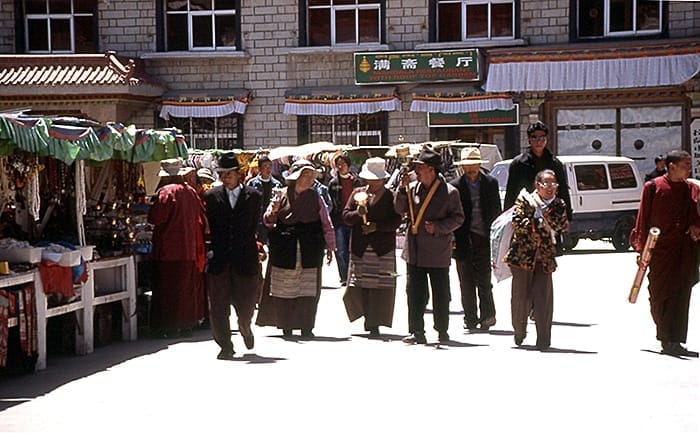
From a western point of view Lhasa is still a mysterious town on the roof of the world. Impressions from the streets of Lhasa provide some insight into the everyday life of the people.
Please read on > Norbulingka, the summer palace in Lhasa
Pin it for later
Text, photos and videos: Copyright © myVideoMedia