After landing at the airport Pulkovo in St. Petersburg, our guide Vera and the driver Gerna expect us already at the airport. During our city tour by car in Saint Petersburg we also visit Catherine Park 25 km south-east of St. Petersburg and the Hermitage Museum.
Pushkin
First, we do not drive towards the center of St. Petersburg but to the south to the city of Pushkin. Pushkin was Russia’s national poet. He spent 6 years here, visiting the Lyceum in Zarskoe Selo (Tsar village), as the village of Pushkin was called at that time.
After the October Revolution, one called it Detskoje Selo (Children’s village). One accommodated orphaned children in the Alexander Palace. Later, Pushkin spent a few years there with his family, until he died. The admiration of Pushkin by the population can be explained by the fact, that the nobility in Russia spoke French until the Napoleonic Wars. Pushkin’s works led to a change of heart.
At the entrance of the city, we pass the Egyptian Gate and the Cathedral of Saint Catherine. The cathedral was destroyed by the Soviets and restored only in 2010. Afterwards, we reach Pushkin’s house, which is now a museum.
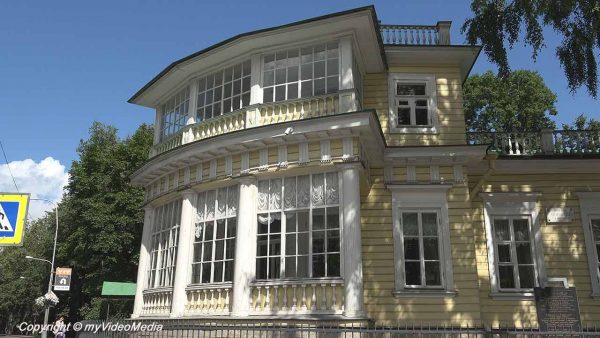
During our visit, the Alexander Palace is closed for restoration. Catherine II built the palace for the future Emperor Alexander II. He gave the building to his brother Emperor Nicholas I.
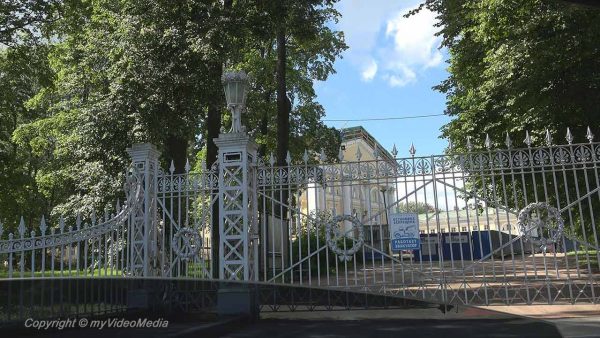
The building served the last Czar Nicholas II and his wife Alexandra as a permanent place of residence. Here they lived a secluded life until their deportation, to protect their son, who was a hemophiliac.
After visiting the Catharine Palace, we leave Pushkin again and drive via the Moskovsky Prospect (Moskovsky Ave) to the north, in the center of St. Petersburg. This boulevard was once the connecting road between the Summer Palace (the Catherine’s Palace) and the Winter Palace (Hermitage) and leads directly to Moscow today.
Moskovsky Prospect
Buildings from the Stalin era characterize the boulevard. It starts at the Victory Square where a huge memorial reminds of the 24 to 40 million dead of the Soviet Union.
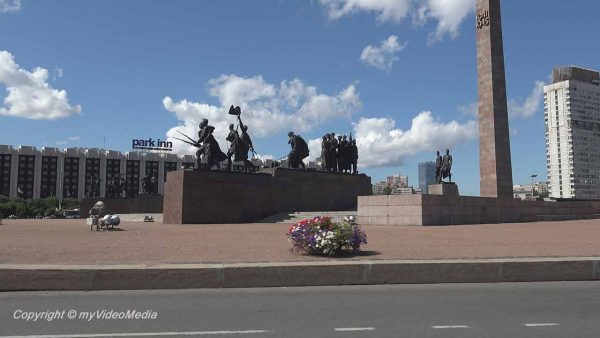
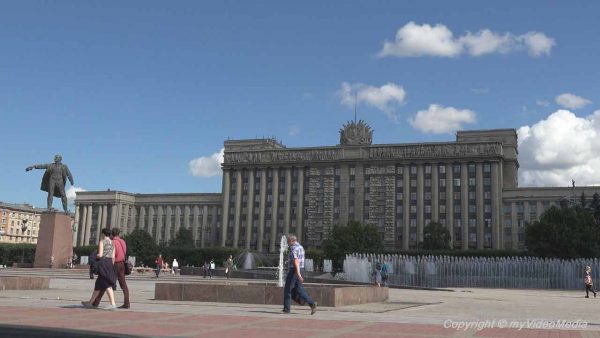
Particular attention is paid to the deaths of the siege of Leningrad, some 1.1 million people died from starvation. One of the most monumental buildings is the House of the Soviets with a typical Lenis statue on the square in front.
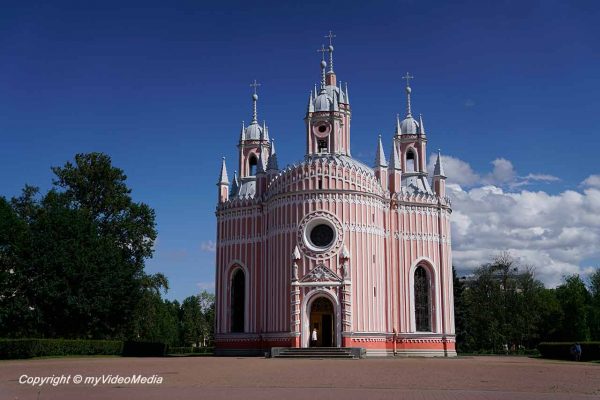
We take a little detour to see the Chesme Church. The pink and white façade is reminiscent of gingerbread style. The church commemorates the victorious naval battle in the 5th Russian Turkish War.
Afterwards, we pass the university on the left and the semicircular Russian National Library. On the round administration building of the region, we see the coat of arms of St. Petersburg. Two crossed anchors, a stock anchor and a drag anchor, recall the maritime past of the city.
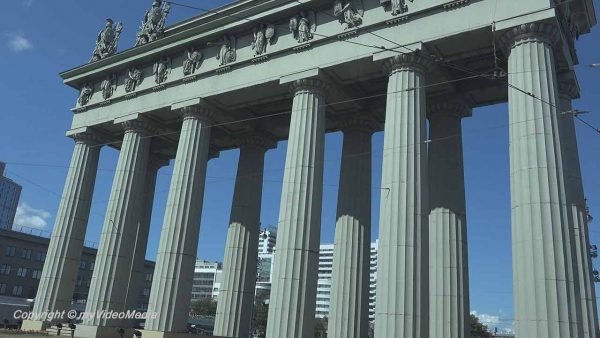
The Moscow Triumphal Gate recalls victories against Persia (1828), Turkey (1829), and the November revolt in Poland (1831, 1838) under Tsar Nicholas I.
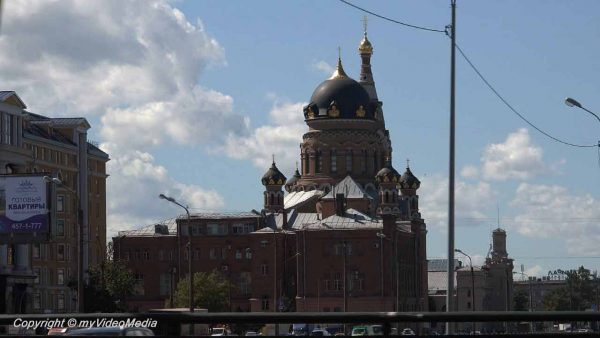
When crossing the Obvodny Canal, we can take a look at the Church of the Resurrection. Its tower reminds of a vodka bottle. This church was built with donations of former alcoholics.
Center of St. Petersburg
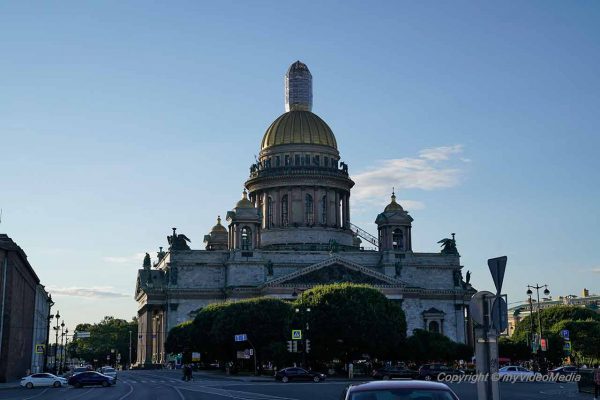
We reach the center of St. Petersburg at the. St. Isaac’s Cathedral is the largest cathedral in the city and one of the largest sacral dome buildings in the world. It offers space for 10.000 people. The dome has a diameter of 26 m. It was the first dome in metal construction worldwide. The height of the cathedral is 101.5 m.
On the left is the central exhibition hall Manege, a museum in the style of a Greek temple. To the right, in the middle of a small parkland, we see the equestrian statue of Peter the Great.
We reach the Neva river and circle the Admiralty building and the Hermitage Museum in search of a parking lot. The Admiralty houses the supreme command of the Russian Navy. It is the geographic center of the city, to which all major roads are aligned.
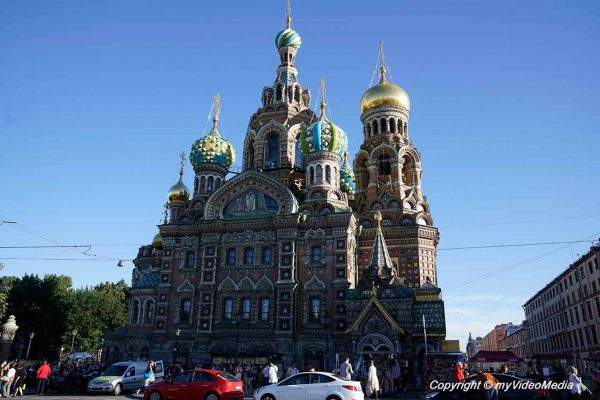
After visiting the Hermitage, we go to the Church of the Savior on Spilled Blood. It is the only church in Russian Orthodox style in St. Petersburg. It was erected on the site (1883 – 1912), where Alexander II fell victim to an assassination attempt.
Newsky Prospect
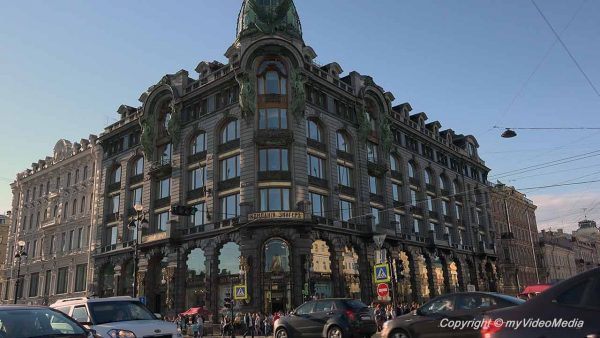
Along the Griboyedov Canal, we reach Nevsky Prospect. It is the grand boulevard of St. Petersburg. Here all the aristocrats have erected their palaces. Right at the corner stands the Singer (sewing machine) house, once the headquarters in St. Petersburg. The splendid façade shows the business climate in the city at that time.
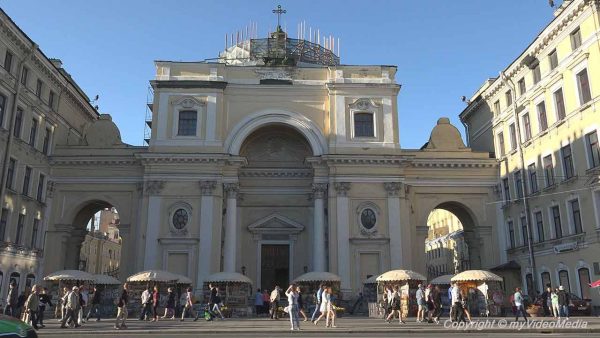
One block further is the Catholic Church of St Catherine and on the right is the Alexandrinsky-Theater.
The Anichkov Bridge over the Fontanka river with its equestrian statues is said to be the most beautiful bridge of St. Petersburg. At the corner stands the Beloselsky-Belozersky Palace. Today it houses a museum for the development of democracy in modern Russia.
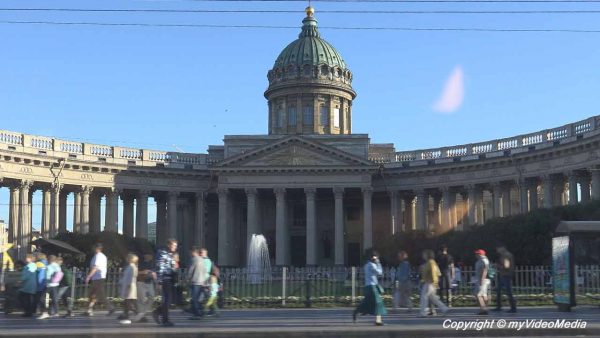
We drive to the roundabout around the Obelisk at Vosstaniya Square. On the way back, the Kazan Cathedral, a replica of St. Peter’s in Rome, stabs us into the eye.
Once again in the center of St. Petersburg
In front of Isaac’s cathedral, we still have time for a photo shoot. Here is the Monument to Nicholas I. It is one of the few equestrian statues in the world where the horse stands only on the hind legs and is not further supported by the tail.
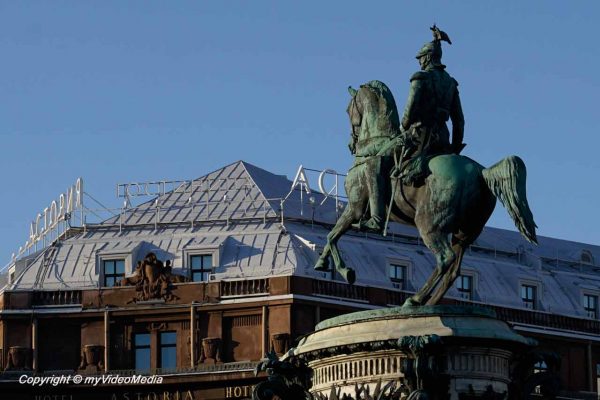
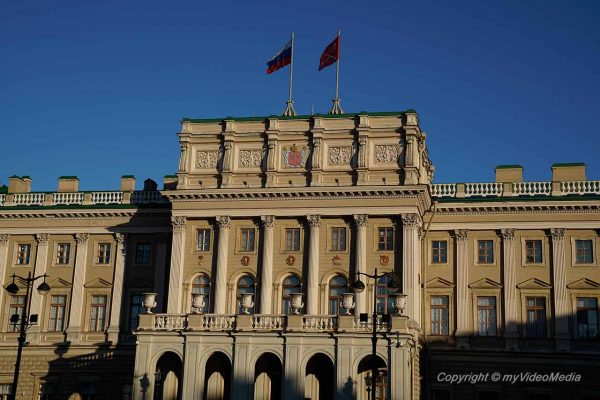
To the south of the square is the Mariinsky Palace, also known as Marie Palace, named after a daughter of Nikolaus I.
First it was the official residence of the Dukes of Leuchtenberg, later the seat of the State Council of Imperial Russia, State Chancellory, and Soviet of Ministers. Today it is the seat of the Legislative Assembly of St. Petersburg.
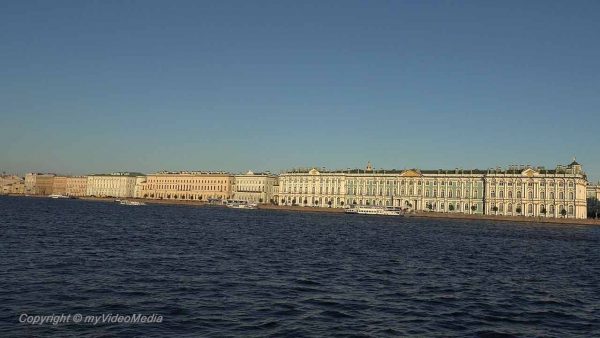
We cross the Neva River via the Blagoveshchenskiy Bridge. On the other shore is the Academy of Fine Arts, the Menshikov Palais as part of the University, the Museum of History of the City of St. Petersburg and the Zoological Museum.
Please watch ther 4K UHD video
You are currently viewing a placeholder content from YouTube. To access the actual content, click the button below. Please note that doing so will share data with third-party providers.
More Information(Music: The Orchestra of the Catherine Palace)
From here one has the most beautiful view of the bridges of the Neva river and the fantastic front of the Admiralty building, the Winter Palace and the Hermitage.
Via the Kronverkskaya Nab, we pass the Hare Island with the Peter and Paul fortress. Part of the fortress is the Saint Peter and Paul Cathedral which houses most of the tombs of the Russian emperors since the 18th century. The fortress was also used as a prison, many famous prisoners were jailed here.
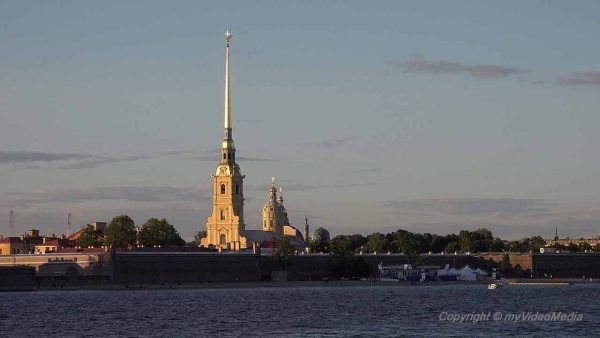
On the side to the Neva, the fortress was covered with granite. On the back, which was not visible from the Winter Palace, one saved themselves the effort. Originally the fortress was planned as the center of the city.
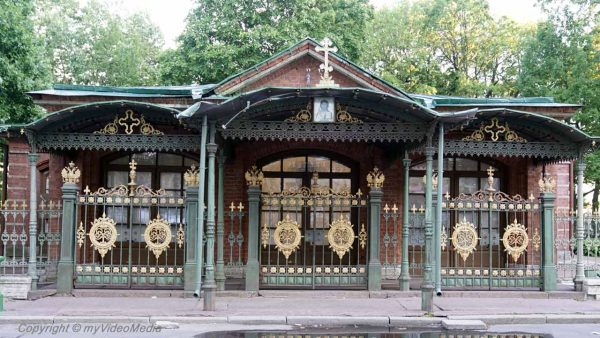
A few meters away stands a small but precious decorated cottage. It is the outer cover of the house, where Peter the Great lived when he founded St. Petersburg in the marsh district.
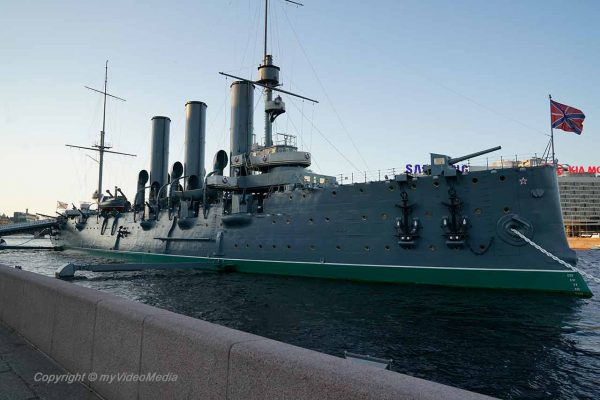
The Russian cruiser Aurora lies at anchor just a few meters away. A shot from its forecastle gun marked the beginning of the October revolution. It gave the signal for a Bolshevik assault on the Winter Palace.
Over the Trinity Bridge, we return the part of the city which is south of the Neva river. We pass the Saint Michael’s Castle, the royal residence for Emperor Paul I.
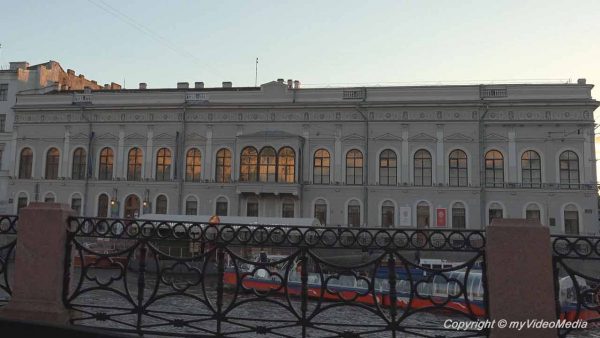
Already after a year one murdered the unloved son of Catherine the Great here. We follow the Fontanka river and pass the Fabergé Museum.
Then it’s time to go back to the airport. At 10.00 am we are at the airport to continue our journey to Dushanbe in Tajikistan.
Pin it for later

Text, photos and video: Copyright © myVideoMedia
Thank you for such wonderful material about my city! My city is my soul )
Come to us again! Come as often as you can 🙂
Thank you very much for your positive feedback. Your are lucky to live in such a beautiful city
What a busy day you had! Great itinerary for 1-day visit Now when e-visas to St. Petersburg are available, it’s time to come back for a couple of days))
Oh yes, there all still a lot of things to see.