Our city walk in the northern part of Warsaw starts at the Castle Square. Instead of going directly from the Castle Square to the north to the Old Town Market Square, we first walk through Kanonia Street to Kanonia-Square.
In the middle is the Warsaw Wish Bell. Allegedly your wishes are fulfilled when you circle the massive bronze bell.
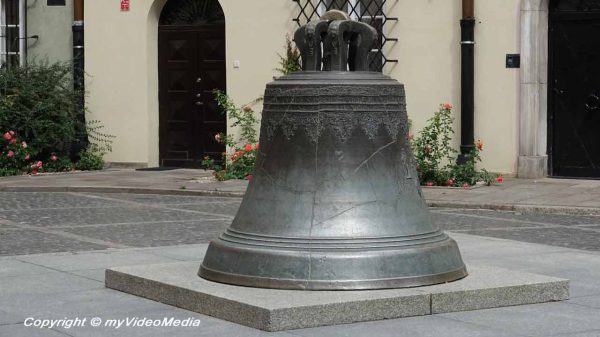
The square lies behind the Gothic St. John’s Archcathedral and used to be the associated cemetery. Later one dissolved the cemetery and converted it into apartment buildings.
In the eastern corner there is a curious building, house no. 18. It is the house with the narrowest facade in Europe. The facade is less than 2 m wide. It was built in this way because at that time the property tax was levied on the basis of the width of the facade.
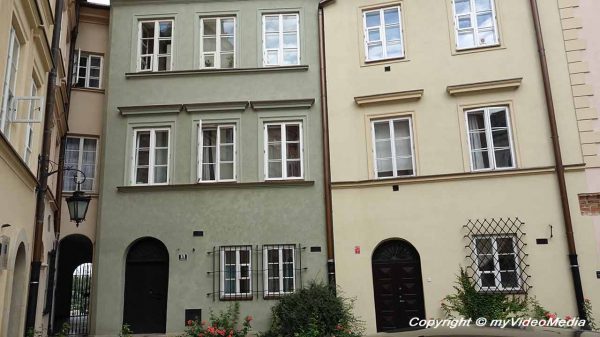
From here we reach the Old Town Market Place in a few steps. It forms the historical center of Warsaw. After the nearly complete destruction by the Nazis at the end of the 2nd World War, one rebuilt the Old Town from 1949 to 1955 as true to the original as possible.
In 1980 it was included in the UNESCO World Heritage List.
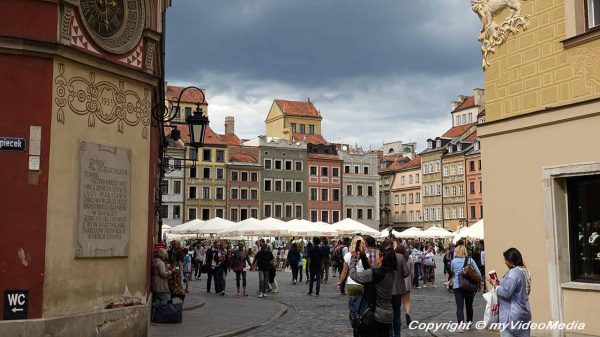
Thus the old town presents itself almost exactly like in the 15th century.
Please watch the 4K UHD video here
You are currently viewing a placeholder content from YouTube. To access the actual content, click the button below. Please note that doing so will share data with third-party providers.
More InformationWe let the hustle and bustle, and the pictures of this fantastic scenery have an effect on us for a while. Then we walk to the front section of the cathedral.
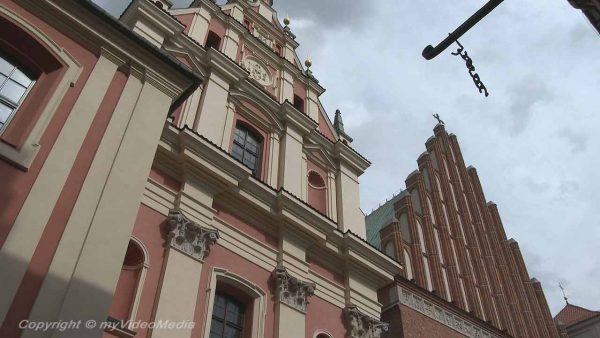
Then we turn around, pass the Old Town Market Square again and go to the Barbican.
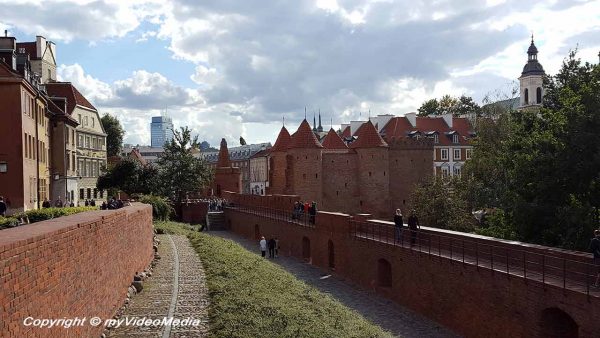
This fortified outpost outside the city walls lies between the Old Town and the New Town.
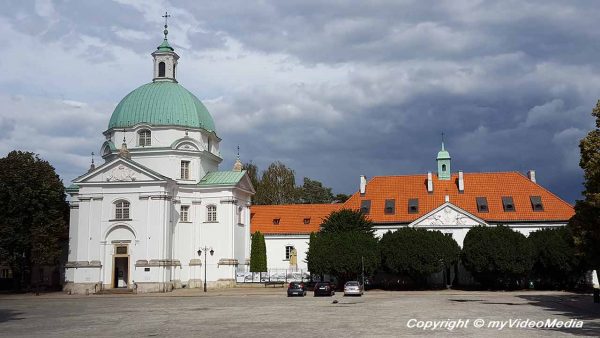
Via the Freta, we pass the New Town Market Place with the sacrament inner church of St. Kazimierz. It served as a military hospital during the Warsaw Uprising. Later, the dome collapsed during a bombing raid and hundreds of injured persons, doctors, and nurses died.
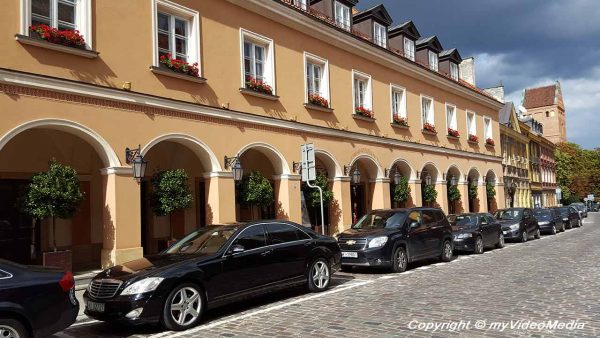
We turn into Kościelna street and stand in front of the 5-star Mamaison Hotel Le Regina. But we change our minds and go to the Zakroczymska Street, leave the school for hearing impaired children on the right and arrive at Legionów Fort.
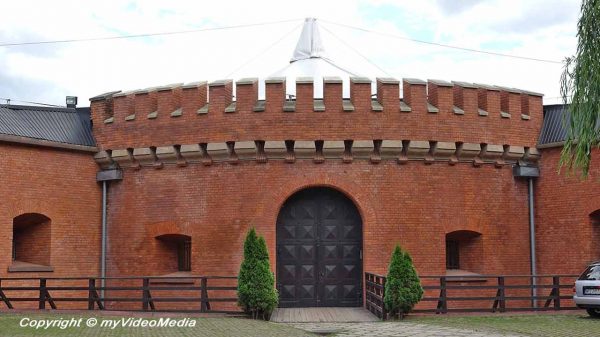
It consists of a three-story artillery tower. The fort was part of the Citadel and later the Warsaw Fortress. From the beginning of the 20th century, it was a prison.
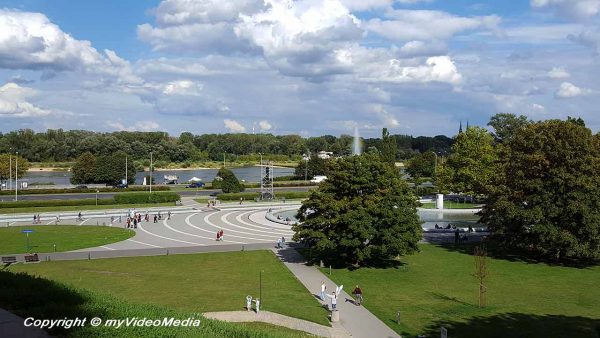
Further south, we reach the Multimedia Fountain Park. In the evening, colorful light and water games are performed here, every Friday and Saturday from May to September. On the other side of the Vistula is an amusement park with a beautiful beach.
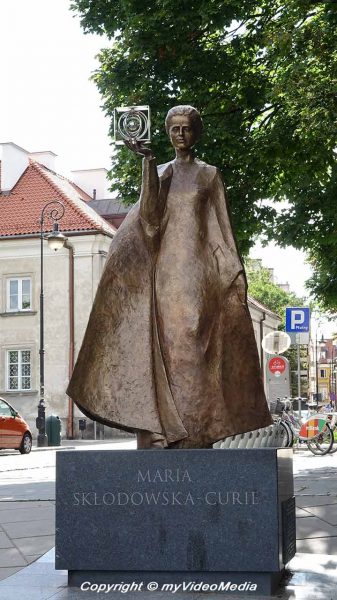
On the embankment above the Multimedia Fountain Park, at the beginning of Kóscielna Street, we see a statue of Marie Curie. We were not aware that Madame Curie was born and raised here.
At that time, Poland belonged to Russia. Women were not allowed to study here and thus she moved to Paris to study there as of 1891.
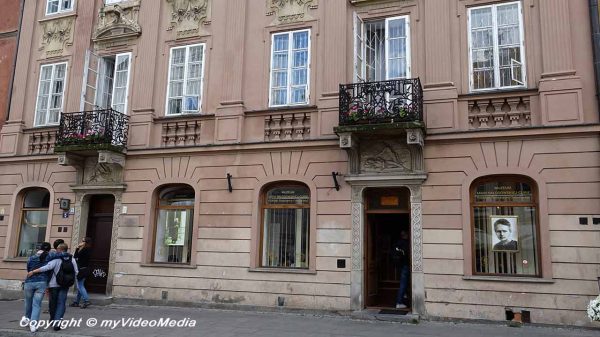
So we returned to the beginning of the Freta where her birthplace is located. In the house on the opposite side of the street is the Marie Curie Museum today.
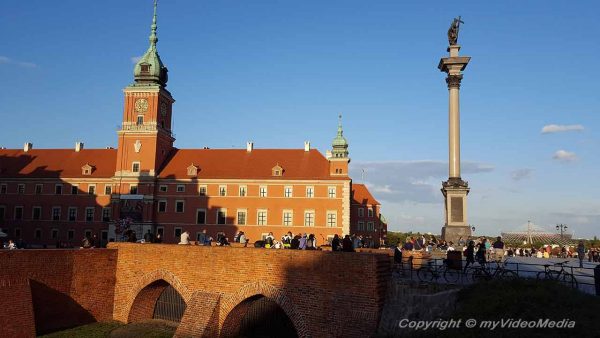
The day slowly draws to a close and so we return to the Castle Square, where we capture the scenery in the warm light of the evening sun and enjoy dinner.
Please read on > Searching for the Warsaw Ghetto
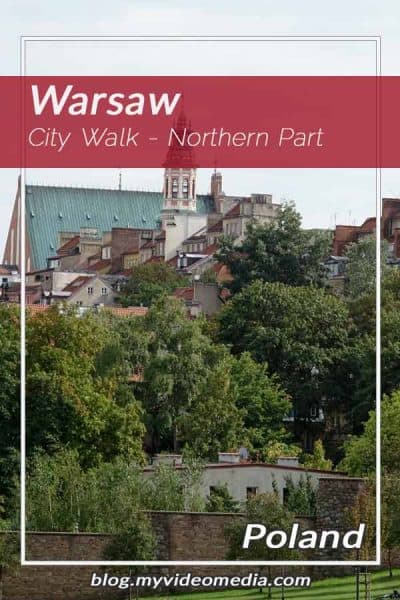
Pin it for later
Soundtracks in video:
- Rêve de l’océan by Bluemillenium (c) copyright 2018
Licensed under a Creative Commons Attribution (3.0) license. http://dig.ccmixter.org/files/Bluemillenium/57907 - Blindly Love by Syngularity (c) copyright 2017
Licensed under a Creative Commons Attribution (3.0) license. http://dig.ccmixter.org/files/Syngularity/55709 Ft: Peer R. - Homesick by Aussens@iter (c) copyright 2018
Licensed under a Creative Commons Attribution (3.0) license. http://dig.ccmixter.org/files/tobias_weber/57147 Ft: Kizzy Lotus