The Hadrian’s Villa or Villa Adriana, as it is called correctly, is about 30 km northeast of Rome near the town of Tivoli.
It is the largest and most elaborate palace that a Roman emperor ever build. It served as his summer residence and retirement home.
Around 300 AD, Emperor Constantine I had brought art treasures and precious marble to Byzantium. Later, it was looted by Cardinal d’Este, in order to decorate his villa in Tivoli. Archaeologists also brought a lot of mosaics in museums around the world.
You are currently viewing a placeholder content from YouTube. To access the actual content, click the button below. Please note that doing so will share data with third-party providers.
More InformationIt is a warm late autumn day and the sun shines pleasantly. Ideal for our sightseeing tour. A long avenue leads uphill to the northern boundary wall of the villa. In a small building is a model of the entire area, which we study in detail, since the area is huge and somewhat confusing. Behind it is the Pecile.
The Pecile
Pecile, the name of the arcades incorrectly derives from the famous Stoa Poikile in Athens. The large artificial terrace was built on the hill and offers a wonderful view above the countryside of Rome.
The upper level was a quadriporticus-garden with long covered walkway delimiting a garden in whose center was a pond. Its purpose was thus to provide an all-weather space for a daily walk.
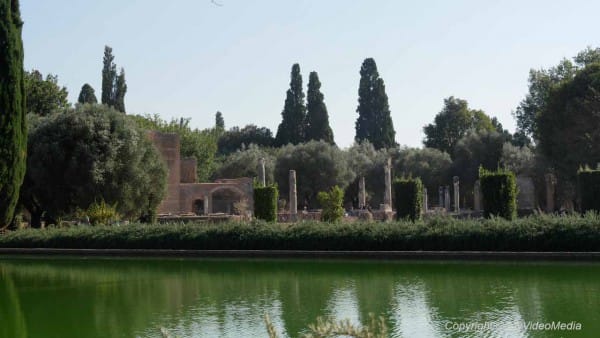
The west side consisted of four floors. The rooms with wooden floors and balconies were accessible via concrete stairs.
The rooms thus provided living quarters for the villa’s service staff. On the eastern end of the pond rises a high ruins called Garden with stage.
Garden with stage
The purpose of this building still remains unclear.
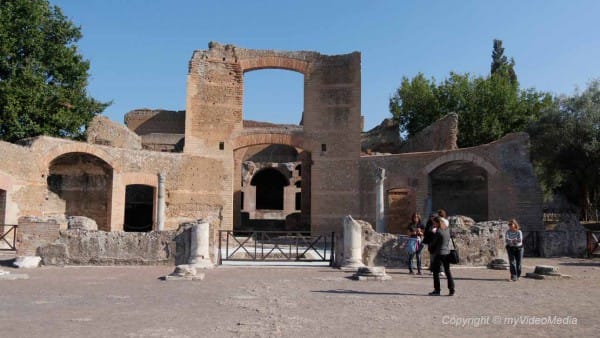
From here you can see the Heliocaminus Bath.
Heliocaminus Bath
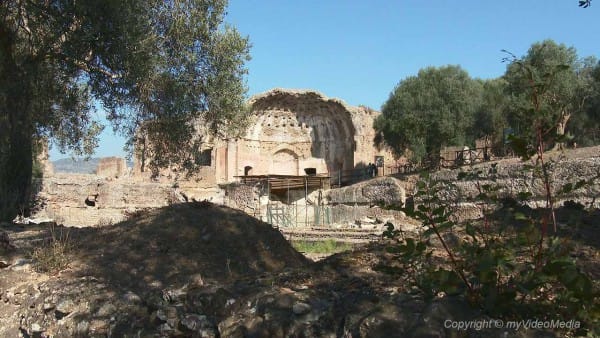
A dome-shaped building which served as a bath. It was equipped with floor and wall heating. To the right rises the
Emperors Residence
The Emperor resided in the top floor. The service rooms were located below.
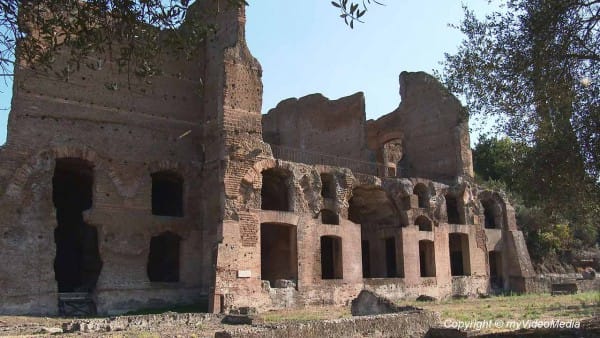
We go further south and pass the small and great baths.
Small and Great baths
Both baths were built after the Bath with Heliocaminus, during the phase of the expansion of the villa. One assumes during 121-136 AD, but it has not been proved for sure.
The Small Bath is positioned in the area of the villa, between the vestibule and the stadium. Presumably, the Small Bath was reserved for the emperor since it was designed considerably more elaborate than the Great Bath.
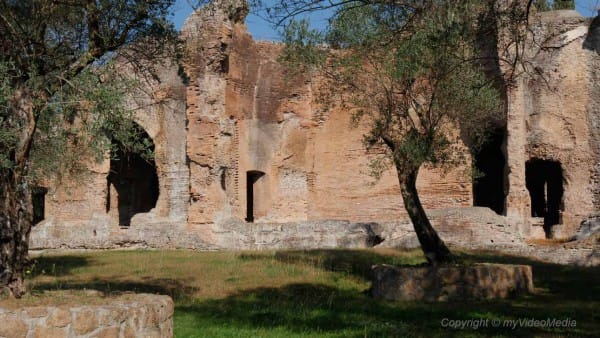
The name of the Great Bath is due to the dimensions, bigger than those of the other two thermal baths complexes present in the villa. They are dominated to the east by a big tuffaceous bank, in which a barrel vaulted cryptoporticus is carved.
It connects the area between the Bath and the Praetorium with the site of the Imperial Palace. During excavations in 1931, the American Academy in Rome found out that the baths were constructed in two phases, dated around the year 125 A.D.
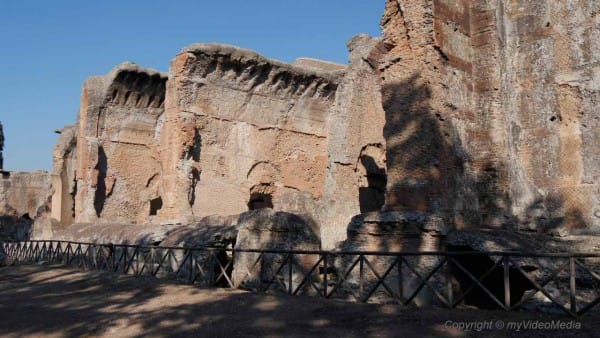
The Small and the Great Baths are oriented in line with the way leading to the Canopus.
Canopus
The Canopus is a stylized Egyptian channel. Built as reminiscent to the channel that connects Alexandria with the Nile, which Hadrian had seen during his trip to Egypt. It is completed by the Serapeium.
Probably the place where festivals were celebrated in balmy nights, because there was a triclinium, a Roman dining room, inside.
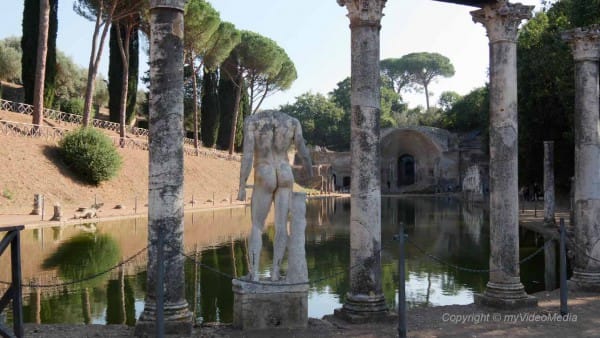
We turn north again and pass the Pretorium.
Pretorium
The name is derived from the already outdated assumption that it was the building of the praetorian guards. The total lack of light and the size of the rooms let to the conclusion that is was more likely a warehouse.
The three-story building was damaged during bombing in World War II. In front of the Praetorium are a series of rooms. One assumes that it were the quarters of staff employed in the warehouse, because the walls have only little colored plaster. The upper floor was used as accommodation for guests.
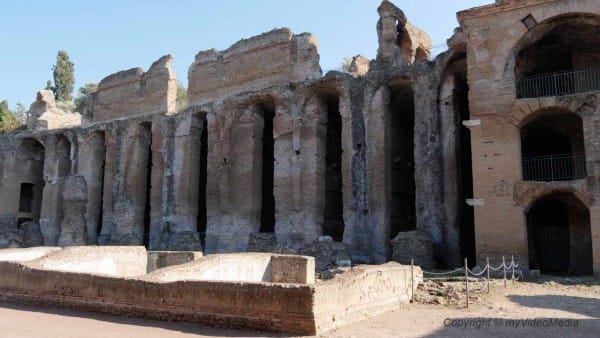
We visit the Small and Great Baths again, this time from the back. Then we climb the hill and stand in front of the Emperors residence.
A pretty fish pond was part of the building. One suspects that Hadrian has primarily stayed here in winter, since this building had a heating. Next to it are the Caserma dei Vigili.
Caserma dei Vigili
It is believed that this building served for military purposes, e.g for the Praetorian Guard and as firehouse.
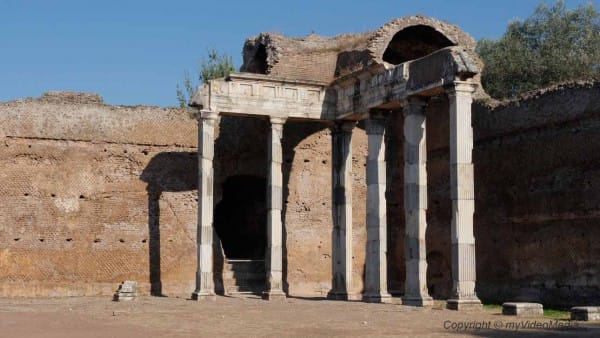
Hall with the Dorian Pillars
The Hall with the Dorian Pillars shows Hadrian’s affection for the Greek art. This room is part of the Imperial Palace. Because of its precious marble flooring it was taken under consideration, that this room was protected by covering. That’s why this building has been erroneously defined as Hall.
Over a paved path we reach the Piazza D’Oro.
Piazza D’Oro
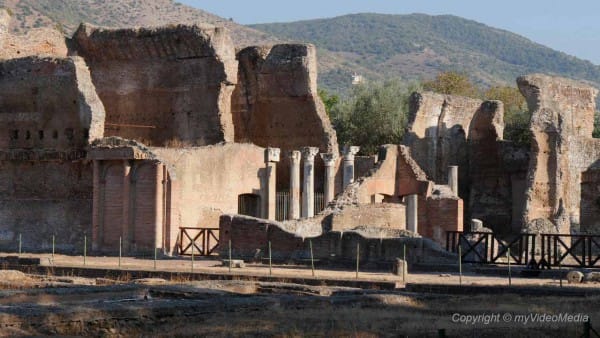
The Piazza d’Oro is one of the most luxurious complexes of the Villa Adriana. It consists of four elements; the vaulted vestibule in the north, a quadriporticus-garden with a canal running down the main axis in the center.
To the south is a cenatio, perhaps also housing a library, and at the end is a nymphaeum. The Piazza d’Oro could be reached from the Hall of Doric Pillars or from a tunnel with an exit into the cryptoporticus, running under the quadriporticus. Presumably, it was used for banquets and receptions.
We return to the Imperial palace.
Imperial palace
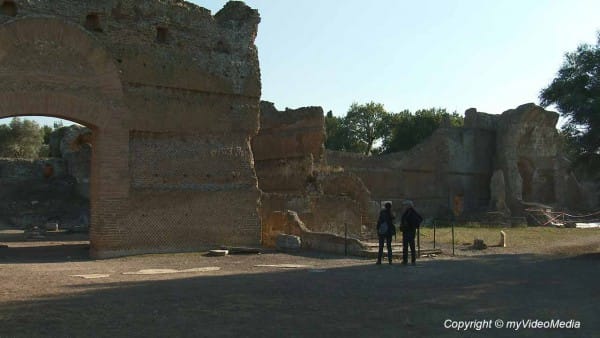
The name refers to the vast rectangular area in which the first nucleus of the Hadrian´s Villa was developed, set up on the earlier republican villa. The existing structures were enlarged and modified to obtain both residential and reception rooms, suitable for the dwelling of an emperor.
A throne room where numerous meetings and hearings were held forms the center of the palace.
To the north, we find a Roman and Greek library.
Roman and Greek library
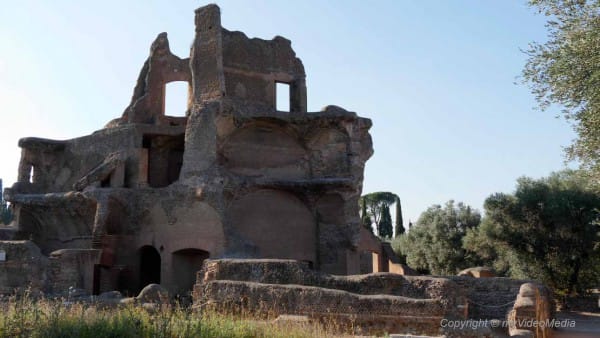
The rest of the Greek library still rises prominently to the sky.
Next to it is the Theatre Marittimo.
Theatre Marittimo
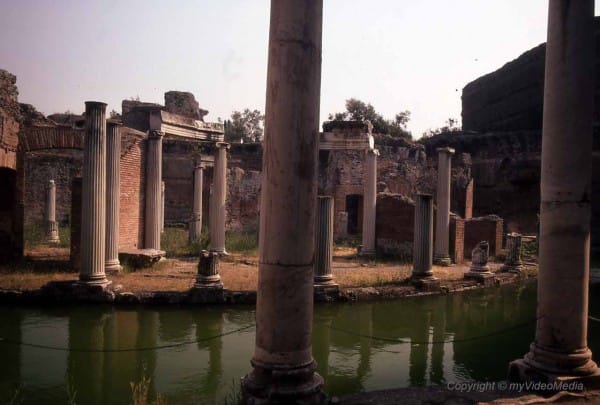
The circular building contained one little pond. In the middle is an island with colonnades. The island could be reached by two drawbridges. Here the ruler could retract to think.
Unfortunately, the theater was not accessible during our visit, due to renovation works, but we still have a photo of an earlier visit in the year 1980.
Hall of the philosophers
The Hall of the philosophers can only be viewed from the outside. Here, Hadrian gathered philosophers to discuss with them, but probably the hall was also used as a place of assembly for the council.
Greek Theater
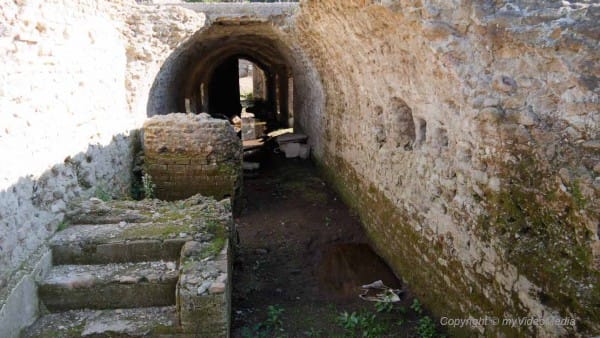
The Greek Theater is located near the main entrance.
Since 1999, the Hadrian’s villa belongs to the UNESCO World Heritage sites.
We are overwhelmed by the splendor and the grandiose lifestyle this villa conveys. Impressed by that day, we make our way back to Rome.
Please read on > Domus Aurea – The Palace of Nero in Rome
Text, photos and video: Copyright © myVideoMedia