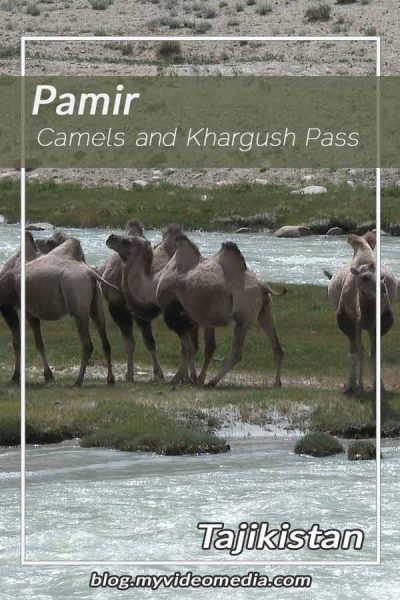
To see a herd of camels in the highlands of the Pamir, surprise us a bit. Not the fact that there are camels in these latitudes, but that camels live at such altitude.

We are at about 3650 m above sea level. The vegetation is sparse but on a small island in the Pamir River, the camels seem to feel comfortable here.
Here you see the 4K UHD video
You are currently viewing a placeholder content from YouTube. To access the actual content, click the button below. Please note that doing so will share data with third-party providers.
More InformationThere are approx 25 animals, divided into two groups. They look quite well nourished. This may be due to the fact that the water of the Pamir river ensures good grass growth. We notice that the animals pull a leg again and again. We suspect that this serves to repel insects.

The island is already located on an Afghan side of the border, that runs through the river.
Crossing the Khargush Pass
After our encounter with the camels, we follow the course of the Pamir river for about 15 km, before we turn off north at Khargush. Kargush has only a few houses. On the way, our drivers meet a colleague from Pamir guides.
The next 15 km, the road climbs slightly. We drive from 3650 m up to 4344 m above sea level. You can hardly see vegetation here. Only a few people are around – from time to time some cyclists or motorcycles. Hardly a car. Still, for us, it’s a surprise that so many cyclists are on the road and even bigger is the surprise that also a lot of women take the effort.
The road is only a gravel road and partly not fixed. This is due to the fact that it is not the original Pamir Highway. This leads directly from Khorugh to Murghab. We drive the detour via the Wakhan Valley. At the moment, we are on the connection between Wakhan Valley and Pamir Highway. Soon, we will hit the Pamir Highway again.

From time to time we pass a salt lake. These are results of the snowmelt. But as the water cannot run off the salinity increases. The first salt lake is on the left side of the road.

Then we pass the Khargush Pass. Three cyclists approach us on the passport height
Please watch Crossing the Khargush Pass
You are currently viewing a placeholder content from YouTube. To access the actual content, click the button below. Please note that doing so will share data with third-party providers.
More InformationBut there is no further marker on the Kargush Pass. The next salt lake is on the right-hand side of the road. It gives us the impression that the glaciers continue to recede here too. During conversations with locals in Murghab, they confirm this impression.

The road leads gently down until the asphalt Pamir highway lies in front of us. The road surfacing looks better, but there are so many holes in the asphalt that the drivers demand the highest concentration.
In front of us is a wide basin with a beautifully colored small saltwater lake, the Tuz Kul.
Please watch “Like from another Star”
You are currently viewing a placeholder content from YouTube. To access the actual content, click the button below. Please note that doing so will share data with third-party providers.
More InformationIt is crisscrossed by salt crusts. The play of colors of nature is unique. If we were talking about a lunar landscape in the valley of the Panj river, then we think that this must be Mars.
But we continue to Bulunkul, a village located on the freshwater lake with the same name.


From here it is only a few kilometers to the Yashikul, another freshwater lake.

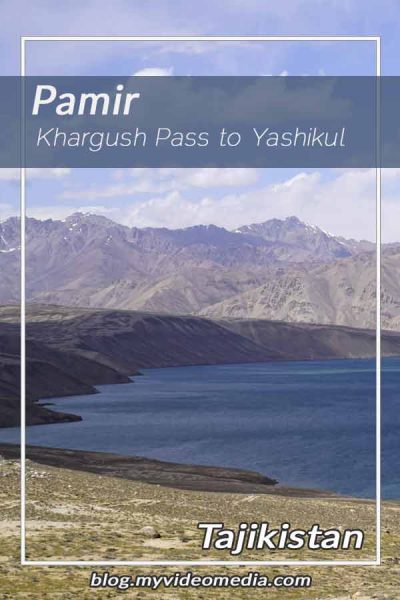
The Yashilkul is at 3723 m above sea level, between up to 4500 m high mountains. Due to the altitude, there is hardly any vegetation here.
Since the lake has a drain and the water flows into the Pandj river at Khorugh, it is a freshwater lake. In the sunlight, the water shimmers in a variety of colors.
Please read on > From Yashikul to Alichur
Pin it for later
Text, photos and video: Copyright © myVideoMedia