The evening in the studio of the Catalan painter Quim Hereu was certainly our top experience in Catalunya.
Quim Hereu
Quim Hereu is a painter of world renown, who is regarded as the leading exponent of Strambotism. You find his work in large private collections around the world, especially in Mexico, United States, France, India and Catalunya.
He was born and raised in Empordà. Ever since childhood, drawing was a refuge where fantastic beings lived together in imagined landscape that he saw daily. Quim is by profession an engineer, however, practiced this profession only briefly. In 1983 he decided to become a painter. The competition was fierce, as there are many creative artists in Girona and Catalonia. Therefore he first traveled around the world to get inspired by deserts, ruins, cultures and exoticism.
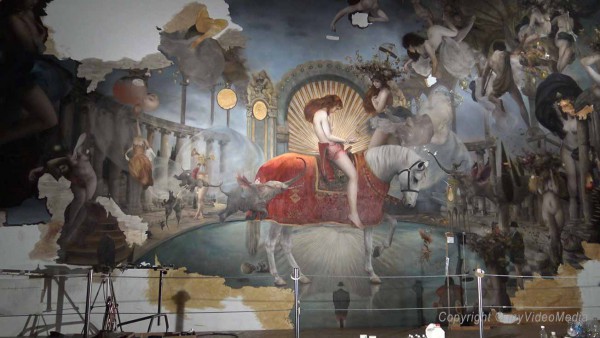
In the year 2000 he decided to paint only large-format paintings. They should be so large that they don’t have place in his house. The result are paintings in the format 6 m x 12 m. Today, he is married and has children. His wife Tania confirms that he works very disciplined every day (presumably a relic of his engineering profession :-))
Estrambotismo
Joan Fuster Gimpera, or simply called Joan Fuster, used the term Estrambotismo for the first time in 1974. He was also a painter from Empordà and died 2011. His role models were Dali, Goya and Bosch. He defined Estrambotismo as a creative process, in which creative ideas are quickly implemented, even from the subconscious. Things are represented as they were in his fantasy and not real.
Fuster: “Everything can be something else, without losing its identity.” All objects are painted faithfully to the smallest detail. The result is an aesthetic, original and bizarre world. The observer is brought into to another world; a world based on reality that comes straight from the imagination of the artist and not of dreams.
Please watch the 4k UHD Video here
You are currently viewing a placeholder content from YouTube. To access the actual content, click the button below. Please note that doing so will share data with third-party providers.
More InformationJoan Fuster and Quim Hereu rapidly developed a deep friendship and Quim shared the ideas of Joan Fuster with enthusiasm, so that Joan testamentary named him as heirs of Estrambotismo, in 2004. In the conversation he told us that the Austrian painter Gustav Klimt has inspired him too.
In the studio of Quim
In the early evening we reach the road with Quim’s studio. To our surprise, it is a modern industrial building. It is necessary because it is the only place where Quim can create his large-format pictures.
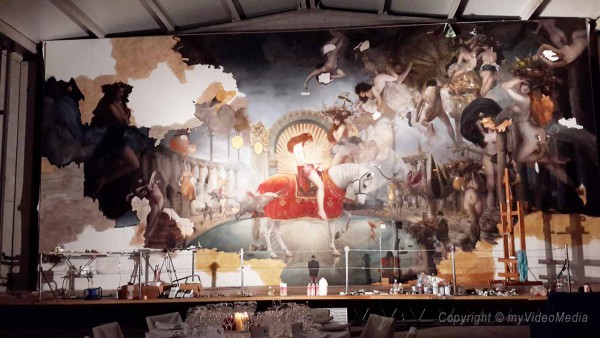
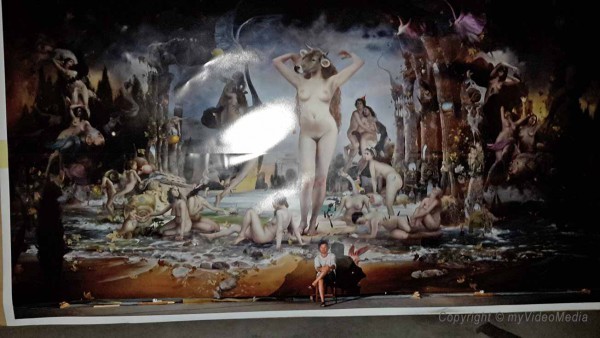
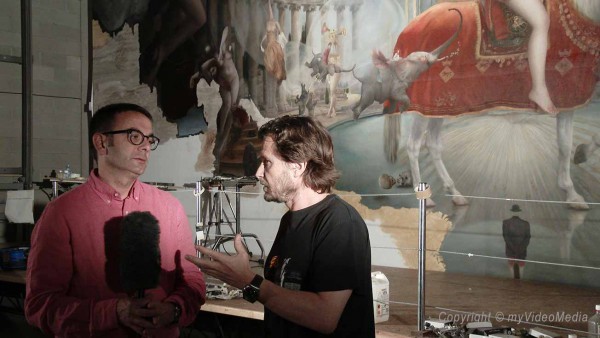
The eye is caught immediately by the end wall with the latest work of Quim. It is the 2nd painting of the world’s greatest Strambotic trilogy: El Temps – El Poder – La Libertat (The time – the energy – the liberty).
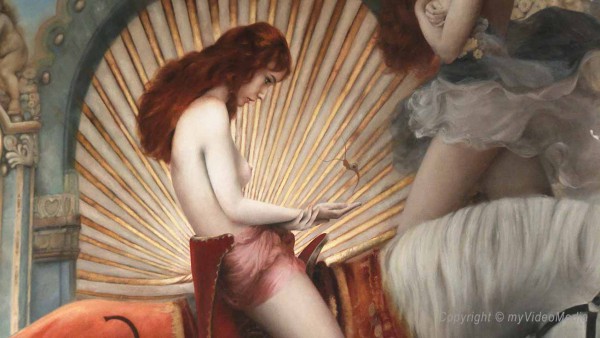
The subtitle is: “The Coronation of Ermessenda (or 18 elephants captivated by varicose veins of a mouse) In the center, the first queen of Catalonia, Ermessenda, sits on a horse and looks at a snail in her hand. Ermessenda has the power about all objects and the time.
Otherwise, the hall is sparsely furnished. An old bed, which belonged Quim’s grandfather, a small greenhouse and a number of propane heaters. When asked Tania confirms that it is very hot in winter and very cold in the summer. Not a place where you would go on vacation.
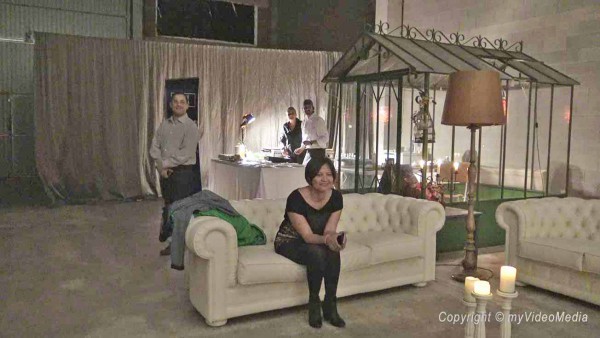
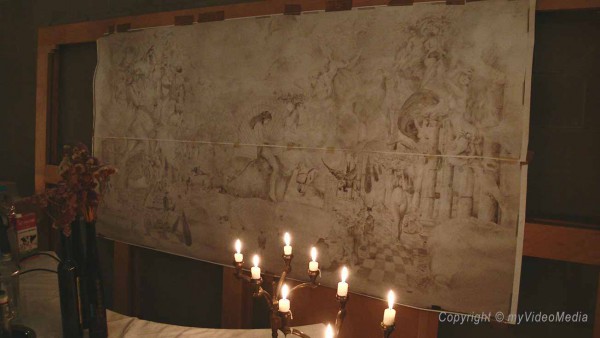
Before Quim starts painting, he creates a detail-accurate sketch. We could see a copy of the sketch of El Poder,
as well as a photo of El Temps, the first painting of the trilogy, which is already packaged for shipment to Mexico.
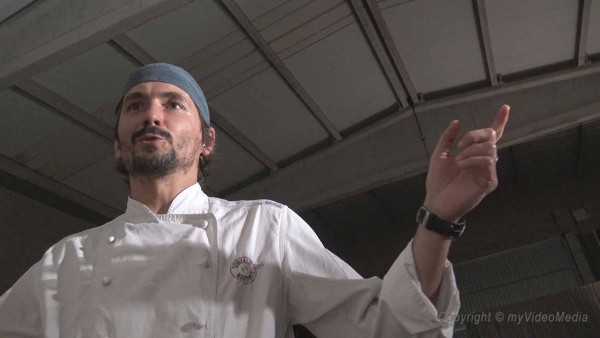
In a corner, Gonzalo Martinez, the Chief Slow Food in the Espai Boisà in Barcelona , built a temporary kitchen and is busy preparing our Strambotic dinner.
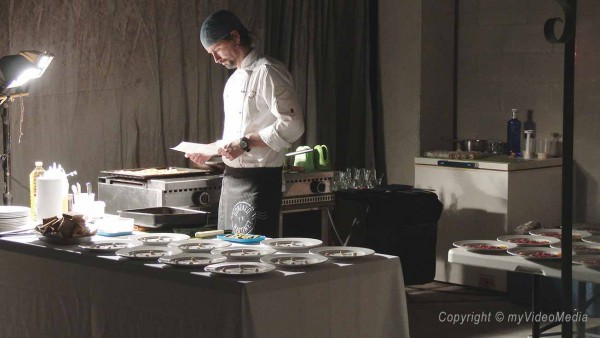
The individual courses of the dinner are his interpretation of single elements of the painting.
Ferran Vila Pujolis the third part of the culinary trilogy. Ferran Vila Pujol from Restaurant La Banyeta in Girona, is one of the leading sommeliers in the region. He completes the dinner with selected drinks, partly produced by himself.
The Strambotic dinner
Participants of the dinner are Quim and his wife Tania, Jaume Marin, Marketing Director of the Costa Brava Girona Tourist Board , Jordi Xargay i Congost, the president of the Consell Comarcal del Pla de l’Estany , Ferran Pujol Vila, and Vikki Benito our tour guide and four bloggers (including ourselves).
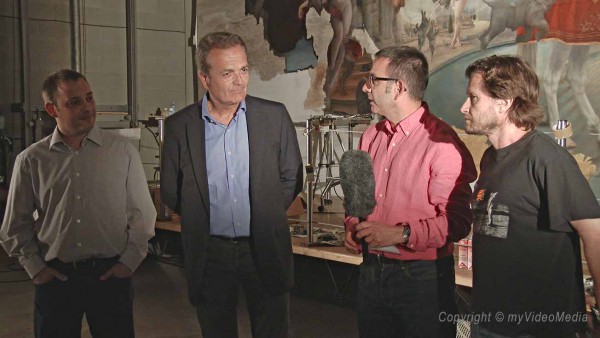
After a short welcome, Jaume interviewed Quim in Catalan, which he translated for us into English (see video).
In the middle of the hall is a festive white-covered round table where the food and drinks are served, always with accompanying explanations of Chef Gonzalo Martinez and Sommelier Ferran Vila Pujol.
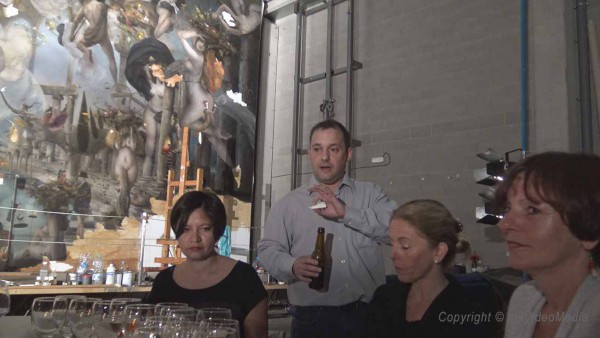
“We were in the company of true creatives and artists, passionate about their respective mediums and their region. Our first drink was a beer, brewed by Ferran with 3 different types of hops – and – this is the cool thing – the texture in the mouth was more important than the smell or the taste as it complimented the textures of the food and the art. By eating replicates of the snails and the clock we were consuming the representation of the snails/time and internalising it.
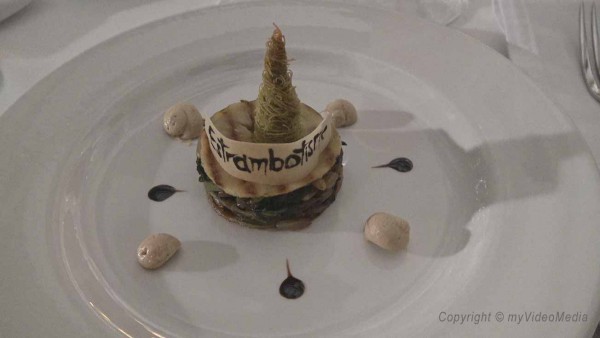
The flavors were sublime: Catalan style spinach, pinenuts, raisins Iberian ham, fois gras and a tiny cypress tree, together with a label – continued the theme of internalising the art and Strambotism.
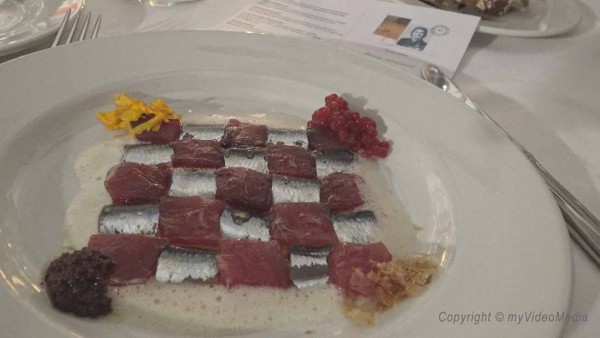
Our second drink was a sparkling wine – again made by Ferran who had produced only 300 bottles and which balanced the saltiness of the chequerboard of the carpa of tuna and anchovies and raspberry caviar.
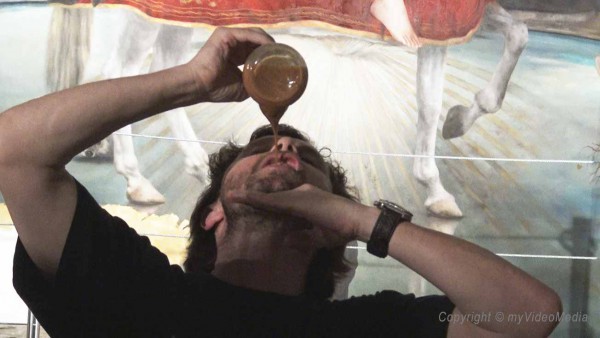
Perhaps the pairing was most visual with the third dish. It was matched to a desert scene but one where the turbaned camel riders had porons instead of heads (a poron is a typical Spanish way of serving wine) – and now we had to drink the most exquisite soup from glass porons.
The desert theme was continued with home made harissa and fish on skewers and paired with a very special white wine from the region. We kept the same shape wine glasses throughout our meal and Ferran explained that in his sommelier world the shape of the glass has no meaning at all. The drink is appreciated through smell and taste not by the shape of the glass.
He also told us that this region of Catalunya is one of the chief producers of cork, and while the artificial bottle stops are fine for a young wine, an older wine should only be stoppered with cork. Our fourth course was a sweet sausage accompanied by a foamy mashed potato. But even the sausages were not simple. They each had a centre of the local herbal drink ratafia and had an outer casing first of a seaweed and then the finest, thinnest spring-roll pastry. The strong flavours of the sausage were balanced with a robust red wine from the south of Catalunya.
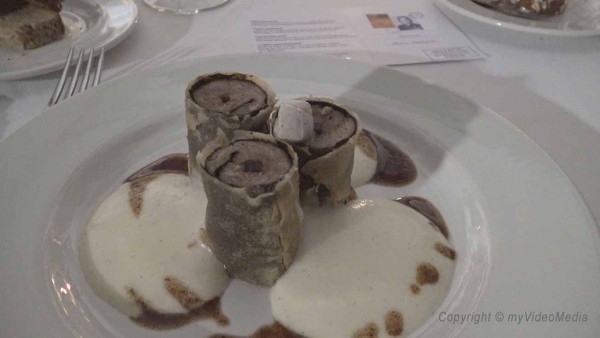
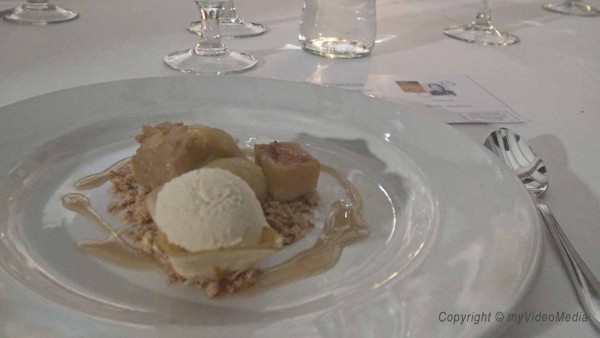
This fourth course was paired with the massive painting under which we were all seated and by now I was certainly appreciating the imagery and the connections. The strength of the horse, the meatiness of the sausage and the flavors of the red wine all connected and flowed through each other. The fifth course was about cats and the apple temple, and like the painting and the sparkling Muscat wine it had an altogether lighter feel to it.“
(Text source: A pairing dinner and a Michelin star restaurant)
It was a fantastic inspiring evening, where art, dining and drinking formed a harmonious symbiosis.
Please read on > Exploring the old town of Banyoles
Disclosure : All views and opinions are our own and were not influenced by the invitation!
Text, photos and video: Copyright © myVideoMedia